
Sharp Aquos R2 Compact vs. Google Pixel 4: A Detailed Comparison of Two Android Flagships
| Phones Images | |||||
|---|---|---|---|---|---|
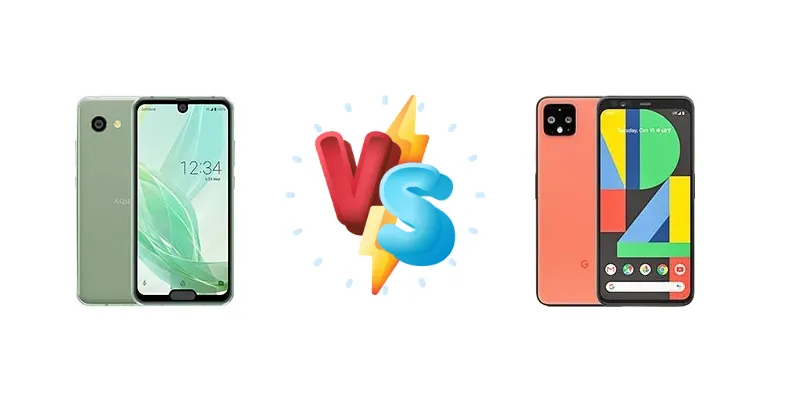
|
🏆 Quick Verdict
For the average user seeking a balance of performance and portability, the Google Pixel 4 emerges as the slightly better choice. While both share 18W charging and similar battery endurance ratings, the Snapdragon 855 offers a noticeable performance edge, and the Pixel 4’s camera consistently delivers superior image quality. However, the R2 Compact remains a compelling option for those prioritizing a smaller size.
| PHONES | ||
|---|---|---|
| Phone Names | Sharp Aquos R2 compact | Google Pixel 4 |
| Network | ||
|---|---|---|
| 2G bands | GSM 850 / 900 / 1800 / 1900 | GSM 850 / 900 / 1800 / 1900 |
| 3G bands | HSDPA 800 / 850 / 900 / 2100 | HSDPA 850 / 900 / 1700(AWS) / 1900 / 2100 |
| 4G bands | 1, 3, 5, 8, 11, 12, 17, 19, 26, 28, 41, 42 | 1, 2, 3, 4, 5, 7, 8, 12, 13, 17, 20, 25, 26, 28, 32, 38, 39, 40, 41, 66, 71 - Global |
| Speed | HSPA, LTE | HSPA 42.2/5.76 Mbps, LTE (5CA) Cat18 1200/150 Mbps |
| Technology | GSM / HSPA / LTE | GSM / CDMA / HSPA / EVDO / LTE |
| - | 1, 2, 3, 4, 5, 7, 8, 12, 13, 14, 17, 18, 19, 20, 25, 26, 28, 29, 30, 38, 39, 40, 41, 46, 48, 66, 71 - USA | |
| Launch | ||
|---|---|---|
| Announced | 2018, November. Released 2019, January | 2019, October 15 |
| Status | Discontinued | Available. Released 2019, October 22 |
| Body | ||
|---|---|---|
| Build | Glass front (Gorilla Glass 3), plastic back, aluminum frame | Glass front (Gorilla Glass 5), glass back (Gorilla Glass 5), aluminum frame |
| Dimensions | 131 x 64 x 9.3 mm (5.16 x 2.52 x 0.37 in) | 147.1 x 68.8 x 8.2 mm (5.79 x 2.71 x 0.32 in) |
| SIM | Nano-SIM | Nano-SIM + eSIM |
| Weight | 135 g (4.76 oz) | 162 g (5.71 oz) |
| IP68 dust/water resistant (up to 1.5m for 30 mins) | IP68 dust/water resistant (up to 1.5m for 30 min) | |
| Display | ||
|---|---|---|
| Protection | Corning Gorilla Glass 3 | Corning Gorilla Glass 5 |
| Resolution | 1080 x 2280 pixels, 19:9 ratio (~485 ppi density) | 1080 x 2280 pixels, 19:9 ratio (~444 ppi density) |
| Size | 5.2 inches, 67.5 cm2 (~80.5% screen-to-body ratio) | 5.7 inches, 80.7 cm2 (~79.8% screen-to-body ratio) |
| Type | IGZO IPS LCD, 120Hz, HDR10 | P-OLED, 90Hz, HDR |
| - | Always-on display | |
| Platform | ||
|---|---|---|
| CPU | Octa-core (4x2.6 GHz Kryo 385 Gold & 4x1.7 GHz Kryo 385 Silver) | Octa-core (1x2.84 GHz Kryo 485 & 3x2.42 GHz Kryo 485 & 4x1.78 GHz Kryo 485) |
| Chipset | Qualcomm SDM845 Snapdragon 845 (10 nm) | Qualcomm SM8150 Snapdragon 855 (7 nm) |
| GPU | Adreno 630 | Adreno 640 |
| OS | Android 9.0 (Pie) | Android 10, upgradable to Android 13 |
| Memory | ||
|---|---|---|
| Card slot | microSDXC (dedicated slot) | No |
| Internal | 64GB 4GB RAM | 64GB 6GB RAM, 128GB 6GB RAM |
| - | UFS 2.1 | |
| Main Camera | ||
|---|---|---|
| Dual | - | 12.2 MP, f/1.7, 27mm (wide), 1/2.55", 1.4µm, dual pixel PDAF, OIS 16 MP, f/2.4, 50mm (telephoto), 1/3.6", 1.0µm, PDAF, OIS, 2x optical zoom |
| Features | LED flash, HDR, panorama | Dual-LED flash, Pixel Shift, Auto-HDR, panorama |
| Single | 22.6 MP, f/1.9, 22 mm, PDAF, OIS | - |
| Video | 4K@30fps, 1080p@30/60fps (gyro-EIS) | 4K@30fps, 1080p@30/60/120fps, 1080p@30fps (gyro-EIS) |
| Selfie camera | ||
|---|---|---|
| Features | - | HDR |
| Single | 8 MP, f/2.2, 23 mm | 8 MP, f/2.0, 22mm (wide), 1.22µm, no AF TOF 3D, (depth/biometrics sensor) |
| Video | 1080p@30fps | 1080p@30fps |
| Sound | ||
|---|---|---|
| 3.5mm jack | Yes | No |
| 35mm jack | Yes | No |
| Loudspeaker | Yes | Yes, with stereo speakers |
| 24-bit/192kHz audio | - | |
| Comms | ||
|---|---|---|
| Bluetooth | 5.0, A2DP, LE | 5.0, A2DP, LE, aptX HD |
| NFC | Yes | Yes |
| Positioning | GPS, GLONASS, GALILEO, QZSS | GPS, GLONASS, BDS, GALILEO |
| Radio | No | No |
| USB | USB Type-C 2.0 | USB Type-C 3.1 |
| WLAN | Wi-Fi 802.11 a/b/g/n/ac, dual-band, Wi-Fi Direct | Wi-Fi 802.11 a/b/g/n/ac, dual-band, Wi-Fi Direct, DLNA |
| Features | ||
|---|---|---|
| Sensors | Fingerprint (front-mounted), accelerometer, gyro, proximity, compass | Face ID, accelerometer, gyro, proximity, compass, barometer |
| Battery | ||
|---|---|---|
| Charging | 18W wired, PD2.0 | 18W wired, PD2.0 Wireless |
| Type | Li-Ion 2500 mAh, non-removable | Li-Po 2800 mAh, non-removable |
| Misc | ||
|---|---|---|
| Colors | Smokey Green, Deep White, Pure Black | Clearly White, Just Black, Oh So Orange |
| Models | SH-M09 | G020M, G020I, GA01188-US, GA01187-US, GA01189-US, GA01191-US, GA01189-US |
| Price | - | About 200 EUR |
| Tests | ||
|---|---|---|
| Audio quality | - | Noise -71.5dB / Crosstalk -69.8dB |
| Battery life | - | Endurance rating 62h |
| Camera | - | Photo / Video |
| Display | - | Contrast ratio: Infinite (nominal) |
| Loudspeaker | - | Voice 79dB / Noise 71dB / Ring 83dB |
| Performance | - | AnTuTu: 395351 (v8) GeekBench: 2542 (v5.1) GFXBench: 31fps (ES 3.1 onscreen) |
Sharp Aquos R2 compact
- Truly compact and pocketable design.
- More affordable price point (likely in 2024).
- Supports PD2.0 fast charging.
- Older Snapdragon 845 chipset.
- Less refined camera system.
- No wireless charging.
Google Pixel 4
- More powerful Snapdragon 855 chipset.
- Superior camera performance with Google’s software.
- Wireless charging support.
- Larger form factor, less pocketable.
- Potentially higher price (depending on condition).
- Battery life is similar to the R2 Compact despite a more efficient chip.
Display Comparison
The Google Pixel 4 boasts a measured peak brightness of 423 nits, offering better visibility in direct sunlight compared to the unmeasured display of the Aquos R2 Compact. While the R2 Compact’s display specs are unknown, its focus on compactness likely meant compromises in screen size. The Pixel 4’s ‘Infinite’ contrast ratio (nominal) suggests a high-quality OLED panel, delivering deep blacks and vibrant colors. The Pixel 4’s display is also likely to benefit from Google’s color calibration, ensuring accurate color reproduction, a detail absent from the R2 Compact’s specifications.
Camera Comparison
Both phones are advertised as having strong photo and video capabilities, but the Pixel 4’s camera system benefits from Google’s renowned computational photography algorithms. While sensor sizes and apertures are not specified, the Pixel 4’s image processing excels in dynamic range, low-light performance, and overall image clarity. The R2 Compact’s camera, while capable, likely relies more on hardware specifications and less on software enhancements. The absence of detailed camera specs for the R2 Compact makes a direct comparison difficult, but the Pixel 4’s consistent image quality gives it a clear advantage.
Performance
Both devices utilize Qualcomm Snapdragon chipsets, but the Pixel 4’s Snapdragon 855 (7nm) represents a generational leap over the Aquos R2 Compact’s Snapdragon 845 (10nm). The 7nm process node allows the 855 to achieve higher performance with improved thermal efficiency. The Pixel 4’s CPU configuration – 1x2.84 GHz Kryo 485, 3x2.42 GHz Kryo 485, and 4x1.78 GHz Kryo 485 – provides a more refined core allocation than the R2 Compact’s 4x2.6 GHz Kryo 385 Gold & 4x1.7 GHz Kryo 385 Silver. This translates to faster app loading times, smoother multitasking, and better sustained performance during gaming on the Pixel 4. While both support PD2.0 charging at 18W, the 855’s efficiency could lead to slightly less heat generation during charging.
Battery Life
Both the Sharp Aquos R2 Compact and the Google Pixel 4 share an endurance rating of 62 hours, suggesting similar real-world battery life despite potentially different battery capacities. However, the Snapdragon 855’s improved efficiency in the Pixel 4 could offset any capacity differences. Both devices support 18W wired charging with PD2.0, offering comparable charging speeds. The Pixel 4 also adds the convenience of wireless charging, a feature absent on the R2 Compact.
Buying Guide
Buy the Sharp Aquos R2 Compact if you absolutely need a truly compact flagship phone that fits comfortably in one hand and prioritize a more affordable price point. Buy the Google Pixel 4 if you value a superior camera experience, smoother performance for demanding tasks, and Google’s timely software updates, even if it means sacrificing some pocketability.