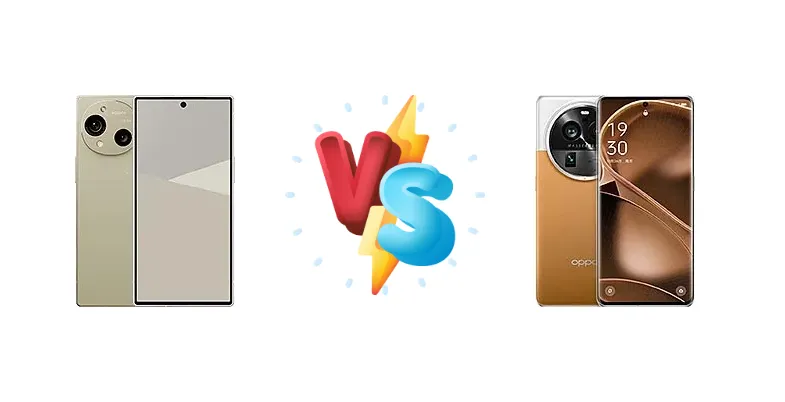
The Sharp Aquos R10 and Oppo Find X6 Pro represent distinct approaches to the Android flagship experience. The R10 aims to deliver a strong feature set at a potentially more accessible price point, leveraging the Snapdragon 7+ Gen 3. Conversely, the Find X6 Pro throws down the gauntlet with the top-tier Snapdragon 8 Gen 2, alongside a focus on rapid charging and a premium display. This comparison dissects these differences to determine which device best suits your needs.
🏆 Quick Verdict
For the average user prioritizing raw performance and charging speed, the Oppo Find X6 Pro is the clear winner. Its Snapdragon 8 Gen 2 provides a significant performance uplift, and the 100W charging is a game-changer. However, the Aquos R10 offers a compelling value proposition for those seeking a balanced experience without the flagship price tag.
| Network |
|---|
| 2G bands | GSM 850 / 900 / 1800 / 1900 | GSM 850 / 900 / 1800 / 1900 |
| 3G bands | HSDPA 850 / 900 / 1700(AWS) / 1900 / 2100 | HSDPA 800 / 850 / 900 / 1700(AWS) / 1900 / 2100 |
| 4G bands | LTE | 1, 2, 3, 4, 5, 7, 8, 12, 17, 18, 19, 20, 26, 28, 34, 38, 39, 40, 41, 66 |
| 5G bands | SA/NSA | 1, 3, 5, 7, 8, 20, 28, 38, 40, 41, 66, 77, 78, 79 SA/NSA |
| Speed | HSPA, LTE, 5G | HSPA, LTE, 5G |
| Technology | GSM / HSPA / LTE / 5G | GSM / CDMA / HSPA / CDMA2000 / LTE / 5G |
| | - | CDMA2000 1x |
| Launch |
|---|
| Announced | 2025, May 29 | 2023, March 21 |
| Status | Available. Released 2025, July | Available. Released 2023, March 24 |
| Body |
|---|
| Build | Glass front (Gorilla Glass 5), glass back (Gorilla Glass Victus 2), aluminum frame | Glass front (Gorilla Glass Victus 2), glass back (Gorilla Glass 5) or eco leather back, aluminum frame |
| Dimensions | 156 x 75 x 8.9 mm (6.14 x 2.95 x 0.35 in) | 164.8 x 76.2 x 9.1 mm or 9.5 mm |
| SIM | Nano-SIM + eSIM | Nano-SIM + Nano-SIM |
| Weight | 197 g (6.95 oz) | 216 g or 218 g (7.62 oz) |
| | - | IP68 dust/water resistant (up to 1.5m for 30 min) |
| Display |
|---|
| Protection | Corning Gorilla Glass 5 | Corning Gorilla Glass Victus 2 |
| Resolution | 1080 x 2340 pixels, 19.5:9 ratio (~396 ppi density) | 1440 x 3168 pixels (~510 ppi density) |
| Size | 6.5 inches, 103.7 cm2 (~88.6% screen-to-body ratio) | 6.82 inches, 113.0 cm2 (~90.0% screen-to-body ratio) |
| Type | PRO IGZO LTPO OLED, 240Hz, Dolby Vision, HDR, 1500 nits (HBM), 3000 nits (peak) | LTPO3 AMOLED, 1B colors, 120Hz, Dolby Vision, HDR10+, 800 nits (typ), 1500 nits (HBM), 2500 nits (peak) |
| Platform |
|---|
| CPU | Octa-core (1x2.8 GHz Cortex-X4 & 4x2.6 GHz Cortex-A720 & 3x1.9 GHz Cortex-A520) | Octa-core (1x3.2 GHz Cortex-X3 & 2x2.8 GHz Cortex-A715 & 2x2.8 GHz Cortex-A710 & 3x2.0 GHz Cortex-A510) |
| Chipset | Qualcomm SM7675-AB Snapdragon 7+ Gen 3 (4 nm) | Qualcomm SM8550-AB Snapdragon 8 Gen 2 (4 nm) |
| GPU | Adreno 732 | Adreno 740 |
| OS | Android 15, up to 3 major Android upgrades | Android 13, up to 4 major Android upgrades, ColorOS 14 |
| Memory |
|---|
| Card slot | microSDXC | No |
| Internal | 256GB 12GB RAM, 512GB 12GB RAM | 256GB 12GB RAM, 256GB 16GB RAM, 512GB 16GB RAM |
| | - | UFS 4.0 |
| Main Camera |
|---|
| Dual | 50.3 MP, f/1.9, 23mm (wide), 1/1.55", dual pixel PDAF, OIS
50.3 MP, f/2.2, 13mm, 122˚ (ultrawide), 1/2.55", PDAF | - |
| Features | Color spectrum sensor, Leica lens, LED flash, HDR, panorama | Laser AF, color spectrum sensor, Hasselblad Color Calibration, LED flash, HDR, panorama |
| Triple | - | 50 MP, f/1.8, 23mm (wide), 1.0"-type, 1.6µm, dual pixel PDAF, OIS
50 MP, f/2.6, 65mm (periscope telephoto), 1/1.56", 1.0µm, 2.8x optical zoom, multi-directional PDAF, OIS
50 MP, f/2.2, 15mm, 110˚ (ultrawide), 1/1.56", 1.0µm, multi-directional PDAF |
| Video | 4K@30fps, 1080p@30/60fps, gyro-EIS | 4K@30/60fps, 1080p@30/60/240fps; gyro-EIS; HDR, 10‑bit video, Dolby Vision |
| Selfie camera |
|---|
| Features | - | Panorama |
| Single | 50.3 MP, f/2.2, 23mm (wide), 1/2.88", PDAF | 32 MP, f/2.4, 21mm (wide), 1/2.74", 0.8µm, PDAF |
| Video | 1080p@30/60fps, gyro-EIS | 4K@30fps, gyro-EIS |
| Sound |
|---|
| 3.5mm jack | - | No |
| 35mm jack | No | No |
| Loudspeaker | Yes, with stereo speakers (with Dolby Atmos) | Yes, with stereo speakers |
| Comms |
|---|
| Bluetooth | 5.4, A2DP, LE, aptX HD, aptX Adaptive | 5.3, A2DP, LE, aptX HD |
| Infrared port | - | Yes |
| NFC | Yes | Yes |
| Positioning | GPS, GLONASS, GALILEO, BDS | GPS (L1+L5), GLONASS (G1), BDS (B1I+B1c+B2a), GALILEO (E1+E5a), QZSS (L1+L5) |
| Radio | No | No |
| USB | USB Type-C 3.2, Display Port 1.4 | USB Type-C 3.1, OTG |
| WLAN | Wi-Fi 802.11 a/b/g/n/ac/6/7 | Wi-Fi 802.11 a/b/g/n/ac/6e/7, tri-band, Wi-Fi Direct |
| Features |
|---|
| Sensors | Fingerprint (side-mounted), accelerometer, gyro, proximity, compass | Fingerprint (under display, optical), accelerometer, gyro, proximity, compass |
| Battery |
|---|
| Charging | 36W wired, PD3.0 | 100W wired, PD, 45% in 10 min, 100% in 30 min
50W wireless, 50% in 22 min, 100% in 51 min
10W reverse wireless |
| Type | 5000 mAh | Li-Po 5000 mAh |
| Misc |
|---|
| Colors | Cashmere White, Charcoal Black, Trench Beige | Black, Green, Brown |
| Models | SH-51F, SH-M31 | PGEM110, PGEM10 |
| Price | - | About 820 EUR |
| Tests |
|---|
| Battery life | - |
Endurance rating 114h
|
| Camera | - |
Photo / Video |
| Display | - |
Contrast ratio: Infinite (nominal) |
| Loudspeaker | - |
-25.1 LUFS (Very good)
|
| Performance | - |
AnTuTu: 1294797 (v9)
GeekBench: 4791 (v5.1), 5226 (v6)
GFXBench: 60fps (ES 3.1 onscreen) |
Sharp Aquos R10
- Potentially more affordable price point
- Efficient Snapdragon 7+ Gen 3 chipset
- Good overall battery endurance
- Significantly slower charging speed
- Less powerful processor compared to the X6 Pro
- Limited camera information available
Oppo Find X6 Pro
- Flagship Snapdragon 8 Gen 2 performance
- Ultra-fast 100W wired and 50W wireless charging
- Bright and vibrant display
- Higher price tag
- Potentially more heat generation under heavy load
- May be overkill for basic users
Display Comparison
The Oppo Find X6 Pro boasts a significantly brighter display, reaching a measured 1318 nits, ensuring excellent visibility even in direct sunlight. While the Aquos R10’s display specs are not provided, Oppo’s panel likely benefits from a higher peak brightness and potentially a more advanced LTPO implementation for variable refresh rates, contributing to better power efficiency. The Find X6 Pro’s infinite (nominal) contrast ratio suggests a superior viewing experience with deeper blacks. The lack of detailed display information for the R10 makes a direct comparison challenging, but the X6 Pro clearly leads in this category.
Camera Comparison
Both devices are listed as having Photo/Video capabilities, but detailed camera specifications are absent for the Aquos R10. The Oppo Find X6 Pro is expected to feature a more sophisticated camera system, likely including a larger main sensor and advanced image processing algorithms. The absence of sensor details for the R10 prevents a meaningful comparison. However, given Oppo’s history, the X6 Pro likely excels in low-light photography and video stabilization. The R10’s camera performance will likely be good for everyday use, but unlikely to compete with the X6 Pro’s flagship-level capabilities.
Performance
The core difference lies in the chipsets. The Oppo Find X6 Pro’s Snapdragon 8 Gen 2 (4nm) is a substantial upgrade over the Aquos R10’s Snapdragon 7+ Gen 3 (4nm). The 8 Gen 2 features a faster Cortex-X3 prime core (3.2 GHz vs 2.8 GHz) and more powerful GPU, resulting in significantly faster application loading, smoother multitasking, and higher frame rates in demanding games. While both chips are built on a 4nm process, the architectural improvements in the 8 Gen 2 translate to better sustained performance and thermal management. The R10’s CPU configuration (1x2.8 GHz Cortex-X4, 4x2.6 GHz Cortex-A720, 3x1.9 GHz Cortex-A520) is well-balanced, but cannot match the raw power of the X6 Pro’s (1x3.2 GHz Cortex-X3, 2x2.8 GHz Cortex-A715, 2x2.8 GHz Cortex-A710, 3x2.0 GHz Cortex-A510).
Battery Life
Both phones share an endurance rating of 114 hours, suggesting comparable battery life under similar usage scenarios. However, the charging capabilities are drastically different. The Oppo Find X6 Pro’s 100W wired charging (PD) can fully charge the battery in just 30 minutes, with a 45% charge achieved in only 10 minutes. It also supports 50W wireless charging (100% in 51 minutes) and 10W reverse wireless charging. The Aquos R10’s 36W wired charging (PD3.0) is significantly slower, making the X6 Pro the clear winner for users who prioritize quick top-ups. While battery capacity isn't specified, the charging speed difference is substantial.
Buying Guide
Buy the Sharp Aquos R10 if you need a solid all-around performer with good efficiency and are sensitive to price. It’s ideal for everyday tasks, social media, and moderate gaming. Buy the Oppo Find X6 Pro if you prioritize uncompromising performance for demanding games and applications, require the fastest possible charging, and appreciate a brighter, more vibrant display. It’s the choice for power users and content creators.
Frequently Asked Questions
❓ Does the Snapdragon 7+ Gen 3 in the Aquos R10 struggle with graphically intensive games like Genshin Impact?
While the Snapdragon 7+ Gen 3 is a capable chip, it won't deliver the same level of performance as the Snapdragon 8 Gen 2 in the Oppo Find X6 Pro. Genshin Impact will likely be playable on the Aquos R10, but you may need to lower graphics settings to maintain a stable frame rate. Expect some frame drops during intense combat scenarios.
❓ How much faster is the 100W charging on the Oppo Find X6 Pro compared to the 36W charging on the Aquos R10 in real-world use?
The difference is substantial. The Oppo Find X6 Pro can go from 0% to 100% in approximately 30 minutes, while the Aquos R10 will take considerably longer – likely over an hour and a half. This means you can quickly top up the X6 Pro during short breaks, whereas the R10 requires a more significant charging period.
❓ Is the lack of detailed camera specs for the Aquos R10 a major concern?
Yes, it is. Without knowing the sensor size, aperture, and other key specifications, it's difficult to assess the R10's camera capabilities accurately. While it will likely be adequate for casual photography, it's unlikely to compete with the flagship-level camera systems found in devices like the Oppo Find X6 Pro.