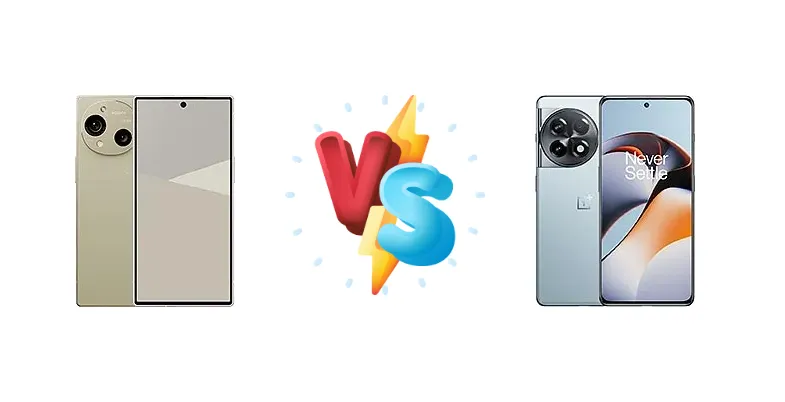
The Sharp Aquos R10 and OnePlus 11R represent interesting points in the smartphone landscape. The R10, powered by the newer Snapdragon 7+ Gen 3, aims to deliver flagship-adjacent performance at a more accessible price. The 11R, leveraging the older but still potent Snapdragon 8+ Gen 1, focuses on raw power and incredibly fast charging. This comparison dissects their strengths and weaknesses to determine which phone offers the best experience.
🏆 Quick Verdict
For the average user prioritizing sustained performance and rapid refueling, the OnePlus 11R emerges as the winner. Its Snapdragon 8+ Gen 1 provides a noticeable performance edge, and the 100W charging is a game-changer. However, the Aquos R10 offers a compelling alternative for those seeking a more efficient chipset and a potentially smoother long-term experience.
| Network |
|---|
| 2G bands | GSM 850 / 900 / 1800 / 1900 | GSM 850 / 900 / 1800 / 1900 |
| 3G bands | HSDPA 850 / 900 / 1700(AWS) / 1900 / 2100 | HSDPA 850 / 900 / 1700(AWS) / 2100 |
| 4G bands | LTE | 1, 3, 4, 5, 8, 28, 34, 38, 39, 40, 41 |
| 5G bands | SA/NSA | 1, 3, 5, 8, 28, 40, 41, 77, 78 SA/NSA |
| Speed | HSPA, LTE, 5G | HSPA, LTE (3CA), 5G |
| Technology | GSM / HSPA / LTE / 5G | GSM / CDMA / HSPA / LTE / 5G |
| | - | CDMA 800 |
| Launch |
|---|
| Announced | 2025, May 29 | 2023, February 07 |
| Status | Available. Released 2025, July | Available. Released 2023, February 21 |
| Body |
|---|
| Build | Glass front (Gorilla Glass 5), glass back (Gorilla Glass Victus 2), aluminum frame | Glass front, glass back (Gorilla Glass 5), plastic frame |
| Dimensions | 156 x 75 x 8.9 mm (6.14 x 2.95 x 0.35 in) | 163.4 x 74.3 x 8.7 mm (6.43 x 2.93 x 0.34 in) |
| SIM | Nano-SIM + eSIM | Nano-SIM + Nano-SIM |
| Weight | 197 g (6.95 oz) | 204 g (7.20 oz) |
| Display |
|---|
| Protection | Corning Gorilla Glass 5 | - |
| Resolution | 1080 x 2340 pixels, 19.5:9 ratio (~396 ppi density) | 1240 x 2772 pixels, 20:9 ratio (~451 ppi density) |
| Size | 6.5 inches, 103.7 cm2 (~88.6% screen-to-body ratio) | 6.74 inches, 109.2 cm2 (~90.0% screen-to-body ratio) |
| Type | PRO IGZO LTPO OLED, 240Hz, Dolby Vision, HDR, 1500 nits (HBM), 3000 nits (peak) | Fluid AMOLED, 1B colors, 120Hz, HDR10+, 1450 nits (peak) |
| Platform |
|---|
| CPU | Octa-core (1x2.8 GHz Cortex-X4 & 4x2.6 GHz Cortex-A720 & 3x1.9 GHz Cortex-A520) | Octa-core (1x3.0 GHz Cortex-X2 & 3x2.5 GHz Cortex-A710 & 4x1.80 GHz Cortex-A510) |
| Chipset | Qualcomm SM7675-AB Snapdragon 7+ Gen 3 (4 nm) | Qualcomm SM8475 Snapdragon 8+ Gen 1 (4 nm) |
| GPU | Adreno 732 | Adreno 730 |
| OS | Android 15, up to 3 major Android upgrades | Android 13, upgradable to Android 15, OxygenOS 15 |
| Memory |
|---|
| Card slot | microSDXC | No |
| Internal | 256GB 12GB RAM, 512GB 12GB RAM | 128GB 8GB RAM, 256GB 16GB RAM, 512GB 18GB RAM |
| | - | UFS 3.1 |
| Main Camera |
|---|
| Dual | 50.3 MP, f/1.9, 23mm (wide), 1/1.55", dual pixel PDAF, OIS
50.3 MP, f/2.2, 13mm, 122˚ (ultrawide), 1/2.55", PDAF | - |
| Features | Color spectrum sensor, Leica lens, LED flash, HDR, panorama | Color spectrum sensor, LED flash, HDR, panorama |
| Single | - | 16 MP, f/2.4, 24mm (wide), 1/3.09", 1.0µm |
| Triple | - | 50 MP, f/1.8, 24mm (wide), 1/1.56", 1.0µm, multi-directional PDAF, OIS
8 MP, f/2.2, 120˚ (ultrawide), 1/4.0", 1.12µm
2 MP (macro) |
| Video | 4K@30fps, 1080p@30/60fps, gyro-EIS | 4K@30/60fps, 1080p@30/60/240fps, gyro-EIS |
| Selfie camera |
|---|
| Features | - | HDR |
| Single | 50.3 MP, f/2.2, 23mm (wide), 1/2.88", PDAF | 16 MP, f/2.4, 24mm (wide), 1/3.09", 1.0µm |
| Video | 1080p@30/60fps, gyro-EIS | 1080p@30fps |
| Sound |
|---|
| 3.5mm jack | - | No |
| 35mm jack | No | No |
| Loudspeaker | Yes, with stereo speakers (with Dolby Atmos) | Yes, with stereo speakers |
| | - | 24-bit/192kHz audio |
| Comms |
|---|
| Bluetooth | 5.4, A2DP, LE, aptX HD, aptX Adaptive | 5.3, A2DP, LE, aptX HD |
| Infrared port | - | Yes |
| NFC | Yes | Yes |
| Positioning | GPS, GLONASS, GALILEO, BDS | GPS (L1+L5), GLONASS (G1), BDS (B1I+B1c+B2a), GALILEO (E1+E5a), QZSS (L1+L5) |
| Radio | No | No |
| USB | USB Type-C 3.2, Display Port 1.4 | USB Type-C 2.0 |
| WLAN | Wi-Fi 802.11 a/b/g/n/ac/6/7 | Wi-Fi 802.11 a/b/g/n/ac/6, dual-band |
| Features |
|---|
| Sensors | Fingerprint (side-mounted), accelerometer, gyro, proximity, compass | Fingerprint (under display, optical), accelerometer, gyro, proximity, compass |
| Battery |
|---|
| Charging | 36W wired, PD3.0 | 100W wired |
| Type | 5000 mAh | Li-Po 5000 mAh |
| Misc |
|---|
| Colors | Cashmere White, Charcoal Black, Trench Beige | Galactic Silver, Sonic Black, Solar Red |
| Models | SH-51F, SH-M31 | CPH2487 |
| Price | - | About 600 EUR |
| SAR | - | 1.16 W/kg (head) 0.61 W/kg (body) |
Sharp Aquos R10
- More efficient Snapdragon 7+ Gen 3 chipset
- Potentially better long-term thermal management
- PD3.0 charging compatibility
- Slower charging speed (36W)
- Less powerful CPU and GPU compared to the 11R
- Potentially less advanced camera processing
OnePlus 11R
- Significantly faster 100W charging
- More powerful Snapdragon 8+ Gen 1 chipset
- Superior GPU performance for gaming
- Potentially higher power consumption
- May experience more thermal throttling under sustained load
- Older chipset architecture
Display Comparison
While display specs aren't provided, both phones likely utilize OLED panels given their market positioning. The key difference will be in calibration and peak brightness. The OnePlus 11R, being a more aggressively priced flagship, may offer a slightly higher peak brightness for HDR content. However, the Aquos R10, historically known for display quality, could potentially offer more accurate color reproduction. The absence of LTPO in either device suggests standard refresh rate management, impacting battery life during dynamic content.
Camera Comparison
Without detailed camera specs, it’s difficult to make a definitive judgment. However, the Snapdragon 8+ Gen 1’s ISP in the OnePlus 11R generally offers more advanced image processing capabilities. The 11R likely benefits from a more sophisticated computational photography pipeline, resulting in better dynamic range and low-light performance. The Aquos R10’s camera will likely be competent, but may not match the 11R’s processing power. We can assume both phones will feature a multi-camera setup, but sensor size and optical image stabilization (OIS) will be crucial differentiators.
Performance
The core battle lies in the chipsets. The OnePlus 11R’s Snapdragon 8+ Gen 1 (4nm) boasts a Cortex-X2 prime core clocked at 3.0 GHz, offering a significant single-core performance advantage over the Aquos R10’s Snapdragon 7+ Gen 3 (4nm) and its 2.8 GHz Cortex-X4. The 11R’s Adreno 730 GPU also surpasses the 7+ Gen 3’s Adreno 690 in graphical prowess. However, the 7+ Gen 3’s newer architecture and potentially more efficient design could lead to better sustained performance and thermal management under prolonged load. The 11R’s LPDDR5X RAM will contribute to faster data transfer speeds, further enhancing its performance lead.
Battery Life
The OnePlus 11R’s 100W charging is a massive advantage, promising a full charge in under 30 minutes. The Aquos R10’s 36W charging, while supporting PD3.0, is significantly slower. While battery capacity isn’t specified, the 11R’s faster charging effectively mitigates any potential capacity disadvantage. The Snapdragon 7+ Gen 3’s efficiency could translate to longer battery life during typical usage, but the 8+ Gen 1’s raw power will drain the battery faster under heavy load. The 11R’s charging speed is a clear convenience factor.
Buying Guide
Buy the Sharp Aquos R10 if you prioritize efficient power consumption, potentially longer battery life during moderate use, and a more recent chipset architecture. This phone is ideal for users who value a balance between performance and efficiency. Buy the OnePlus 11R if you demand maximum performance for gaming and demanding applications, and if incredibly fast charging is a must-have feature. This is the phone for power users who don't want to wait for their device to recharge.
Frequently Asked Questions
❓ Will the OnePlus 11R get noticeably hot during extended gaming sessions?
The Snapdragon 8+ Gen 1 is a powerful chip, and it can generate heat under sustained load. While OnePlus implements cooling solutions, some thermal throttling is likely during prolonged gaming. However, the 11R’s performance headroom means it will likely maintain higher frame rates for longer before throttling becomes significant.
❓ Is the Snapdragon 7+ Gen 3 in the Aquos R10 powerful enough for demanding mobile games?
The Snapdragon 7+ Gen 3 is a capable chipset and can handle most mobile games at high settings. However, it won’t match the raw performance of the Snapdragon 8+ Gen 1 in the OnePlus 11R, particularly in graphically intensive titles. Expect slightly lower frame rates and potentially the need to lower graphics settings in some games.
❓ Does the Aquos R10's 36W charging feel slow compared to the 11R's 100W?
Yes, the difference is substantial. 36W charging will take significantly longer to fully charge the Aquos R10, likely exceeding an hour. The 11R’s 100W charging can top up the battery from 0-100% in around 25-30 minutes, offering a much more convenient experience.
❓ Which phone is better for long-term software support?
OnePlus generally provides more consistent and longer software support than Sharp. While the Aquos R10 will likely receive updates, the OnePlus 11R is more likely to receive major Android version updates and security patches for a longer period.