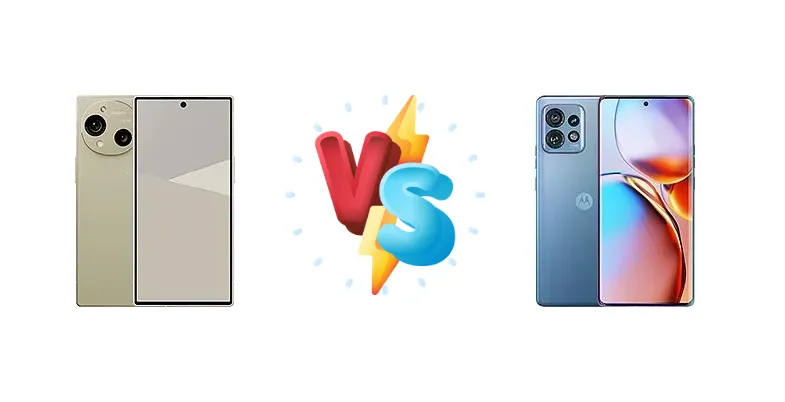
The Sharp Aquos R10 and Motorola Edge 40 Pro represent interesting points in the Android landscape. The R10 aims to deliver a strong experience at a potentially lower price point with the Snapdragon 7+ Gen 3, while the Edge 40 Pro leverages the flagship Snapdragon 8 Gen 2. This comparison dissects their key differences to determine which device offers the best value for your money.
🏆 Quick Verdict
For most users, the Motorola Edge 40 Pro is the superior choice. Its Snapdragon 8 Gen 2 chipset provides significantly higher performance, and its 125W charging is a game-changer, fully charging the device in just 23 minutes. While the Aquos R10 offers a respectable experience, the Edge 40 Pro’s power and convenience justify the price difference.
| Network |
|---|
| 2G bands | GSM 850 / 900 / 1800 / 1900 | GSM 850 / 900 / 1800 / 1900 |
| 3G bands | HSDPA 850 / 900 / 1700(AWS) / 1900 / 2100 | HSDPA 850 / 900 / 1700(AWS) / 1900 / 2100 |
| 4G bands | LTE | 1, 2, 3, 4, 5, 7, 8, 12, 13, 17, 18, 19, 20, 25, 26, 28, 32, 38, 39, 40, 41, 42, 43, 48, 66 |
| 5G bands | SA/NSA | 1, 2, 3, 5, 7, 8, 20, 28, 38, 40, 41, 66, 77, 78 SA/NSA/Sub6 |
| Speed | HSPA, LTE, 5G | HSPA, LTE, 5G |
| Technology | GSM / HSPA / LTE / 5G | GSM / HSPA / LTE / 5G |
| Launch |
|---|
| Announced | 2025, May 29 | 2023, April 04 |
| Status | Available. Released 2025, July | Available. Released 2023, April 04 |
| Body |
|---|
| Build | Glass front (Gorilla Glass 5), glass back (Gorilla Glass Victus 2), aluminum frame | Glass front (Gorilla Glass Victus), glass back (Gorilla Glass Victus), aluminum frame |
| Dimensions | 156 x 75 x 8.9 mm (6.14 x 2.95 x 0.35 in) | 161.2 x 74 x 8.6 mm (6.35 x 2.91 x 0.34 in) |
| SIM | Nano-SIM + eSIM | Nano-SIM + eSIM |
| Weight | 197 g (6.95 oz) | 199 g (7.02 oz) |
| | - | IP68 dust/water resistant (up to 1.5m for 30 min) |
| Display |
|---|
| Protection | Corning Gorilla Glass 5 | Corning Gorilla Glass Victus |
| Resolution | 1080 x 2340 pixels, 19.5:9 ratio (~396 ppi density) | 1080 x 2400 pixels, 20:9 ratio (~394 ppi density) |
| Size | 6.5 inches, 103.7 cm2 (~88.6% screen-to-body ratio) | 6.67 inches, 108.0 cm2 (~90.5% screen-to-body ratio) |
| Type | PRO IGZO LTPO OLED, 240Hz, Dolby Vision, HDR, 1500 nits (HBM), 3000 nits (peak) | OLED, 1B colors, 165Hz, HDR10+, Dolby Vision, 1300 nits (peak) |
| Platform |
|---|
| CPU | Octa-core (1x2.8 GHz Cortex-X4 & 4x2.6 GHz Cortex-A720 & 3x1.9 GHz Cortex-A520) | Octa-core (1x3.2 GHz Cortex-X3 & 2x2.8 GHz Cortex-A715 & 2x2.8 GHz Cortex-A710 & 3x2.0 GHz Cortex-A510) |
| Chipset | Qualcomm SM7675-AB Snapdragon 7+ Gen 3 (4 nm) | Qualcomm SM8550-AB Snapdragon 8 Gen 2 (4 nm) |
| GPU | Adreno 732 | Adreno 740 |
| OS | Android 15, up to 3 major Android upgrades | Android 13, up to 3 major Android upgrades |
| Memory |
|---|
| Card slot | microSDXC | No |
| Internal | 256GB 12GB RAM, 512GB 12GB RAM | 256GB 12GB RAM, 512GB 12GB RAM |
| | - | UFS 4.0 |
| Main Camera |
|---|
| Dual | 50.3 MP, f/1.9, 23mm (wide), 1/1.55", dual pixel PDAF, OIS
50.3 MP, f/2.2, 13mm, 122˚ (ultrawide), 1/2.55", PDAF | - |
| Features | Color spectrum sensor, Leica lens, LED flash, HDR, panorama | Dual-LED flash, panorama, HDR |
| Triple | - | 50 MP, f/1.8, (wide), 1/1.55", 1.0µm, multi-directional PDAF, OIS
12 MP, f/1.6, (telephoto), 1/2.93", 1.22µm, PDAF, 2x optical zoom
50 MP, f/2.2, 114˚ (ultrawide), 1/2.76", 0.64µm, AF |
| Video | 4K@30fps, 1080p@30/60fps, gyro-EIS | 8K@30fps, 4K@30/60fps, 1080p@30/60/120/240/960fps, 10-bit HDR10+, gyro-EIS |
| Selfie camera |
|---|
| Features | - | HDR |
| Single | 50.3 MP, f/2.2, 23mm (wide), 1/2.88", PDAF | 60 MP, f/2.2, (wide), 1/2.8", 0.61µm |
| Video | 1080p@30/60fps, gyro-EIS | 4K@30/60fps, 1080p@30/60fps |
| Sound |
|---|
| 3.5mm jack | - | No |
| 35mm jack | No | No |
| Loudspeaker | Yes, with stereo speakers (with Dolby Atmos) | Yes, with stereo speakers |
| Comms |
|---|
| Bluetooth | 5.4, A2DP, LE, aptX HD, aptX Adaptive | 5.3, A2DP, LE |
| NFC | Yes | Yes |
| Positioning | GPS, GLONASS, GALILEO, BDS | GPS, GLONASS, GALILEO, BDS |
| Radio | No | No |
| USB | USB Type-C 3.2, Display Port 1.4 | USB Type-C 3.2, OTG, DisplayPort 1.4 |
| WLAN | Wi-Fi 802.11 a/b/g/n/ac/6/7 | Wi-Fi 802.11 a/b/g/n/ac/6e/7, tri-band, Wi-Fi Direct |
| Features |
|---|
| Sensors | Fingerprint (side-mounted), accelerometer, gyro, proximity, compass | Fingerprint (under display, optical), accelerometer, gyro, proximity, compass |
| | - | Ready For 3.5 support |
| Battery |
|---|
| Charging | 36W wired, PD3.0 | 125W wired, PD3.0, QC5, 50% in 6 min, 100% in 23 min
15W wireless
5W reverse wired
5W reverse wireless |
| Type | 5000 mAh | Li-Po 4600 mAh |
| Misc |
|---|
| Colors | Cashmere White, Charcoal Black, Trench Beige | Interstellar Black, Lunar Blue |
| Models | SH-51F, SH-M31 | - |
| Price | - | € 313.87 |
| Tests |
|---|
| Battery life | - |
Endurance rating 117h
|
| Camera | - |
Photo / Video |
| Display | - |
Contrast ratio: Infinite (nominal) |
| Loudspeaker | - |
-22.6 LUFS (Excellent)
|
| Performance | - |
AnTuTu: 1273764 (v9)
GeekBench: 4896 (v5.1), 5352 (v6)
GFXBench: 112fps (ES 3.1 onscreen) |
Sharp Aquos R10
- Potentially lower price point
- Efficient Snapdragon 7+ Gen 3 chipset
- PD3.0 charging support
- Significantly less powerful than the Edge 40 Pro
- Slower 36W charging
- Limited camera information
Motorola Edge 40 Pro
- Flagship Snapdragon 8 Gen 2 performance
- Ultra-fast 125W charging
- Wireless and reverse charging capabilities
- Higher price tag
- May run hotter under sustained load
- Potential for software bloat (Motorola's history)
Display Comparison
The Motorola Edge 40 Pro boasts a display capable of reaching 1050 nits of peak brightness, ensuring excellent visibility even in direct sunlight. While the Aquos R10’s display specifications are not provided, Motorola’s panel offers an infinite (nominal) contrast ratio, suggesting deep blacks and vibrant colors. The absence of refresh rate data for the Aquos R10 makes a direct comparison difficult, but the Edge 40 Pro’s high brightness and contrast give it a clear advantage for media consumption and outdoor use.
Camera Comparison
Both devices are listed as having Photo/Video capabilities, but detailed camera specifications are missing for the Aquos R10. The Edge 40 Pro’s camera system, while details are limited, benefits from the processing power of the Snapdragon 8 Gen 2, enabling faster image processing and potentially better low-light performance. Without sensor size or aperture information for the R10, it’s difficult to assess its camera capabilities, but the Edge 40 Pro’s flagship chipset gives it a likely advantage in image quality and video recording.
Performance
The core difference lies in the chipsets. The Motorola Edge 40 Pro’s Snapdragon 8 Gen 2 (4nm) features a Cortex-X3 prime core clocked at 3.2 GHz, significantly outperforming the Aquos R10’s Snapdragon 7+ Gen 3 (4nm) with its 2.8 GHz Cortex-X4. The Edge 40 Pro’s CPU configuration (1x3.2GHz, 2x2.8GHz, 2x2.8GHz, 3x2.0GHz) is more robust than the R10’s (1x2.8GHz, 4x2.6GHz, 3x1.9GHz), translating to faster app loading, smoother multitasking, and superior gaming performance. Both utilize a 4nm process, but the architectural improvements in the 8 Gen 2 provide a substantial performance leap.
Battery Life
Both phones have an endurance rating of 117 hours, suggesting similar real-world battery life despite differing charging capabilities. However, the Motorola Edge 40 Pro’s charging system is a standout feature. Its 125W wired charging can replenish the battery to 50% in just 6 minutes and 100% in 23 minutes, a significant advantage over the Aquos R10’s 36W wired charging. The Edge 40 Pro also includes 15W wireless charging, 5W reverse wired, and 5W reverse wireless, offering greater versatility. The R10 lacks these additional charging options.
Buying Guide
Buy the Sharp Aquos R10 if you prioritize a potentially lower price and still need a smooth, responsive experience for everyday tasks and moderate gaming. It’s ideal for users who don’t demand the absolute highest performance. Buy the Motorola Edge 40 Pro if you’re a power user, gamer, or content creator who needs the fastest possible processor, rapid charging, and a more future-proofed device. It’s the better choice for those who demand top-tier performance and features.
Frequently Asked Questions
❓ Does the Snapdragon 7+ Gen 3 in the Aquos R10 struggle with demanding games like Genshin Impact?
While the Snapdragon 7+ Gen 3 is a capable chip, it won't deliver the same level of performance as the Snapdragon 8 Gen 2 in the Edge 40 Pro. Genshin Impact may require lower graphics settings to maintain a stable frame rate on the Aquos R10, whereas the Edge 40 Pro can likely handle it at higher settings.
❓ How much faster is the 125W charging on the Motorola Edge 40 Pro compared to the 36W charging on the Aquos R10 in real-world use?
The difference is substantial. The Edge 40 Pro can go from 0-100% in 23 minutes, while the Aquos R10 will take considerably longer – likely over an hour. This means you can quickly top up the Edge 40 Pro during short breaks, making it ideal for users on the go.
❓ Is the lack of detailed camera specs for the Aquos R10 a cause for concern?
Yes, it is. In the smartphone market, camera performance is a key selling point. The absence of information about sensor size, aperture, and image stabilization suggests the Aquos R10’s camera may not compete with the more established offerings from Motorola and other flagship manufacturers.
❓ Does the Motorola Edge 40 Pro get excessively hot during prolonged gaming sessions?
The Snapdragon 8 Gen 2 is known for its improved thermal efficiency compared to previous generations, but it can still generate heat under heavy load. Motorola typically implements thermal management solutions, but sustained gaming at maximum settings may lead to some throttling to prevent overheating. The Aquos R10, with its less powerful chipset, is likely to run cooler.