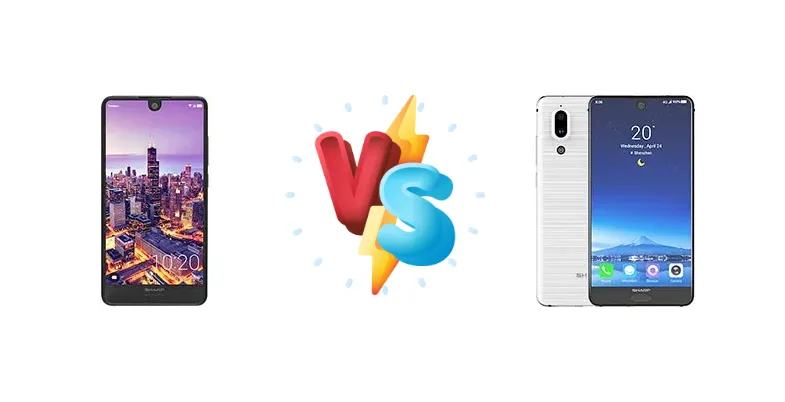
The Sharp Aquos C10 and S2 represent a fascinating case study in incremental upgrades within the mid-range smartphone space. Both leverage Qualcomm's Snapdragon 630, but the S2 offers a configuration with the more powerful Snapdragon 660. This comparison dissects the real-world implications of this chipset difference, alongside variations in RAM and charging, to determine which Aquos model delivers the best user experience.
🏆 Quick Verdict
For most users, the Sharp Aquos S2 with the Snapdragon 660 and 6GB of RAM is the superior choice. The performance uplift provided by the 660, coupled with the increased memory, translates to smoother multitasking and a more responsive experience, justifying the potential price premium. However, the C10 remains a viable option for budget-conscious users.
| Network |
|---|
| 2G bands | GSM 850 / 900 / 1800 / 1900 | GSM 850 / 900 / 1800 / 1900 |
| 3G bands | HSDPA 850 / 900 / 1900 / 2100 | HSDPA 850 / 900 / 1900 / 2100 |
| 4G bands | 1, 3, 7, 8, 20 | 1, 3, 4, 5, 7, 8, 12, 28, 39, 40, 41 |
| Speed | HSPA 42.2/11.5 Mbps, LTE Cat4 150/50 Mbps | HSPA 42.2/5.76 Mbps, LTE (2CA) Cat6 300/50 Mbps |
| Technology | GSM / HSPA / LTE | GSM / CDMA / HSPA / LTE |
| | - | CDMA 800 & TD-SCDMA |
| Launch |
|---|
| Announced | 2018, July. Released 2018, July | 2017, August. Released 2017, August |
| Status | Discontinued | Discontinued |
| Body |
|---|
| Build | Glass front (Gorilla Glass), glass back, aluminum frame | Glass front (Gorilla Glass), glass back, aluminum frame |
| Dimensions | 141.8 x 72 x 7.9 mm (5.58 x 2.83 x 0.31 in) | 141.8 x 72 x 7.9 mm (5.58 x 2.83 x 0.31 in) |
| SIM | Nano-SIM + Nano-SIM | Nano-SIM + Nano-SIM |
| Weight | 140 g (4.94 oz) | 140 g (4.94 oz) |
| Display |
|---|
| Protection | Corning Gorilla Glass (unspecified version) | Corning Gorilla Glass (unspecified version) |
| Resolution | 1080 x 2040 pixels, 17:9 ratio (~420 ppi density) | 1080 x 2040 pixels, 17:9 ratio (~420 ppi density) |
| Size | 5.5 inches, 80.7 cm2 (~79.0% screen-to-body ratio) | 5.5 inches, 80.7 cm2 (~79.0% screen-to-body ratio) |
| Type | IPS LCD | IPS LCD |
| Platform |
|---|
| CPU | Octa-core (4x2.2 GHz Cortex-A53 & 4x1.8 GHz Cortex A53) | Octa-core (4x2.2 GHz Cortex-A53 & 4x1.8 GHz Cortex A53) - 64/4GBOcta-core (4x2.2 GHz Kryo 260 Gold & 4x1.8 GHz Kryo 260 Silver) - 128/6GB |
| Chipset | Qualcomm SDM630 Snapdragon 630 (14 nm) | Qualcomm SDM630 Snapdragon 630 (14 nm) - 64/4GBQualcomm SDM660 Snapdragon 660 (14 nm) - 128/6GB |
| GPU | Adreno 508 | Adreno 508 - 64/4GBAdreno 512 - 128/6GB |
| OS | Android 8.0 (Oreo), Sharp UI | Android 7.1.1 (Nougat) |
| Memory |
|---|
| Card slot | microSDXC (uses shared SIM slot) | microSDXC (uses shared SIM slot) |
| Internal | 64GB 4GB RAM | 64GB 4GB RAM, 128GB 6GB RAM |
| | - | eMMC 5.1 |
| Main Camera |
|---|
| Dual | 12 MP, f/1.8, 1/2.55", 1.4µm, PDAF
8 MP, f/2.0, 1/3.2", 1.4µm | 12 MP, f/1.8, 1/2.55", 1/3.2", 1.4µm, dual pixel PDAF
8 MP |
| Features | Dual-LED dual-tone flash, panorama, HDR | Dual-LED dual-tone flash, panorama, HDR |
| Video | 1080p@30fps | 1080p@30fps |
| Selfie camera |
|---|
| Features | 1080p@30fps | - |
| Single | 8 MP, f/2.0, 1/3.2", 1.4µm | 8 MP, f/2.0, 1/3.2", 1.4µm |
| Video | 1080p@30fps | - |
| Sound |
|---|
| 3.5mm jack | No | No |
| 35mm jack | No | No |
| Loudspeaker | Yes | Yes |
| Comms |
|---|
| Bluetooth | 5.0, A2DP, LE | 4.2, A2DP, LE |
| NFC | Yes | Yes |
| Positioning | GPS, GLONASS, GALILEO | GPS, GLONASS, BDS |
| Radio | FM radio | No |
| USB | USB Type-C 2.0, OTG | USB Type-C, OTG |
| WLAN | Wi-Fi 802.11 a/b/g/n/ac, dual-band, Wi-Fi Direct | Wi-Fi 802.11 a/b/g/n/ac, dual-band, Wi-Fi Direct |
| Features |
|---|
| Sensors | Fingerprint (front-mounted), accelerometer, gyro, proximity, compass | Fingerprint (front-mounted), accelerometer, gyro, proximity, compass |
| Battery |
|---|
| Charging | 18W wired | 10W wired |
| Type | Li-Ion 2700 mAh, non-removable | Li-Po 3020 mAh, non-removable |
| Misc |
|---|
| Colors | Black | White, Black, Blue, Green |
| Models | - | FS8010 |
| Price | About 400 EUR | About 450 EUR |
| SAR EU | 0.35 W/kg (head) | - |
| Tests |
|---|
| Performance | - |
GeekBench: 4046 (v4.4)
GFXBench: 5.6fps (ES 3.1 onscreen) |
Sharp Aquos C10
- Faster 18W wired charging
- Potentially lower price point
- Sufficient for basic smartphone tasks
- Less powerful Snapdragon 630 chipset
- Limited to 4GB of RAM
- Potentially slower app loading times
Sharp Aquos S2
- More powerful Snapdragon 660 chipset (128/6GB variant)
- 6GB of RAM for smoother multitasking (128/6GB variant)
- Improved image processing capabilities (128/6GB variant)
- Slower 10W wired charging
- Potentially higher price point
- 64/4GB variant offers minimal upgrade over C10
Display Comparison
Unfortunately, detailed display specifications are unavailable. However, given both phones target the mid-range, we can assume similar LCD panel technology. The key difference will likely be color calibration and peak brightness. Without specific nit ratings, it's difficult to definitively state which display is superior, but the S2's higher price point *suggests* a potentially more refined display experience.
Camera Comparison
Detailed camera specifications are lacking. However, the market segment suggests both phones will feature similar camera setups, likely with a primary sensor around 12-13MP. The image signal processor (ISP) within the Snapdragon 660 on the S2 offers improved image processing capabilities, potentially leading to better dynamic range and low-light performance. Without specific aperture and sensor size data, it’s difficult to make a definitive judgment, but the 660’s ISP provides a theoretical advantage.
Performance
The core difference lies in the chipset. While both phones offer an octa-core CPU configuration (4x2.2 GHz Cortex-A53 & 4x1.8 GHz Cortex A53), the Aquos S2’s 128/6GB variant features the Snapdragon 660, utilizing Kryo 260 Gold and Silver cores. This represents a significant architectural improvement over the Snapdragon 630’s Cortex-A53 cores, resulting in approximately 20-30% better CPU and GPU performance. The S2’s 6GB of RAM, compared to the C10’s 4GB, further enhances multitasking capabilities, preventing apps from frequently reloading. The 64/4GB version of the S2 uses the same SDM630 as the C10, making the RAM the only differentiator.
Battery Life
Battery capacity is not specified. However, the Aquos C10’s 18W wired charging is a clear advantage over the S2’s 10W charging. While a larger battery capacity on the S2 could offset this, the faster charging on the C10 means less time tethered to a wall outlet. The Snapdragon 660 is slightly more power-efficient than the 630, but the difference is unlikely to be substantial enough to significantly impact real-world battery life, especially given the unknown battery capacities.
Buying Guide
Buy the Sharp Aquos C10 if you prioritize affordability and basic smartphone functionality, and your usage primarily revolves around calls, texts, and light social media. Buy the Sharp Aquos S2 if you demand a smoother, more responsive experience for multitasking, moderate gaming, and content creation, and are willing to spend a bit more for the Snapdragon 660 and 6GB of RAM configuration.
Frequently Asked Questions
❓ Will the Snapdragon 660 in the Aquos S2 handle demanding games like PUBG Mobile smoothly?
The Snapdragon 660 is capable of running PUBG Mobile at medium settings with reasonable frame rates. While it won't deliver a flagship-level gaming experience, it provides a noticeable improvement over the Snapdragon 630, especially when paired with the 6GB of RAM, reducing stuttering and lag.
❓ Is the difference between 4GB and 6GB of RAM significant for everyday use?
For basic tasks like browsing and social media, the difference may not be immediately noticeable. However, with 6GB of RAM, the Aquos S2 can keep more apps open in the background without reloading them, resulting in a smoother and more responsive multitasking experience. This is particularly beneficial for users who frequently switch between applications.
❓ Does the slower charging speed of the Aquos S2 significantly impact usability?
The 10W charging on the S2 is slower than the 18W charging on the C10. This means it will take longer to fully charge the device. However, the Snapdragon 660's slightly better power efficiency might partially offset this, and the convenience of faster charging isn't always a priority for all users.