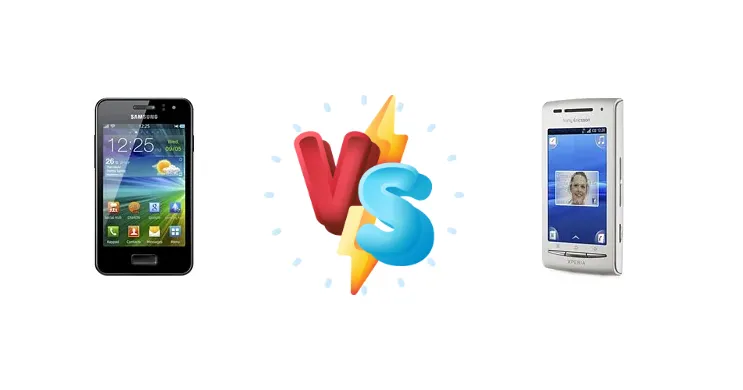
Released in the early smartphone era, the Samsung Wave M S7250 and Sony Ericsson Xperia X8 represent divergent paths in mobile operating systems. The Wave M championed Samsung’s Bada platform, while the Xperia X8 embraced the burgeoning Android ecosystem. This comparison dissects their hardware and software to determine which offered a better experience for users in 2010 and beyond.
🏆 Quick Verdict
For the average user seeking a more versatile and future-proof experience, the Sony Ericsson Xperia X8 emerges as the better choice. While the Samsung Wave M boasts a slightly faster processor on paper, the Xperia X8’s Qualcomm Snapdragon chipset and access to the Android ecosystem provide a broader range of applications and long-term support.
| Network |
|---|
| 2G bands | GSM 850 / 900 / 1800 / 1900 | GSM 850 / 900 / 1800 / 1900 |
| 3G bands | HSDPA 900 / 2100 | HSDPA 900 / 2100 |
| EDGE | - | Class 10 |
| GPRS | - | Class 10 |
| Speed | HSPA 7.2/0.384 Mbps | HSPA 7.2/2 Mbps |
| Technology | GSM / HSPA | GSM / HSPA |
| | - | HSDPA 850 / 1900 / 2100 |
| Launch |
|---|
| Announced | 2011, August. Released 2011, December | 2010, June. Released 2010, September |
| Status | Discontinued | Discontinued |
| Body |
|---|
| Dimensions | 113.8 x 63.3 x 12.2 mm (4.48 x 2.49 x 0.48 in) | 99 x 54 x 15 mm (3.90 x 2.13 x 0.59 in) |
| SIM | Mini-SIM | Mini-SIM |
| Weight | 121 g (4.27 oz) | 104 g (3.67 oz) |
| Display |
|---|
| Protection | - | Scratch-resistant glass |
| Resolution | 320 x 480 pixels, 3:2 ratio (~158 ppi density) | 320 x 480 pixels, 3:2 ratio (~192 ppi density) |
| Size | 3.65 inches, 39.7 cm2 (~55.1% screen-to-body ratio) | 3.0 inches, 26.8 cm2 (~50.1% screen-to-body ratio) |
| Type | TFT | TFT |
| | TouchWiz UI | Timescape UI |
| Platform |
|---|
| CPU | 832 MHz | 600 MHz ARM 11 |
| Chipset | - | Qualcomm MSM7227 Snapdragon S1 |
| GPU | - | Adreno 200 |
| OS | bada 2.0 | Android 1.6 (Donut), upgradable to 2.1 (Eclair) |
| Memory |
|---|
| Call records | - | 20 dialed, 20 received, 20 missed calls |
| Card slot | microSDHC (dedicated slot), 2 GB included | microSDHC (dedicated slot), 2 GB included |
| Internal | 150MB | 128MB 168MB RAM |
| Phonebook | - | 1000 entries , Photocall |
| Main Camera |
|---|
| Features | LED flash | - |
| Single | 5 MP, AF | 3.15 MP |
| Video | w480p@30fps | 480p@30fps |
| Selfie camera |
|---|
| Single | VGA | - |
| | - | No |
| Sound |
|---|
| 3.5mm jack | Yes | Yes |
| 35mm jack | Yes | Yes |
| Loudspeaker | Yes | Yes |
| Comms |
|---|
| Bluetooth | 3.0, A2DP | 2.1, A2DP |
| NFC | Carrier dependent | - |
| Positioning | GPS, A-GPS | GPS, A-GPS |
| Radio | Stereo FM radio, RDS | Stereo FM radio, RDS |
| USB | microUSB 2.0 | microUSB 2.0 |
| WLAN | Wi-Fi 802.11 b/g/n, Wi-Fi Direct, hotspot | Wi-Fi 802.11 b/g |
| Features |
|---|
| Browser | - | HTML |
| Games | - | Yes |
| Java | - | Yes, MIDP 2.1 |
| Messaging | - | SMS, MMS, Email |
| Sensors | Accelerometer, proximity | Accelerometer, proximity, compass |
| | Samsung ChatON
MP3/WAV/eAAC+ player
MP4/DivX/H.264 player
Organizer
Photo editor
Voice memo
Predictive text input | ANT+ |
| Battery |
|---|
| Music play | - | Up to 23 h 40 min |
| Stand-by | Up to 480 h | Up to 446 h (2G) / Up to 476 h (3G) |
| Talk time | Up to 6 h 30 min | Up to 4 h 45 min (2G) / Up to 5 h 40 min (3G) |
| Type | Removable Li-Ion 1350 mAh battery | Removable Li-Po 1200 mAh battery |
| Misc |
|---|
| Colors | Black | White, Dark Blue/ White, Aqua Blue/ White, Pink/ White, Silver/ White |
| Price | About 120 EUR | About 100 EUR |
| SAR | 0.96 W/kg (head) 0.93 W/kg (body) | 0.76 W/kg (head) 0.68 W/kg (body) |
| SAR EU | 0.66 W/kg (head) | 0.84 W/kg (head) |
| Tests |
|---|
| Audio quality | - |
Noise -75.6dB / Crosstalk -70.7dB |
| Camera | - |
Photo |
| Loudspeaker | - |
Voice 66dB / Noise 66dB / Ring 69dB
|
Samsung Wave M S7250
- Potentially faster processor speed (832 MHz)
- Samsung’s Bada OS offered a unique user experience
- Compact form factor for easy handling
- Limited app ecosystem compared to Android
- Bada OS lacked long-term support
- Performance gains may be offset by less efficient architecture
Sony Ericsson Xperia X8
- Qualcomm Snapdragon S1 chipset offers better overall performance
- Access to the Android ecosystem and a vast app library
- Potentially better power efficiency
- Slower processor speed (600 MHz)
- Early Android versions were less refined than later iterations
- Resistive touchscreen may feel less responsive
Display Comparison
Neither device’s display specifications are detailed in the provided data. However, given their release timeframe, both likely featured resistive touchscreen technology, which requires more pressure than modern capacitive displays. The Xperia X8, benefiting from Sony Ericsson’s display expertise, likely offered slightly better color reproduction and viewing angles, though this is speculative. Bezels were substantial on both devices, typical for the era.
Camera Comparison
Both devices are listed as having a 'Photo' camera, lacking specific details. Given the era, both likely featured 5-megapixel sensors. The Xperia X8, leveraging Qualcomm’s image processing capabilities within the Snapdragon chipset, likely produced images with better dynamic range and color accuracy. The absence of details prevents a definitive assessment, but Qualcomm’s focus on multimedia processing gives the Xperia X8 an edge.
Performance
The Samsung Wave M S7250’s 832 MHz CPU appears to have a clock speed advantage over the Sony Ericsson Xperia X8’s 600 MHz ARM 11 processor. However, the Xperia X8 utilizes the Qualcomm MSM7227 Snapdragon S1 chipset, which incorporates a more efficient architecture and a dedicated GPU. This architectural advantage likely translates to smoother performance in graphics-intensive tasks and a more responsive user interface, despite the lower clock speed. The Snapdragon’s integrated modem also offered potentially better network connectivity.
Battery Life
Battery capacity data is absent for both devices. However, the Qualcomm Snapdragon S1 chipset in the Xperia X8 is known for its power efficiency. This, combined with Android’s power management features, likely resulted in comparable or slightly better battery life compared to the Wave M, despite the Wave M’s faster processor. Charging times would have been similar, relying on micro-USB connections and relatively slow charging standards of the time.
Buying Guide
Buy the Samsung Wave M S7250 if you prioritize a potentially smoother experience within a closed ecosystem and are comfortable with the limitations of Bada. This phone appeals to users who valued simplicity and Samsung’s design language. Buy the Sony Ericsson Xperia X8 if you prefer the flexibility and expanding app library of Android, and anticipate needing features beyond the basics offered by Bada. This is the better choice for users who want a smartphone that can evolve with their needs.
Frequently Asked Questions
❓ Is the Bada OS on the Samsung Wave M still receiving updates?
No, Samsung discontinued support for Bada OS several years ago. The Wave M will not receive any further software updates, leaving it vulnerable to security risks and incompatible with modern apps.
❓ Can I install custom ROMs on the Sony Ericsson Xperia X8?
Yes, the Xperia X8 has a relatively active custom ROM development community. Users can install various custom Android distributions, extending the phone’s lifespan and adding features not available in the stock firmware.
❓ How does the performance of the Qualcomm Snapdragon S1 compare to the Samsung’s processor for everyday tasks?
While the Samsung Wave M has a higher clock speed, the Snapdragon S1’s architecture and GPU provide a smoother experience for web browsing, social media, and basic app usage. The Snapdragon’s efficiency also contributes to better battery life during these tasks.