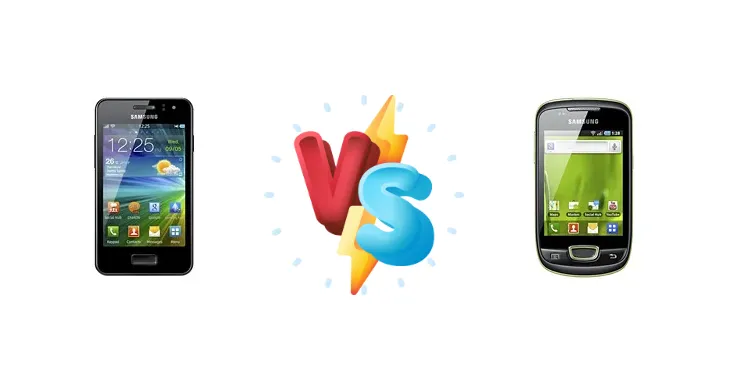
In 2011, Samsung was hedging its bets in the smartphone market, simultaneously pushing its proprietary Bada OS with the Wave M S7250 and embracing the burgeoning Android ecosystem with the Galaxy Mini S5570. This comparison revisits these two devices, analyzing their hardware and software to understand their respective strengths and weaknesses in the context of the early smartphone landscape.
🏆 Quick Verdict
For the average user seeking a slightly more responsive experience and access to a wider app ecosystem, the Samsung Galaxy Mini S5570 is the better choice. While the Wave M boasts a faster CPU on paper, the Snapdragon S1 chipset in the Mini provides a more optimized experience for Android’s early iterations.
| Network |
|---|
| 2G bands | GSM 850 / 900 / 1800 / 1900 | GSM 850 / 900 / 1800 / 1900 |
| 3G bands | HSDPA 900 / 2100 | HSDPA 900 / 2100 |
| Speed | HSPA 7.2/0.384 Mbps | HSPA 7.2/0.384 Mbps |
| Technology | GSM / HSPA | GSM / HSPA |
| Launch |
|---|
| Announced | 2011, August. Released 2011, December | 2011, January. Released 2011, February |
| Status | Discontinued | Discontinued |
| Body |
|---|
| Dimensions | 113.8 x 63.3 x 12.2 mm (4.48 x 2.49 x 0.48 in) | 110.4 x 60.8 x 12.1 mm (4.35 x 2.39 x 0.48 in) |
| SIM | Mini-SIM | Mini-SIM |
| Weight | 121 g (4.27 oz) | 105 g (3.70 oz) |
| Display |
|---|
| Resolution | 320 x 480 pixels, 3:2 ratio (~158 ppi density) | 240 x 320 pixels, 4:3 ratio (~127 ppi density) |
| Size | 3.65 inches, 39.7 cm2 (~55.1% screen-to-body ratio) | 3.14 inches, 30.5 cm2 (~45.5% screen-to-body ratio) |
| Type | TFT | TFT, 256K colors |
| | TouchWiz UI | - |
| Platform |
|---|
| CPU | 832 MHz | 600 MHz ARMv6 |
| Chipset | - | Qualcomm MSM7227 Snapdragon S1 |
| GPU | - | Adreno 200 |
| OS | bada 2.0 | Android 2.2 (Froyo), upgradable to 2.3 (Gingerbread), TouchWiz UI 3 |
| Memory |
|---|
| Card slot | microSDHC (dedicated slot), 2 GB included | microSDHC (dedicated slot), 2 GB included |
| Internal | 150MB | 160MB 384MB RAM |
| Main Camera |
|---|
| Features | LED flash | - |
| Single | 5 MP, AF | 3.15 MP |
| Video | w480p@30fps | 320p@15fps |
| Selfie camera |
|---|
| Single | VGA | - |
| | - | No |
| Sound |
|---|
| 3.5mm jack | Yes | Yes |
| 35mm jack | Yes | Yes |
| Loudspeaker | Yes | Yes |
| Comms |
|---|
| Bluetooth | 3.0, A2DP | 2.1, A2DP |
| NFC | Carrier dependent | - |
| Positioning | GPS, A-GPS | GPS, A-GPS |
| Radio | Stereo FM radio, RDS | Stereo FM radio, RDS |
| USB | microUSB 2.0 | microUSB 2.0 |
| WLAN | Wi-Fi 802.11 b/g/n, Wi-Fi Direct, hotspot | Wi-Fi 802.11 b/g/n, hotspot |
| Features |
|---|
| Browser | - | HTML |
| Sensors | Accelerometer, proximity | Accelerometer, proximity, compass |
| | Samsung ChatON
MP3/WAV/eAAC+ player
MP4/DivX/H.264 player
Organizer
Photo editor
Voice memo
Predictive text input | - |
| Battery |
|---|
| Stand-by | Up to 480 h | Up to 570 h |
| Talk time | Up to 6 h 30 min | Up to 9 h 30 min |
| Type | Removable Li-Ion 1350 mAh battery | Removable Li-Ion 1200 mAh battery |
| Misc |
|---|
| Colors | Black | Black, White |
| Models | - | GT-S5570 |
| Price | About 120 EUR | About 90 EUR |
| SAR | 0.96 W/kg (head) 0.93 W/kg (body) | - |
| SAR EU | 0.66 W/kg (head) | 0.96 W/kg (head) |
| Tests |
|---|
| Audio quality | - |
Noise -83.0dB / Crosstalk -80.6dB |
| Camera | - |
Photo |
| Loudspeaker | - |
Voice 68dB / Noise 65dB / Ring 70dB |
Samsung Wave M S7250
- Higher CPU clock speed (832 MHz)
- Unique Bada OS experience
- Potentially smoother interface (due to CPU)
- Limited app availability on Bada OS
- Lack of dedicated GPU
- Potentially higher power consumption
Samsung Galaxy Mini S5570
- Access to Android Market (Google Play Store)
- Qualcomm Snapdragon S1 chipset with integrated GPU
- Optimized power management
- Lower CPU clock speed (600 MHz)
- Older ARMv6 architecture
- Basic camera capabilities
Display Comparison
Neither device boasts a particularly impressive display by modern standards. Specifics regarding panel type, resolution, and brightness are unavailable, but both were targeted at the budget segment. The focus was on affordability, meaning compromises were made in display quality. The Wave M’s slightly larger form factor *may* translate to a marginally larger display, but this is speculative. Bezels were substantial on both devices, typical for the era.
Camera Comparison
Both devices feature a 'Photo' camera, but specific megapixel counts and features are not provided. Given their market positioning, image quality would have been basic. The Galaxy Mini’s Snapdragon S1 chipset includes an image signal processor (ISP), which aids in image processing and noise reduction, potentially giving it an edge over the Wave M’s camera, even if the sensor resolution is similar. The lack of detailed camera specifications makes a definitive comparison difficult, but the presence of an ISP in the Mini is a significant advantage.
Performance
The Samsung Wave M S7250 features an 832 MHz CPU, while the Galaxy Mini S5570 is equipped with a 600 MHz ARMv6 processor based on the Qualcomm MSM7227 Snapdragon S1 chipset. While the Wave M’s CPU clock speed is higher, the Snapdragon S1 benefits from Qualcomm’s optimization for mobile platforms. The ARMv6 architecture in the Mini is a mature and efficient design. The Snapdragon S1 also includes an integrated GPU, providing hardware acceleration for graphics, which the Wave M’s CPU likely lacks. This translates to a potentially smoother user experience on the Galaxy Mini, particularly when running Android applications.
Battery Life
Battery capacity details are unavailable for either device. However, both were designed for moderate usage, prioritizing standby time over intensive tasks. The 600 MHz processor in the Galaxy Mini, coupled with the Snapdragon S1’s power management features, likely contributes to better battery life compared to the Wave M’s 832 MHz CPU, which may consume more power due to its higher clock speed. Charging times would have been slow by today’s standards, likely several hours for a full charge.
Buying Guide
Buy the Samsung Wave M S7250 if you are interested in experiencing Samsung’s Bada OS and prefer a potentially smoother interface due to the higher CPU clock speed, understanding that app availability will be limited. Buy the Samsung Galaxy Mini S5570 if you prioritize access to the Android Market (now Google Play Store) and a broader range of applications, even if it means sacrificing some raw processing power.
Frequently Asked Questions
❓ Is Bada OS still supported on the Samsung Wave M S7250?
No, Samsung discontinued support for Bada OS several years ago. There are no further updates or security patches available for the Wave M, making it vulnerable to modern security threats. The app ecosystem is also effectively frozen in time.
❓ Can I install a custom ROM (like LineageOS) on the Samsung Galaxy Mini S5570?
While the Galaxy Mini S5570 is an older device, a small but dedicated community has developed custom ROMs based on older versions of Android. However, the process is not straightforward and requires technical expertise. Compatibility and stability can vary significantly depending on the ROM chosen.
❓ Which phone is better for playing older Android games?
The Samsung Galaxy Mini S5570 is likely the better choice for playing older Android games. The Snapdragon S1’s integrated GPU provides hardware acceleration, which the Wave M lacks. While neither phone is capable of running modern games, the Mini will offer a smoother experience with titles designed for its era.