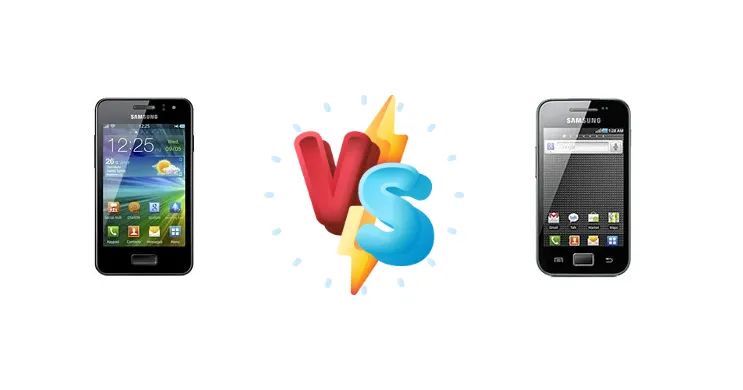
Released around the same timeframe, the Samsung Wave M S7250 and Galaxy Ace S5830I represent Samsung’s dual-pronged approach to the burgeoning smartphone market of the early 2010s. The Wave M championed Samsung’s in-house Bada OS, while the Galaxy Ace embraced the rapidly growing Android ecosystem. This comparison dissects their hardware and software differences to determine which device offered the better experience for the price.
🏆 Quick Verdict
For the average user seeking broader app compatibility and future software support, the Samsung Galaxy Ace S5830I is the better choice. While both phones share an 832 MHz processor, the Ace’s Android OS and Broadcom chipset provide access to a larger software ecosystem, outweighing the Wave M’s Bada OS limitations.
| Network |
|---|
| 2G bands | GSM 850 / 900 / 1800 / 1900 | GSM 850 / 900 / 1800 / 1900 |
| 3G bands | HSDPA 900 / 2100 | HSDPA 900 / 2100 |
| Speed | HSPA 7.2/0.384 Mbps | HSPA 7.2/0.384 Mbps |
| Technology | GSM / HSPA | GSM / HSPA |
| Launch |
|---|
| Announced | 2011, August. Released 2011, December | 2011 |
| Status | Discontinued | Discontinued |
| Body |
|---|
| Dimensions | 113.8 x 63.3 x 12.2 mm (4.48 x 2.49 x 0.48 in) | 112.4 x 59.9 x 11.5 mm (4.43 x 2.36 x 0.45 in) |
| SIM | Mini-SIM | Mini-SIM |
| Weight | 121 g (4.27 oz) | 113 g (3.99 oz) |
| Display |
|---|
| Protection | - | Corning Gorilla Glass |
| Resolution | 320 x 480 pixels, 3:2 ratio (~158 ppi density) | 320 x 480 pixels, 3:2 ratio (~165 ppi density) |
| Size | 3.65 inches, 39.7 cm2 (~55.1% screen-to-body ratio) | 3.5 inches, 36.5 cm2 (~54.2% screen-to-body ratio) |
| Type | TFT | TFT |
| | TouchWiz UI | - |
| Platform |
|---|
| CPU | 832 MHz | 832 MHz |
| Chipset | - | Broadcom BCM21553 |
| GPU | - | VideoCore IV |
| OS | bada 2.0 | Android 2.2 (Froyo), TouchWiz UI 3 |
| Memory |
|---|
| Card slot | microSDHC (dedicated slot), 2 GB included | microSDHC (dedicated slot) |
| Internal | 150MB | 158MB |
| Main Camera |
|---|
| Features | LED flash | LED flash |
| Single | 5 MP, AF | 5 MP, AF |
| Video | w480p@30fps | Yes |
| Selfie camera |
|---|
| Single | VGA | - |
| | - | No |
| Sound |
|---|
| 3.5mm jack | Yes | Yes |
| 35mm jack | Yes | Yes |
| Loudspeaker | Yes | Yes |
| Comms |
|---|
| Bluetooth | 3.0, A2DP | 3.0, A2DP |
| NFC | Carrier dependent | - |
| Positioning | GPS, A-GPS | GPS, A-GPS |
| Radio | Stereo FM radio, RDS | Stereo FM radio, RDS |
| USB | microUSB 2.0 | microUSB 2.0 |
| WLAN | Wi-Fi 802.11 b/g/n, Wi-Fi Direct, hotspot | Wi-Fi 802.11 b/g/n, DLNA, hotspot |
| Features |
|---|
| Sensors | Accelerometer, proximity | Accelerometer, proximity, compass |
| | Samsung ChatON
MP3/WAV/eAAC+ player
MP4/DivX/H.264 player
Organizer
Photo editor
Voice memo
Predictive text input | - |
| Battery |
|---|
| Stand-by | Up to 480 h | Up to 640 h (2G) / Up to 420 h (3G) |
| Talk time | Up to 6 h 30 min | Up to 11 h (2G) / Up to 6 h 30 min (3G) |
| Type | Removable Li-Ion 1350 mAh battery | Removable Li-Ion 1350 mAh battery |
| Misc |
|---|
| Colors | Black | Black |
| Models | - | GT-S5830i |
| Price | About 120 EUR | About 70 EUR |
| SAR | 0.96 W/kg (head) 0.93 W/kg (body) | - |
| SAR EU | 0.66 W/kg (head) | 0.69 W/kg (head) |
Samsung Wave M S7250
- Potentially smoother user experience with Bada OS
- Samsung’s integrated services and ecosystem
- Simpler, less cluttered interface
- Limited app availability compared to Android
- Slower software updates and limited long-term support
- Less customization options
Samsung Galaxy Ace S5830I
- Access to the vast Android app ecosystem
- Greater customization options
- More robust software support and updates
- Potential for fragmentation and OS inconsistencies
- May experience slightly slower performance due to Android overhead
- Interface can be more complex for novice users
Display Comparison
Both devices likely feature similar display technologies common to the era – likely TFT LCD panels. Without specific resolution or size data, a direct comparison is difficult. However, the Galaxy Ace, being part of the Galaxy line, may have benefited from slightly better color calibration and viewing angles, typical of Samsung’s display engineering. The Wave M’s display quality would have been geared towards optimizing Bada OS’s visual presentation.
Camera Comparison
Without detailed camera specifications, a precise comparison is challenging. Both devices likely featured basic rear cameras, typical of the time. The Galaxy Ace, benefiting from Android’s more robust camera API, may have offered more software features and potentially better image processing capabilities. The Wave M’s camera performance would have been heavily reliant on Samsung’s Bada OS camera application and its associated algorithms.
Performance
Both the Wave M and Galaxy Ace are equipped with an 832 MHz CPU. However, the critical difference lies in the chipset: the Wave M utilizes a Samsung processor, while the Galaxy Ace employs a Broadcom BCM21553. The Broadcom chipset, while also 832MHz, likely incorporates a different architecture and potentially more efficient memory controller. This could translate to slightly faster app loading times and smoother multitasking on the Galaxy Ace, despite the identical clock speed. The Android OS on the Ace also benefits from a more mature and optimized runtime environment compared to Bada.
Battery Life
Battery life will heavily depend on usage patterns and network conditions. Without mAh ratings, it’s difficult to definitively state which device offers superior endurance. However, the Galaxy Ace’s Android OS, with its more granular power management features, may allow users to optimize battery life more effectively. The Broadcom chipset’s power efficiency could also contribute to slightly longer battery life on the Ace.
Buying Guide
Buy the Samsung Wave M S7250 if you prioritize a potentially smoother, more streamlined user experience with a focus on Samsung’s services and a simpler interface, and are comfortable with a limited app selection. Buy the Samsung Galaxy Ace S5830I if you value access to the vast Android app ecosystem, greater customization options, and long-term software support, even if it means potentially encountering more fragmentation.
Frequently Asked Questions
❓ Is Bada OS still supported on the Samsung Wave M S7250?
No, Samsung discontinued support for Bada OS several years ago. This means no further software updates, security patches, or app compatibility improvements will be released for the Wave M. The Galaxy Ace, running Android, benefited from a longer support lifecycle, though even that is now outdated.
❓ Can I install Android on the Samsung Wave M S7250?
While custom ROM development exists for many older devices, finding a stable and fully functional Android ROM for the Wave M S7250 is challenging. The hardware differences and lack of official support make the process complex and potentially risky, often resulting in limited functionality.
❓ Which phone is better for basic tasks like calling and texting?
Both phones are perfectly capable of handling basic tasks like calling and texting. The difference in performance is negligible for these functions. The choice comes down to preference for the operating system and app ecosystem.