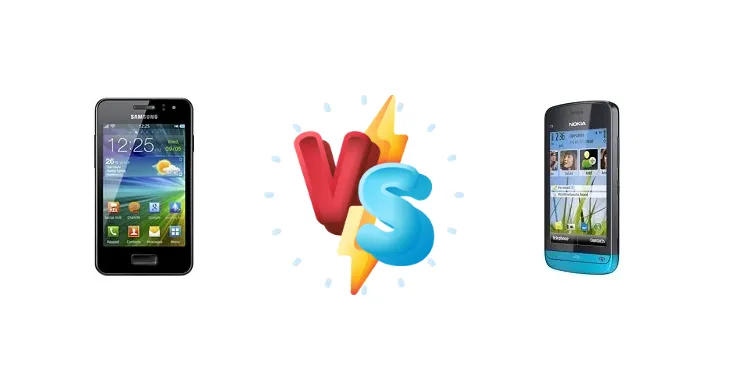
In a world dominated by smartphones, feature phones retain a dedicated following, prized for their simplicity, durability, and exceptional battery life. We pit the Samsung Wave M S7250, running Samsung’s Bada OS, against the Nokia C5-03, powered by Symbian, to determine which offers the best experience for users seeking a no-frills mobile solution.
🏆 Quick Verdict
For the average user prioritizing battery endurance and a slightly more modern (though still limited) software experience, the Nokia C5-03 emerges as the winner. Its 66-hour endurance rating and 10W charging provide a significant advantage over the Samsung Wave M, despite the latter’s faster CPU.
| Network |
|---|
| 2G bands | GSM 850 / 900 / 1800 / 1900 | GSM 850 / 900 / 1800 / 1900 |
| 3G bands | HSDPA 900 / 2100 | HSDPA 900 / 1900 / 2100 |
| 4G bands | - | 1, 3, 5, 7, 8, 20, 38, 40, 41 |
| Speed | HSPA 7.2/0.384 Mbps | HSPA 10.2/2 Mbps |
| Technology | GSM / HSPA | GSM / HSPA |
| Launch |
|---|
| Announced | 2011, August. Released 2011, December | 2010, October. Released 2010, December |
| Status | Discontinued | Discontinued |
| Body |
|---|
| Build | - | Glass front, plastic back, plastic frame |
| Dimensions | 113.8 x 63.3 x 12.2 mm (4.48 x 2.49 x 0.48 in) | 105.8 x 51 x 13.8 mm, 65 cc (4.17 x 2.01 x 0.54 in) |
| SIM | Mini-SIM | Mini-SIM |
| Weight | 121 g (4.27 oz) | 93 g (3.28 oz) |
| Display |
|---|
| Resolution | 320 x 480 pixels, 3:2 ratio (~158 ppi density) | 360 x 640 pixels, 16:9 ratio (~229 ppi density) |
| Size | 3.65 inches, 39.7 cm2 (~55.1% screen-to-body ratio) | 3.2 inches, 28.2 cm2 (~52.3% screen-to-body ratio) |
| Type | TFT | TFT resistive touchscreen, 16M colors |
| | TouchWiz UI | Handwriting recognition |
| Platform |
|---|
| CPU | 832 MHz | 600 MHz ARM 11 |
| Chipset | - | Exynos 9609 (10 nm) |
| GPU | - | Mali-G72 MP3 |
| OS | bada 2.0 | Symbian 9.4, Series 60 rel. 5 |
| Memory |
|---|
| Card slot | microSDHC (dedicated slot), 2 GB included | microSDHC (dedicated slot), 2 GB included |
| Internal | 150MB | 40MB 128MB RAM |
| Main Camera |
|---|
| Features | LED flash | Dual-LED dual-tone flash, HDR, panorama |
| Single | 5 MP, AF | 5 MP |
| Triple | - | 12 MP, f/1.8, 26mm (wide), 1/2.8", 1.25µm, PDAF
16 MP, f/2.2, 14mm (ultrawide), dedicated video camera (1080p)
5 MP, f/2.2, (depth) |
| Video | w480p@30fps | 480p@15fps |
| Selfie camera |
|---|
| Features | - | HDR |
| Single | VGA | 12 MP, f/2.0, 26mm (wide), 1/2.8", 1.25µm |
| Video | - | 1080p@30fps |
| | - | No |
| Sound |
|---|
| 3.5mm jack | Yes | Yes |
| 35mm jack | Yes | Yes |
| Loudspeaker | Yes | Yes |
| Comms |
|---|
| Bluetooth | 3.0, A2DP | 2.0, A2DP |
| NFC | Carrier dependent | Yes |
| Positioning | GPS, A-GPS | GPS, A-GPS; Nokia Maps |
| Radio | Stereo FM radio, RDS | Stereo FM radio |
| USB | microUSB 2.0 | microUSB 2.0 |
| WLAN | Wi-Fi 802.11 b/g/n, Wi-Fi Direct, hotspot | Wi-Fi 802.11 b/g, UPnP technology |
| Features |
|---|
| Browser | - | WAP 2.0/xHTML, HTML, Adobe Flash Lite |
| Sensors | Accelerometer, proximity | Accelerometer |
| | Samsung ChatON
MP3/WAV/eAAC+ player
MP4/DivX/H.264 player
Organizer
Photo editor
Voice memo
Predictive text input | MP4/H.264/WMV player
MP3/WAV/еAAC+/WMA player
Photo editor
Organizer
Voice command/dial
Predictive text input |
| Battery |
|---|
| Charging | - | 10W wired |
| Music play | - | Up to 35 h |
| Stand-by | Up to 480 h | Up to 600 h (2G) / Up to 576 h (3G) |
| Talk time | Up to 6 h 30 min | Up to 11 h 30 min (2G) / Up to 4 h 30 min (3G) |
| Type | Removable Li-Ion 1350 mAh battery | Removable Li-Ion 1000 mAh battery |
| Misc |
|---|
| Colors | Black | Graphite Black, Lime Green, Petrol Blue, Aluminum Grey, Pink/black |
| Models | - | XT2013-1, XT2013-2, XT2013-4 |
| Price | About 120 EUR | About 100 EUR |
| SAR | 0.96 W/kg (head) 0.93 W/kg (body) | 1.36 W/kg (head) 0.89 W/kg (body) |
| SAR EU | 0.66 W/kg (head) | 1.29 W/kg (head) |
| Tests |
|---|
| Audio quality | - |
Noise -90.0dB / Crosstalk -92.0dB |
| Battery life | - | Endurance rating 66h |
| Camera | - |
Photo |
| Display | - |
Contrast ratio: 1237:1 (nominal) |
| Loudspeaker | - |
Voice 73dB / Noise 65dB / Ring 75dB
|
| Performance | - |
AnTuTu: 148748 (v7)
GeekBench: 5271 (v4.4) |
Samsung Wave M S7250
- Faster 832 MHz CPU for potentially smoother operation.
- Runs Samsung’s Bada OS, offering a slightly different software experience.
- Potentially more responsive user interface.
- Battery life data unavailable, likely inferior to Nokia C5-03.
- Display specifications unknown, potentially lower contrast.
- Bada OS is no longer supported.
Nokia C5-03
- Exceptional 66-hour battery life.
- 10W wired charging for faster replenishment.
- Higher contrast ratio (1237:1) for improved display clarity.
- Slower 600 MHz ARM 11 processor.
- Runs Symbian OS, which is also no longer supported.
- Limited app ecosystem.
Display Comparison
The Nokia C5-03 boasts a contrast ratio of 1237:1, suggesting a more visually defined image compared to the Samsung Wave M, for which display specifications are unavailable. While neither device will rival modern smartphone displays, the Nokia’s higher contrast ratio likely translates to better readability in bright sunlight. Given both phones target a budget-conscious market, expect TN-type panels with limited viewing angles on both.
Camera Comparison
Both devices feature a 'Photo' camera, but lack specific details regarding resolution or features. Given their market segment, image quality is unlikely to be a primary strength of either device. The absence of details suggests both cameras are basic, intended for simple snapshots rather than detailed photography. Without further information, a meaningful comparison is impossible.
Performance
The Samsung Wave M S7250 features an 832 MHz CPU, significantly faster than the Nokia C5-03’s 600 MHz ARM 11 processor. This difference in clock speed suggests the Wave M will offer a more responsive user experience when navigating menus and launching applications. However, both devices are limited by their operating systems and available RAM (not specified in the provided data), meaning the performance gap may not be dramatically noticeable in real-world usage. The Nokia C5-03 utilizes an Exynos 9609 chipset fabricated on a 10nm process, which, while slower in clock speed, benefits from improved power efficiency compared to the likely older process node used in the Samsung Wave M.
Battery Life
The Nokia C5-03 shines in battery life, achieving an endurance rating of 66 hours. This is a substantial advantage over the Samsung Wave M, for which battery life data is unavailable. The Nokia also supports 10W wired charging, allowing for a relatively quick recharge. The combination of long battery life and reasonable charging speed makes the C5-03 ideal for users who prioritize minimizing the need for frequent charging.
Buying Guide
Buy the Samsung Wave M S7250 if you need a slightly more responsive user interface thanks to its 832 MHz processor, and are comfortable with the older Bada OS. Buy the Nokia C5-03 if you prioritize exceptional battery life, a more established (though also aging) Symbian OS, and a contrast ratio that delivers a more visually distinct display experience.
Frequently Asked Questions
❓ Is the Exynos 9609 chip in the Nokia C5-03 prone to overheating during extended use?
Given the relatively low clock speed of the CPU and the 10nm fabrication process, overheating is unlikely to be a significant concern with the Nokia C5-03. The chipset is designed for efficiency rather than raw performance, prioritizing battery life over sustained high-intensity tasks.
❓ Will I be able to find apps for either the Bada OS or Symbian operating systems?
App availability is a major limitation for both devices. Both Bada and Symbian are discontinued operating systems, meaning the app ecosystems are severely limited and many modern apps are unavailable. Users should expect to rely on pre-installed applications and a small selection of legacy apps.
❓ How does the contrast ratio of the Nokia C5-03 affect the viewing experience?
The 1237:1 contrast ratio on the Nokia C5-03 means a greater difference between the darkest blacks and brightest whites displayed on the screen. This results in a more vibrant and visually distinct image, improving readability, especially in bright lighting conditions, compared to a display with a lower contrast ratio.