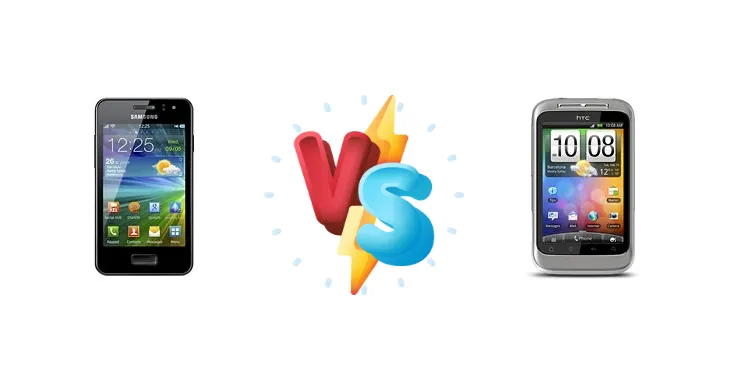
In 2011, the smartphone landscape was rapidly evolving. Samsung's Wave M S7250, running the proprietary Bada OS, and HTC's Wildfire S, powered by Android and a Qualcomm Snapdragon processor, represented distinct approaches to bringing smartphone functionality to a wider audience. This comparison dissects their key differences, revealing which device offered the better experience for the price.
🏆 Quick Verdict
For the average user seeking a more versatile and future-proof experience, the HTC Wildfire S emerges as the better choice. While the Samsung Wave M boasts a slightly faster processor on paper, the Wildfire S’s Snapdragon chipset and access to the Android ecosystem provide a broader range of applications and long-term support.
| Network |
|---|
| 2G bands | GSM 850 / 900 / 1800 / 1900 | GSM 850 / 900 / 1800 / 1900 |
| 3G bands | HSDPA 900 / 2100 | HSDPA 900 / 2100 |
| Speed | HSPA 7.2/0.384 Mbps | HSPA 7.2/0.384 Mbps |
| Technology | GSM / HSPA | GSM / HSPA |
| | - | HSDPA 2100 - for Australia |
| Launch |
|---|
| Announced | 2011, August. Released 2011, December | 2011, February. Released 2011, May |
| Status | Discontinued | Discontinued |
| Body |
|---|
| Dimensions | 113.8 x 63.3 x 12.2 mm (4.48 x 2.49 x 0.48 in) | 101.3 x 59.4 x 12.4 mm (3.99 x 2.34 x 0.49 in) |
| SIM | Mini-SIM | Mini-SIM |
| Weight | 121 g (4.27 oz) | 105 g (3.70 oz) |
| Display |
|---|
| Resolution | 320 x 480 pixels, 3:2 ratio (~158 ppi density) | 320 x 480 pixels, 3:2 ratio (~180 ppi density) |
| Size | 3.65 inches, 39.7 cm2 (~55.1% screen-to-body ratio) | 3.2 inches, 30.5 cm2 (~50.7% screen-to-body ratio) |
| Type | TFT | TFT, 256K colors |
| | TouchWiz UI | - |
| Platform |
|---|
| CPU | 832 MHz | 600 MHz ARM 11 |
| Chipset | - | Qualcomm MSM7227 Snapdragon S1 |
| GPU | - | Adreno 200 |
| OS | bada 2.0 | Android 2.3 (Gingerbread), upgradable to 2.3.5 (Gingerbread), Sense UI 2.1 |
| Memory |
|---|
| Card slot | microSDHC (dedicated slot), 2 GB included | microSDHC (dedicated slot), 2 GB included |
| Internal | 150MB | 512MB 512MB RAM |
| Main Camera |
|---|
| Features | LED flash | LED flash |
| Single | 5 MP, AF | 5 MP, AF |
| Video | w480p@30fps | 480p@24fps |
| Selfie camera |
|---|
| Single | VGA | - |
| | - | No |
| Sound |
|---|
| 3.5mm jack | Yes | Yes |
| 35mm jack | Yes | Yes |
| Loudspeaker | Yes | Yes |
| Comms |
|---|
| Bluetooth | 3.0, A2DP | 3.0, A2DP, EDR |
| NFC | Carrier dependent | - |
| Positioning | GPS, A-GPS | GPS, A-GPS |
| Radio | Stereo FM radio, RDS | Stereo FM radio, RDS |
| USB | microUSB 2.0 | microUSB 2.0 |
| WLAN | Wi-Fi 802.11 b/g/n, Wi-Fi Direct, hotspot | Wi-Fi 802.11 b/g/n, hotspot |
| Features |
|---|
| Browser | - | HTML |
| Sensors | Accelerometer, proximity | Accelerometer, proximity, compass |
| | Samsung ChatON
MP3/WAV/eAAC+ player
MP4/DivX/H.264 player
Organizer
Photo editor
Voice memo
Predictive text input | MP3/AAC+/WAV player
Xvid/MP4/H.264 player
Organizer
Voice memo
Predictive text input |
| Battery |
|---|
| Stand-by | Up to 480 h | Up to 360 h (2G) / Up to 570 h (3G) |
| Talk time | Up to 6 h 30 min | Up to 7 h 10 min (2G) / Up to 5 h 50 min (3G) |
| Type | Removable Li-Ion 1350 mAh battery | Removable Li-Ion 1230 mAh battery |
| Misc |
|---|
| Colors | Black | Black, Silver, Brown, Lilac |
| Price | About 120 EUR | About 100 EUR |
| SAR | 0.96 W/kg (head) 0.93 W/kg (body) | 0.90 W/kg (head) 1.21 W/kg (body) |
| SAR EU | 0.66 W/kg (head) | - |
| Tests |
|---|
| Audio quality | - |
Noise -81.3dB / Crosstalk -81.3B |
| Camera | - |
Photo |
| Display | - |
Contrast ratio: 414:1 (nominal) |
| Loudspeaker | - |
Voice 73dB / Noise 66dB / Ring 69dB
|
Samsung Wave M S7250
- Potentially faster CPU clock speed (832 MHz)
- Bada OS offers a unique, streamlined experience (for some)
- Samsung’s brand recognition in 2011
- Limited app ecosystem with Bada OS
- Lack of future software updates
- Vague camera specifications
HTC Wildfire S
- Access to the Android ecosystem and app library
- Qualcomm Snapdragon S1 chipset offers better graphics performance
- Potential for software updates (though limited)
- Slower CPU clock speed (600 MHz)
- Entry-level processor may struggle with demanding apps
- Vague camera specifications
Display Comparison
Both the Samsung Wave M and HTC Wildfire S share a nominal contrast ratio of 414:1, suggesting similar display quality in terms of black levels and color separation. However, the context data lacks specifics on screen size, resolution, or panel technology (TFT vs IPS). Given the era, both likely utilized TFT LCDs. The absence of detailed display specs makes a definitive judgment difficult, but the Wildfire S’s Android OS allows for potential customization of color profiles, a feature likely absent on the Wave M.
Camera Comparison
Both devices are listed as having a 'Photo' camera, a frustratingly vague specification. Without megapixel counts or aperture information, a detailed comparison is impossible. However, given the market positioning of both phones, it’s reasonable to assume both cameras were entry-level, likely around 3-5 megapixels. The Wildfire S benefits from the Android ecosystem, which offered a wider range of camera applications and image processing options, even in 2011. The Wave M’s camera experience would have been limited to Samsung’s native camera app.
Performance
The Samsung Wave M’s 832 MHz CPU appears to have a clock speed advantage over the HTC Wildfire S’s 600 MHz ARM 11 processor. However, the Qualcomm MSM7227 Snapdragon S1 chipset in the Wildfire S incorporates a more efficient architecture and a dedicated GPU. This architectural difference is crucial; the Snapdragon S1 provides better graphics performance and responsiveness for tasks beyond basic operation. The ARM 11 in the Wildfire S, while slower on clock speed, benefits from Qualcomm’s optimizations, potentially closing the performance gap in real-world usage. The Wave M’s Bada OS, being less resource-intensive than Android, might mitigate the CPU difference, but the Wildfire S’s GPU gives it an edge in multimedia and gaming.
Battery Life
Battery capacity data is absent for both devices. Considering their similar target markets and hardware configurations, battery life was likely comparable. The Snapdragon S1 in the Wildfire S is known for its relatively efficient power consumption, potentially offsetting the Wave M’s faster processor. Without specific mAh ratings and usage patterns, it’s difficult to declare a clear winner. Charging wattage is also unknown, making a comparison of 0-100% charge times impossible.
Buying Guide
Buy the Samsung Wave M S7250 if you prioritize a potentially smoother, albeit limited, user experience with Bada OS and are comfortable within a closed ecosystem. Buy the HTC Wildfire S if you value access to the vast Android app library, a more established platform, and the potential for future software updates, even if it means a slightly slower processor.
Frequently Asked Questions
❓ Is Bada OS still supported on the Samsung Wave M S7250?
No, Samsung discontinued support for Bada OS several years ago. This means no further software updates, security patches, or app compatibility improvements are available. The app ecosystem is also largely stagnant.
❓ Can I install custom ROMs on the HTC Wildfire S to improve performance?
Yes, the HTC Wildfire S has a relatively active custom ROM community. While finding actively maintained ROMs may be challenging given the device's age, installing a custom ROM based on a newer version of Android can significantly improve performance and add features.
❓ How does the Qualcomm Snapdragon S1 compare to the Samsung’s processor in terms of gaming?
The Snapdragon S1’s dedicated GPU provides a noticeable advantage in gaming compared to the Samsung Wave M’s processor, which likely relies on software-based rendering. While neither phone is capable of running modern games, the Wildfire S will offer a smoother experience with games available in 2011.