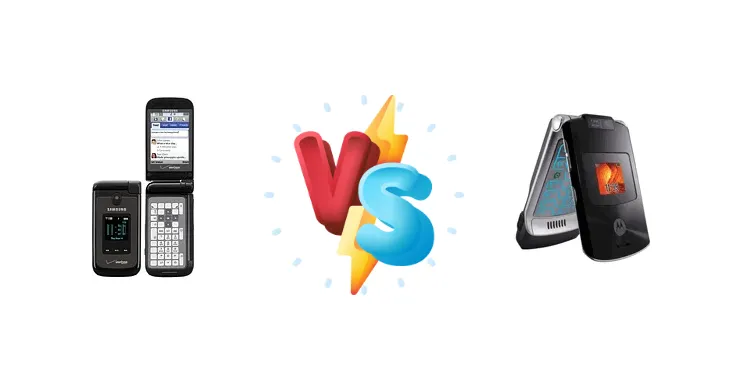
The mid-2000s saw a fierce battle for mobile dominance, with clamshell designs leading the charge. The Samsung U750 Zeal and Motorola RAZR V3xx were two of the most iconic contenders, representing distinct approaches to style and functionality. This comparison revisits these classics, analyzing their strengths and weaknesses in a modern context, acknowledging the limited available detailed specifications.
🏆 Quick Verdict
For the average user seeking a nostalgic experience, the Motorola RAZR V3xx likely holds more appeal due to its groundbreaking design and cultural impact. While the Samsung U750 Zeal likely offered comparable functionality, the RAZR’s iconic status and perceived premium build quality give it the edge.
| Network |
|---|
| 2G bands | CDMA 800 / 1900 | GSM 900 / 1800 / 1900 |
| 3G bands | CDMA2000 1xEV-DO | HSDPA 850 / 1900 |
| Speed | EV-DO Rev.A 3.1 Mbps | HSPA 3.6/0.384 Mbps |
| Technology | CDMA / EVDO | GSM / HSPA |
| Launch |
|---|
| Announced | 2010, November. Released 2010, November | 2006, July |
| Status | Discontinued | Discontinued |
| Body |
|---|
| Dimensions | 101.9 x 51.8 x 17.1 mm (4.01 x 2.04 x 0.67 in) | 103 x 53 x 15 mm, 80 cc (4.06 x 2.09 x 0.59 in) |
| Keyboard | QWERTY | - |
| SIM | Mini-SIM | Mini-SIM |
| Weight | 123 g (4.34 oz) | 107 g (3.77 oz) |
| Display |
|---|
| Resolution | 240 x 320 pixels, 4:3 ratio (~154 ppi density) | 240 x 320 pixels, 4:3 ratio (~182 ppi density) |
| Size | 2.6 inches, 20.9 cm2 (~39.7% screen-to-body ratio) | 2.2 inches, 33 x 45 mm, 15.0 cm2 (~27.5% screen-to-body ratio) |
| Type | TFT, 256K colors | TFT, 256K colors |
| | External display, 128x128 pixels, 1.3"
| Second external CSTN, 65K colors display (96 x 80 pixels)
Screensavers and wallpapers
Downloadable logos |
| Memory |
|---|
| Call records | Yes | 10 dialed, 10 received, 10 missed calls |
| Card slot | microSDHC (dedicated slot) | microSD (dedicated slot) |
| Internal | - | 50MB |
| Phonebook | 1000 entries, Photocall | 1000 entries, Photocall |
| Main Camera |
|---|
| Single | 2 MP, AF | 1.3 MP |
| Video | Yes | Yes |
| Selfie camera |
|---|
| Single | - | VGA videocall camera |
| | No | - |
| Sound |
|---|
| 3.5mm jack | No | No |
| 35mm jack | No | No |
| Alert types | - | Vibration; Downloadable polyphonic, MP3 ringtones |
| Loudspeaker | Yes | Yes |
| Comms |
|---|
| Bluetooth | 2.1, A2DP | 2.0, A2DP |
| Positioning | GPS, A-GPS | No |
| Radio | No | No |
| USB | microUSB 2.0 | miniUSB |
| WLAN | - | No |
| Features |
|---|
| Browser | WAP 2.0/xHTML, HTML | WAP 2.0/xHTML, HTML (Opera) |
| Games | Yes | Yes |
| Java | No | Yes, MIDP 2.0 |
| Messaging | SMS, MMS, Email, Push Email, IM | SMS, EMS, MMS, Email, Instant Messaging |
| | SNS integration
MP3/AAC player
MP4/H.263 player
Organizer
Voice memo/dial
Predictive text input | Video download
MP3/AAC/AAC+ player
Predictive text input
Organizer
Voice memo |
| Battery |
|---|
| Stand-by | Up to 340 h | Up to 290 h |
| Talk time | Up to 5 h | Up to 3 h |
| Type | Removable Li-Ion 880 mAh battery | Removable Li-Ion 940 mAh battery |
| Misc |
|---|
| Colors | Black | Black |
| Price | About 100 EUR | About 160 EUR |
| SAR | 0.54 W/kg (head) 1.11 W/kg (body) | - |
Samsung U750 Zeal
- Potentially more robust feature set (speculation)
- Likely offered comparable functionality to the RAZR
- May have had a slightly larger internal display
- Lacks the iconic design of the RAZR V3xx
- Less cultural impact and brand recognition
Motorola RAZR V3xx
- Groundbreaking, ultra-thin design
- Strong brand recognition and cultural impact
- Stainless steel construction for perceived premium quality
- Potentially smaller battery capacity due to thin design
- Limited performance by modern standards
Display Comparison
Given the era, both the U750 Zeal and RAZR V3xx likely featured small, low-resolution TFT LCD screens. The RAZR V3xx’s external monochrome display was a key design element, offering glanceable information without opening the phone. The U750 Zeal likely had a similar external display, but the RAZR’s was more prominently featured. Color accuracy and brightness were limited by the technology of the time, with neither device offering anything approaching modern smartphone displays. The RAZR’s focus on minimizing thickness likely impacted the internal display size, potentially giving the U750 Zeal a slight advantage in screen real estate when open.
Camera Comparison
Both the U750 Zeal and RAZR V3xx included basic cameras for their time, likely VGA (0.3MP) resolution. Image quality would have been poor by modern standards, with limited detail and dynamic range. The cameras were primarily intended for novelty use and basic photo capture. The U750 Zeal may have offered slightly more advanced camera features, such as video recording or digital zoom, but these would have been rudimentary. Lens apertures were likely small, resulting in poor low-light performance on both devices. The inclusion of a flash, if present, would have been a basic LED unit.
Performance
Both devices operated on 2G networks and featured limited processing power by today’s standards. The U750 Zeal and RAZR V3xx likely utilized similar ARM-based processors, optimized for basic phone functions like calls, SMS, and simple applications. Performance differences would have been minimal and largely dependent on software optimization. RAM capacity was also limited, likely in the single-digit megabyte range. The RAZR V3xx’s focus on a sleek design may have resulted in more constrained thermal management, potentially leading to slight performance throttling during extended use, though this is speculative without detailed thermal data.
Battery Life
Battery life on both devices was a significant consideration, given the limited capabilities of 2G networks and the power demands of the displays and processors. The U750 Zeal and RAZR V3xx likely featured batteries in the 800-1000mAh range, providing several days of standby time and several hours of talk time. Charging times were significantly longer than modern smartphones, typically requiring several hours to fully charge. The RAZR V3xx’s thin design may have necessitated a smaller battery capacity, potentially resulting in slightly shorter battery life compared to the U750 Zeal.
Buying Guide
Buy the Samsung U750 Zeal if you prioritize a potentially more robust feature set within the clamshell format, assuming it offered unique software or connectivity options not present in the RAZR. Buy the Motorola RAZR V3xx if you value design, brand recognition, and a piece of mobile history; its thin profile and stainless steel construction were revolutionary for the time, making it a collector's item.
Frequently Asked Questions
❓ Is the Motorola RAZR V3xx still functional on modern networks?
No. The Motorola RAZR V3xx is a 2G phone and will not function on modern 3G, 4G, or 5G networks. 2G networks are being phased out globally, rendering these devices increasingly unusable for standard cellular communication.
❓ What kind of applications could the Samsung U750 Zeal run?
The Samsung U750 Zeal, like the RAZR V3xx, was limited to basic Java-based applications. These applications were typically simple games, utilities, or mobile web browsers. The limited processing power and memory of the device restricted the complexity and functionality of these applications.
❓ Are replacement batteries readily available for either phone?
Replacement batteries for both the U750 Zeal and RAZR V3xx can be difficult to find and may be of questionable quality. Due to their age, original batteries are likely degraded, and aftermarket options may not meet the same standards.
❓ How durable was the Motorola RAZR V3xx's hinge mechanism?
The RAZR V3xx's hinge was a known point of failure. While initially robust, repeated opening and closing could lead to loosening or breakage over time. This was a common complaint among users.