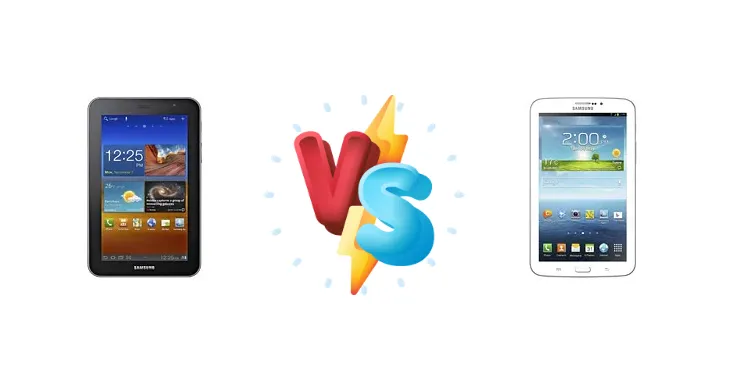
The Samsung Galaxy Tab 7.0 Plus and Tab 3 7.0 were both popular choices for those seeking a compact Android tablet. But with different processors and features, which one holds up best today? This comparison dives deep into their specs and performance to help you decide.
🏆 Quick Verdict
The Galaxy Tab 7.0 Plus edges out the Tab 3 7.0 thanks to its significantly better battery life and superior contrast ratio on the display. While both offer similar processing power, the Plus's longevity and visual quality make it the slightly better choice for most users.
| Network |
|---|
| 2G bands | GSM 850 / 900 / 1800 / 1900 | GSM 850 / 900 / 1800 / 1900 - SM-T211, SM-T215 |
| 3G bands | HSDPA 900 / 1900 / 2100 | HSDPA 850 / 900 / 1900 / 2100 - SM-T211, SM-T215 |
| 4G bands | - | 3, 7 - SM-T215 |
| Speed | HSPA 21.1/5.76 Mbps | HSPA 21.1/5.76 Mbps, LTE Cat3 100/50 Mbps (SM-T215) |
| Technology | GSM / HSPA | GSM / HSPA / LTE |
| Launch |
|---|
| Announced | 2011, September. Released 2011, October | 2013, April. Released 2013, July |
| Status | Discontinued | Discontinued |
| Body |
|---|
| Dimensions | 193.7 x 122.4 x 9.9 mm (7.63 x 4.82 x 0.39 in) | 188 x 111.1 x 9.9 mm (7.40 x 4.37 x 0.39 in) |
| SIM | Mini-SIM | Micro-SIM |
| Weight | 345 g (12.17 oz) | 306 g (10.79 oz) |
| Display |
|---|
| Resolution | 600 x 1024 pixels, 16:9 ratio (~170 ppi density) | 600 x 1024 pixels, 16:9 ratio (~170 ppi density) |
| Size | 7.0 inches, 137.9 cm2 (~58.2% screen-to-body ratio) | 7.0 inches, 137.9 cm2 (~66.0% screen-to-body ratio) |
| Type | PLS LCD | TFT |
| Platform |
|---|
| CPU | Dual-core 1.2 GHz Cortex-A9 | Dual-core 1.2 GHz Cortex-A9 |
| Chipset | Exynos 4210 | Marvell PXA986 |
| GPU | Mali-400MP4 | PowerVR SGX540 |
| OS | Android 3.2 (Honeycomb), upgradable to 4.1 (Jelly Bean), TouchWiz UX UI | Android 4.1.2 (Jelly Bean), TouchWiz UX UI |
| Memory |
|---|
| Card slot | microSDXC (dedicated slot) | microSDXC (dedicated slot) |
| Internal | 16GB 1GB RAM, 32GB 1GB RAM | 8GB 1GB RAM, 16GB 1GB RAM |
| Main Camera |
|---|
| Features | LED flash | - |
| Single | 3.15 MP, AF | 3.15 MP |
| Video | 720p@30fps | 720p@30fps |
| Selfie camera |
|---|
| Single | 2 MP | 1.3 MP |
| Sound |
|---|
| 3.5mm jack | Yes | Yes |
| 35mm jack | Yes | Yes |
| Loudspeaker | Yes, with stereo speakers | Yes |
| Comms |
|---|
| Bluetooth | 3.0, A2DP, aptX | 3.0, A2DP |
| Infrared port | Yes | Yes |
| NFC | - | No |
| Positioning | GPS, A-GPS | GPS, GLONASS |
| Radio | No | No |
| USB | 2.0 (TV-out), OTG | 2.0 (TV-out) |
| WLAN | Wi-Fi 802.11 a/b/g/n, dual-band, Wi-Fi Direct, DLNA, hotspot | Wi-Fi 802.11 a/b/g/n, dual-band, Wi-Fi Direct, DLNA, hotspot |
| Features |
|---|
| Sensors | Accelerometer, gyro, proximity, compass | Accelerometer, gyro, proximity, compass |
| Battery |
|---|
| Music play | - | Up to 108 h |
| Stand-by | Up to 1000 h (2G) / Up to 1000 h (3G) | - |
| Talk time | Up to 40 h (2G) / Up to 20 h (3G) | Up to 8 h (multimedia) |
| Type | Non-removable Li-Ion 4000 mAh battery | Li-Ion 4000 mAh, non-removable |
| Misc |
|---|
| Colors | Black, White | White |
| Models | GT-P6200 | GT-P3200, SM-T211, SM-T215, SM-T217S, SM-T217T |
| Price | About 260 EUR | About 150 EUR |
| SAR | - | 0.63 W/kg (head) 1.59 W/kg (body) |
| SAR EU | 0.71 W/kg (head) | 0.71 W/kg (head) 0.98 W/kg (body) |
| Tests |
|---|
| Audio quality |
Noise -89.5dB / Crosstalk -83.1dB | - |
| Battery life |
Endurance rating 63h
| - |
| Camera |
Photo / Video | - |
| Display |
Contrast ratio: 1236:1 (nominal) |
Contrast ratio: 1098 (nominal) |
| Loudspeaker |
Voice 66dB / Noise 65dB / Ring 65dB
| - |
Samsung P6200 Galaxy Tab 7.0 Plus
- Exceptional battery life (63h)
- Superior contrast ratio (1236:1)
- Slightly more efficient chipset (Exynos 4210)
- Older device, potential software support limitations
- Camera quality is basic
Samsung Galaxy Tab 3 7.0
- More readily available (potentially)
- Budget-friendly option
- Shorter battery life
- Lower contrast ratio (1098:1)
- Less efficient chipset (Marvell PXA986)
Display Comparison
The Galaxy Tab 7.0 Plus boasts a significantly higher contrast ratio of 1236:1 compared to the Tab 3 7.0's 1098:1. This translates to deeper blacks and more vibrant colors on the Plus, resulting in a more immersive viewing experience. Both tablets feature a 7-inch display, but the Plus's superior contrast makes a noticeable difference.
Camera Comparison
Camera specifications are similar on both devices, featuring standard photo and video capabilities for their time. Image quality is adequate for casual snapshots, but neither tablet excels in this area. Don't expect high-resolution photos or videos from either device.
Performance
Both tablets are powered by a dual-core 1.2 GHz Cortex-A9 CPU. However, the Tab 7.0 Plus utilizes an Exynos 4210 chipset, generally considered slightly more efficient than the Tab 3 7.0's Marvell PXA986. Real-world performance will likely feel similar for basic tasks, but the Plus might handle slightly more demanding apps with a bit more grace.
Battery Life
This is where the Galaxy Tab 7.0 Plus truly shines. It boasts an endurance rating of 63 hours, a substantial advantage over the Tab 3 7.0. This means significantly longer usage between charges, making it a more practical choice for extended use.
Buying Guide
The Samsung Galaxy Tab 7.0 Plus is ideal for users prioritizing long battery life and a vibrant display for media consumption. The Galaxy Tab 3 7.0 might appeal to those seeking a budget-friendly option, but be prepared for shorter battery life and a less impressive screen.
Frequently Asked Questions
❓ Are these tablets still receiving software updates?
Both tablets are quite old, and official software updates are unlikely. You might find custom ROMs available for advanced users, but this is not guaranteed.
❓ Which tablet is better for watching videos?
The Galaxy Tab 7.0 Plus is the better choice for video watching due to its superior contrast ratio, which provides a more vibrant and immersive viewing experience.