
Samsung Galaxy S4 vs. iPhone 6s: A Throwback Tech Showdown
| Phones Images | |||||
|---|---|---|---|---|---|
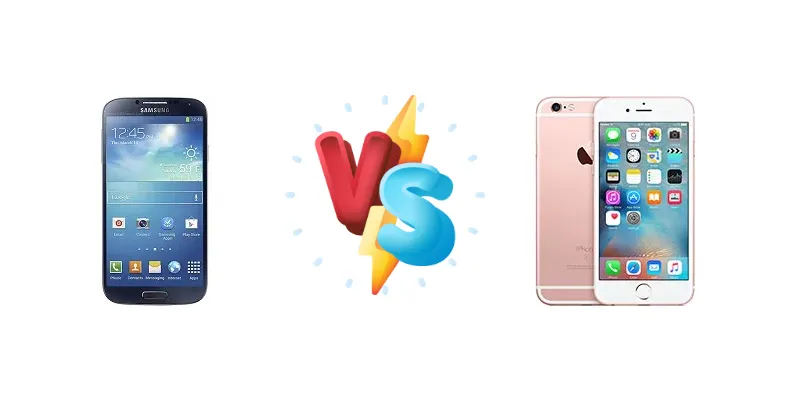
|
🏆 Quick Verdict
The Galaxy S4 edges out the iPhone 6s with a slightly better endurance rating and a potentially superior sunlight display. However, the iPhone 6s benefits from Apple's ecosystem and generally smoother software experience, making the choice dependent on user preference and priorities.
| PHONES | ||
|---|---|---|
| Phone Names | Samsung I9505 Galaxy S4 | Apple iPhone 6s |
| Network | ||
|---|---|---|
| 2G bands | GSM 850 / 900 / 1800 / 1900 - all versions | GSM 850 / 900 / 1800 / 1900 |
| 3G bands | HSDPA 850 / 900 / 1900 / 2100 | HSDPA 850 / 900 / 1700 / 1900 / 2100 |
| 4G bands | 1, 3, 5, 7, 8, 20 | 1, 2, 3, 4, 5, 7, 8, 12, 13, 17, 18, 19, 20, 25, 26, 28, 29 - A1688 |
| Speed | HSPA 42.2/5.76 Mbps, LTE Cat3 100/50 Mbps | HSPA 42.2/5.76 Mbps, LTE (2CA) Cat6 300/50 Mbps, EV-DO Rev.A 3.1 Mbps |
| Technology | GSM / HSPA / LTE | GSM / CDMA / HSPA / EVDO / LTE |
| 1, 2, 4, 5, 7, 17 - SGH-i337 | 1, 2, 3, 4, 5, 7, 8, 12, 13, 17, 18, 19, 20, 25, 26, 28, 29, 30, 38, 39, 40, 41 - A1687 | |
| Launch | ||
|---|---|---|
| Announced | 2013, March. Released 2013, April | 2015, September 09. Released 2015, September 25 |
| Status | Discontinued | Discontinued |
| Body | ||
|---|---|---|
| Build | Glass front (Gorilla Glass 3), plastic back, plastic frame | Glass front (Corning-made glass), aluminum back, aluminum frame |
| Dimensions | 136.6 x 69.8 x 7.9 mm (5.38 x 2.75 x 0.31 in) | 138.3 x 67.1 x 7.1 mm (5.44 x 2.64 x 0.28 in) |
| SIM | Micro-SIM | Nano-SIM |
| Weight | 130 g (4.59 oz) | 143 g (5.04 oz) |
| - | Apple Pay (Visa, MasterCard, AMEX certified) | |
| Display | ||
|---|---|---|
| Protection | Corning Gorilla Glass 3 | Ion-strengthened glass, oleophobic coating |
| Resolution | 1080 x 1920 pixels, 16:9 ratio (~441 ppi density) | 750 x 1334 pixels, 16:9 ratio (~326 ppi density) |
| Size | 5.0 inches, 68.9 cm2 (~72.3% screen-to-body ratio) | 4.7 inches, 60.9 cm2 (~65.6% screen-to-body ratio) |
| Type | Super AMOLED | IPS LCD, 500 nits |
| - | 3D Touch | |
| Platform | ||
|---|---|---|
| CPU | Quad-core 1.9 GHz Krait 300 | Dual-core 1.84 GHz Twister |
| Chipset | Qualcomm APQ8064T Snapdragon 600 | Apple A9 (14/16 nm - maker dependant) |
| GPU | Adreno 320 | PowerVR GT7600 (six-core graphics) |
| OS | Android 4.2.2 (Jelly Bean), upgradable to 5.0 (Lollipop), TouchWiz UI | iOS 9, upgradable to iOS 15.8.5 |
| Memory | ||
|---|---|---|
| Card slot | microSDXC (dedicated slot) | No |
| Internal | 16GB 2GB RAM, 32GB 2GB RAM, 64GB 2GB RAM | 16GB 2GB RAM, 32GB 2GB RAM, 64GB 2GB RAM, 128GB 2GB RAM |
| Main Camera | ||
|---|---|---|
| Features | LED flash, HDR | Dual-LED dual-tone flash, HDR |
| Single | 13 MP, f/2.2, 31mm (standard), 1/3.1", 1.14µm, AF | 12 MP, f/2.2, 29mm (standard), 1/3.0", 1.22µm, PDAF |
| Video | 1080p@30fps | 4K@30fps, 1080p@60fps,1080p@120fps, 720p@240fps |
| Selfie camera | ||
|---|---|---|
| Features | Dual video call | Face detection, HDR, panorama |
| Single | 2 MP, f/2.4, 31mm (standard) | 5 MP, f/2.2, 31mm (standard) |
| Video | 1080p@30fps | 720p@30fps |
| Sound | ||
|---|---|---|
| 3.5mm jack | Yes | Yes |
| 35mm jack | Yes | Yes |
| Loudspeaker | Yes | Yes |
| - | 16-bit/44.1kHz audio | |
| Comms | ||
|---|---|---|
| Bluetooth | 4.0, A2DP, EDR, LE, aptX | 4.2, A2DP, LE |
| Infrared port | Yes | - |
| NFC | Yes | Yes (Apple Pay only) |
| Positioning | GPS, GLONASS | GPS, GLONASS, GALILEO, QZSS |
| Radio | No | No |
| USB | microUSB 2.0 (MHL 2 TV-out), OTG | Lightning, USB 2.0 |
| WLAN | Wi-Fi 802.11 a/b/g/n/ac, dual-band, Wi-Fi Direct, DLNA, hotspot | Wi-Fi 802.11 a/b/g/n/ac, dual-band, hotspot |
| Features | ||
|---|---|---|
| Sensors | Accelerometer, gyro, proximity, compass, barometer, temperature, humidity, gesture | Fingerprint (front-mounted), accelerometer, gyro, proximity, compass, barometer |
| ANT+ S-Voice natural language commands and dictation Air gestures | - | |
| Battery | ||
|---|---|---|
| Charging | Wireless (Qi) (market dependent) | - |
| Music play | Up to 62 h | - |
| Stand-by | Up to 350 h (3G) | Up to 240 h (3G) |
| Talk time | Up to 17 h (3G) | Up to 14 h (3G) |
| Type | Li-Ion 2600 mAh, removable | Li-Ion 1715 mAh, non-removable (6.91 Wh) |
| Misc | ||
|---|---|---|
| Colors | White Frost, Black Mist, Aurora Red (AT&T only), Arctic Blue, Purple Mirage, Brown Autumn, Pink Twilight, Black Edition | Space Gray, Silver, Gold, Rose Gold |
| Models | GT-I9505, GT-I9515, SGH-I337, SC-04E, GT-I9515L | A1633, A1688, A1691, A1700, iPhone8,1 |
| Price | About 330 EUR | About 230 EUR |
| SAR | 0.77 W/kg (head) 1.17 W/kg (body) | 1.14 W/kg (head) 1.14 W/kg (body) |
| SAR EU | 0.28 W/kg (head) 0.40 W/kg (body) | 0.87 W/kg (head) 0.98 W/kg (body) |
| Tests | ||
|---|---|---|
| Audio quality | Noise -95.9dB / Crosstalk -96.4dB | Noise -93.8dB / Crosstalk -73.2dB |
| Battery life | Endurance rating 69h | Endurance rating 62h |
| Camera | Photo / Video | Photo / Video |
| Display | Contrast ratio: Infinite (nominal) / 3.352:1 (sunlight) | Contrast ratio: 1481 (nominal), 3.783 (sunlight) |
| Loudspeaker | Voice 70dB / Noise 66dB / Ring 77dB | Voice 66dB / Noise 64dB / Ring 65dB |
| Performance | - | Basemark OS II 2.0: 2195 |
Samsung I9505 Galaxy S4
- Excellent battery life
- Vibrant display (especially indoors)
- Wireless charging (market dependent)
- Expandable storage via microSD
- Older chipset shows its age
- Camera can be inconsistent
- Software updates discontinued
- Plastic build feels less premium
Apple iPhone 6s
- Smoother software experience (iOS)
- Better performance for gaming
- More consistent camera results
- Strong resale value (relatively)
- Apple ecosystem integration
- Shorter battery life than S4
- Non-expandable storage
- Older design
- Software updates discontinued
Display Comparison
Both phones feature excellent displays for their era. The S4 boasts a nominal 'infinite' contrast ratio, though the sunlight readability is rated at 3.352:1. The iPhone 6s has a contrast ratio of 1481:1 (nominal) and 3.783:1 in sunlight, suggesting slightly better outdoor visibility. The S4's display is known for its vibrant colors, while the iPhone 6s offers accurate color reproduction.
Camera Comparison
Camera quality was a key differentiator. While both offer Photo/Video capabilities, the iPhone 6s generally produced more consistent and pleasing results, particularly in low light. The S4's camera was prone to over-saturation. Both cameras are adequate for casual photography but lack the features and image quality of modern smartphones.
Performance
The Galaxy S4's Snapdragon 600 chipset with a quad-core 1.9 GHz Krait 300 CPU provides respectable performance, though it shows its age compared to modern devices. The iPhone 6s's dual-core 1.84 GHz Twister chip, powered by the A9 chip, is surprisingly efficient and offers a smoother overall experience, benefiting from Apple's optimized software. Gaming performance will be noticeably better on the iPhone 6s.
Battery Life
The Galaxy S4 takes a slight lead in battery endurance with a reported 69h rating, compared to the iPhone 6s's 62h. However, real-world usage will vary depending on usage patterns and battery health (given their age).
Buying Guide
The Samsung Galaxy S4 is ideal for users prioritizing battery life and a vibrant display, especially in bright conditions. The iPhone 6s is a better choice for those invested in the Apple ecosystem, valuing ease of use and a more polished software experience, even with older hardware.