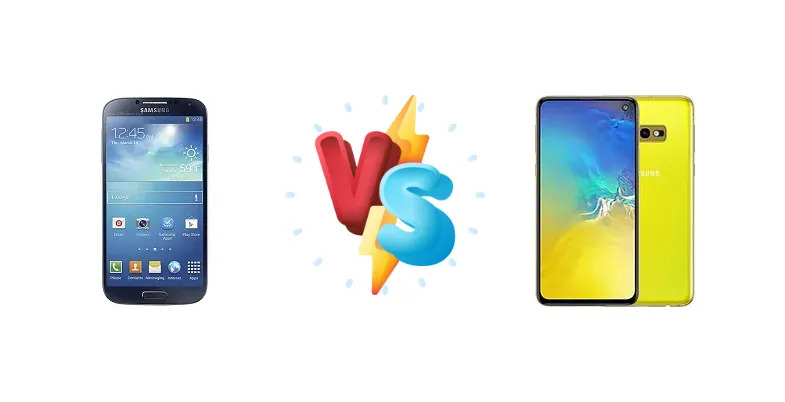
The Samsung Galaxy S4 was a groundbreaking phone in its time, setting a new standard for Android devices. Now, let's see how it stacks up against the much newer Galaxy S10e. This comparison will explore design, performance, camera capabilities, and overall value to help you decide which phone is right for you.
🏆 Quick Verdict
The Galaxy S10e is the clear winner. While the S4 holds nostalgic value, the S10e boasts significantly improved performance, a superior camera, a modern design, and longer battery life. It's a substantial upgrade across the board, justifying its existence even today.
| Network |
|---|
| 2G bands | GSM 850 / 900 / 1800 / 1900 | GSM 850 / 900 / 1800 / 1900 |
| 3G bands | HSDPA 850 / 900 / 1900 / 2100 | HSDPA 850 / 900 / 1700(AWS) / 1900 / 2100 - Global, USA |
| 4G bands | - | 1, 2, 3, 4, 5, 7, 8, 12, 13, 17, 18, 19, 20, 25, 26, 28, 32, 38, 39, 40, 41, 66 - Global |
| EDGE | Yes | - |
| GPRS | Yes | - |
| Speed | HSPA 42.2/5.76 Mbps | HSPA 42.2/5.76 Mbps, LTE (7CA) Cat20 2000/150 Mbps |
| Technology | GSM / HSPA | GSM / CDMA / HSPA / EVDO / LTE |
| | - | 1, 2, 3, 4, 5, 7, 8, 12, 13, 14, 17, 18, 19, 20, 25, 26, 28, 29, 30, 38, 39, 40, 41, 46, 66, 71 - USA |
| Launch |
|---|
| Announced | 2013, March. Released 2013, April | 2019, February 20. Released 2019, March 08 |
| Status | Discontinued | Discontinued |
| Body |
|---|
| Build | Glass front (Gorilla Glass 3), plastic back, plastic frame | Glass front (Gorilla Glass 5), glass back (Gorilla Glass 5), aluminum frame |
| Dimensions | 136.6 x 69.8 x 7.9 mm (5.38 x 2.75 x 0.31 in) | 142.2 x 69.9 x 7.9 mm (5.60 x 2.75 x 0.31 in) |
| SIM | Micro-SIM | · Nano-SIM· Nano-SIM + Nano-SIM |
| Weight | 130 g (4.59 oz) | 150 g (5.29 oz) |
| | - | IP68 dust/water resistant (up to 1.5m for 30 min) |
| Display |
|---|
| Protection | Corning Gorilla Glass 3 | Corning Gorilla Glass 5 |
| Resolution | 1080 x 1920 pixels, 16:9 ratio (~441 ppi density) | 1080 x 2280 pixels, 19:9 ratio (~438 ppi density) |
| Size | 5.0 inches, 68.9 cm2 (~72.3% screen-to-body ratio) | 5.8 inches, 82.8 cm2 (~83.3% screen-to-body ratio) |
| Type | Super AMOLED | Dynamic AMOLED, HDR10+ |
| | - | Always-on display |
| Platform |
|---|
| CPU | Octa-core (4x1.6 GHz Cortex-A15 & 4x1.2 GHz Cortex-A7) | Octa-core (2x2.73 GHz Mongoose M4 & 2x2.31 GHz Cortex-A75 & 4x1.95 GHz Cortex-A55) - EMEA/LATAMOcta-core (1x2.84 GHz Kryo 485 & 3x2.42 GHz Kryo 485 & 4x1.78 GHz Kryo 485) - USA/China |
| Chipset | Exynos 5410 Octa (28 nm) | Exynos 9820 (8 nm) - EMEA/LATAMQualcomm SM8150 Snapdragon 855 (7 nm) - USA/China |
| GPU | PowerVR SGX544MP3 | Mali-G76 MP12 - EMEA/LATAM Adreno 640 - USA/China |
| OS | Android 4.2.2 (Jelly Bean), upgradable to 5.0.1 (Lollipop), TouchWiz UI | Android 9.0 (Pie), upgradable to Android 12, One UI 4.1 |
| Memory |
|---|
| Call records | Yes | - |
| Card slot | microSDXC (dedicated slot) | microSDXC (uses shared SIM slot) - dual SIM model only |
| Internal | 16GB 2GB RAM, 32GB 2GB RAM, 64GB 2GB RAM | 128GB 6GB RAM, 128GB 8GB RAM, 256GB 8GB RAM |
| Phonebook | 2000 entries | - |
| | eMMC 5.0 | UFS 2.1 |
| Main Camera |
|---|
| Dual | - | 12 MP, f/1.5-2.4, 26mm (wide), 1/2.55", 1.4µm, dual pixel PDAF, OIS
16 MP, f/2.2, 12mm (ultrawide), 1/3.1", 1.0µm, Super Steady video |
| Features | LED flash, HDR | LED flash, auto-HDR, panorama |
| Single | 13 MP, f/2.2, 31mm (standard), 1/3.1", 1.14µm, AF | - |
| Video | 1080p@30fps | 4K@60fps (no EIS), 4K@30fps, 1080p@30/60/240fps, 720p@960fps, HDR10+, stereo sound rec., gyro-EIS & OIS |
| Selfie camera |
|---|
| Features | Dual video call | HDR |
| Single | 2 MP, f/2.4, 31mm (standard) | 10 MP, f/1.9, 26mm (wide), 1/3", 1.22µm, dual pixel PDAF |
| Video | 1080p@30fps | 4K@30/60fps, 1080p@30fps |
| Sound |
|---|
| 3.5mm jack | Yes | Yes |
| 35mm jack | Yes | Yes |
| Loudspeaker | Yes | Yes, with stereo speakers |
| | - | 32-bit/384kHz audio
Tuned by AKG |
| Comms |
|---|
| Bluetooth | 4.0, A2DP, EDR, LE, aptX | 5.0, A2DP, LE, aptX |
| Infrared port | Yes | - |
| NFC | Yes | Yes |
| Positioning | GPS, GLONASS | GPS, GLONASS, BDS, GALILEO |
| Radio | No | FM radio (USA & Canada only) |
| USB | microUSB 2.0 (MHL 2 TV-out), OTG | USB Type-C 3.1 |
| WLAN | Wi-Fi 802.11 a/b/g/n/ac, dual-band, Wi-Fi Direct, DLNA, hotspot | Wi-Fi 802.11 a/b/g/n/ac/6, dual-band, Wi-Fi Direct |
| Features |
|---|
| Games | Downloadable | - |
| Java | Yes | - |
| Messaging | SMS(threaded view), MMS, Email, IM | - |
| Sensors | Accelerometer, gyro, proximity, compass, barometer, temperature, humidity, gesture | Fingerprint (side-mounted), accelerometer, gyro, proximity, compass, barometer |
| | ANT+
S-Voice natural language commands and dictation
Air gestures | ANT+
Bixby natural language commands and dictation
Samsung Pay (Visa, MasterCard certified) |
| Battery |
|---|
| Charging | Wireless (Qi) (market dependent) | 15W wired, PD2.0
15W wireless (Qi)
4.5W reverse wireless |
| Music play | Up to 62 h | - |
| Stand-by | Up to 370 h (3G) | - |
| Talk time | Up to 17 h (3G) | - |
| Type | Li-Ion 2600 mAh, removable | Li-Ion 3100 mAh, non-removable |
| Misc |
|---|
| Colors | White Frost, Black Mist, Arctic Blue, Black Edition | Prism White, Prism Black, Prism Green, Prism Blue, Canary Yellow, Flamingo Pink |
| Models | GT-I9500, SGH-I337M, SGH-M919, GT-I9507V, SHV-E330L, SPH-L720T, SHV-E300S, SHV-E300L, SHV-E300K, GT-I9507, SGH-M919N | SM-G970F, SM-G970U, SM-G970W, SM-G9700, SM-G970U1, SM-G970N, SM-G970X |
| Price | About 320 EUR | About 130 EUR |
| SAR | 0.85 W/kg (head) 1.55 W/kg (body) | 0.56 W/kg (head) 0.70 W/kg (body) |
| SAR EU | 0.42 W/kg (head) 0.54 W/kg (body) | 0.58 W/kg (head) 1.57 W/kg (body) |
| Tests |
|---|
| Audio quality |
Noise -95.9dB / Crosstalk -96.4dB |
Noise -92.9dB / Crosstalk -89.4dB |
| Battery life |
Endurance rating 65h
|
Endurance rating 83h
|
| Camera |
Photo / Video |
Photo / Video |
| Display |
Contrast ratio: Infinite (nominal) / 3.352:1 (sunlight) |
Contrast ratio: infinite |
| Loudspeaker |
Voice 70dB / Noise 66dB / Ring 77dB
|
Voice 71dB / Noise 76dB / Ring 80dB
|
| Performance | - |
AnTuTu: 325192 (v7), 389694 (v8)
GeekBench: 10081 (v4.4), 2141 (v5.1)
GFXBench: 40fps (ES 3.1 onscreen) |
Samsung I9500 Galaxy S4
- Affordable
- Compact size
- Wireless charging (market dependent)
- Nostalgic appeal
- Outdated performance
- Lower resolution display
- Less impressive camera
- Shorter battery life
- No modern features
Samsung Galaxy S10e
- Excellent performance
- Vibrant AMOLED display
- Superior camera
- Longer battery life
- Modern features (reverse wireless charging, fast charging)
- Compact and premium design
- Can be more expensive (depending on condition)
- Older model - software support may be limited
Display Comparison
The Galaxy S10e's display is a significant leap forward. While both boast 'infinite' contrast ratios (likely a marketing term), the S10e features a vibrant AMOLED panel with higher resolution and better color accuracy. The S4's LCD screen, while decent for its time, simply can't compete with the S10e's visual fidelity and brightness.
Camera Comparison
The S10e's camera system is a major upgrade. It offers better image quality, improved low-light performance, and more versatile shooting modes. The S4's camera was good for its time, but it lacks the detail, dynamic range, and features of the S10e.
Performance
The S10e's chipset (Exynos 9820 or Snapdragon 855) and CPU are vastly superior to the S4's Exynos 5410 Octa. The S10e handles demanding apps and games with ease, while the S4 can feel sluggish at times. The S10e's newer architecture and fabrication process (8nm vs 28nm) contribute to both performance and efficiency.
Battery Life
The S10e provides significantly better battery life, with an endurance rating of 83h compared to the S4's 65h. The S10e also supports faster charging and reverse wireless charging, further enhancing its convenience.
Buying Guide
Who should buy the Samsung Galaxy S4? Primarily those seeking a budget-friendly, functional Android phone for basic tasks or those with a strong nostalgic attachment to older Samsung devices. Who should buy the Samsung Galaxy S10e? Anyone looking for a reliable, modern smartphone with a great camera, fast performance, and a compact design – especially if found at a discounted price.
Frequently Asked Questions
❓ Is the Galaxy S4 still usable in 2024?
Yes, the Galaxy S4 is still functional for basic tasks like calling, texting, and browsing. However, its outdated hardware and software limit its capabilities and security.
❓ What are the main differences between the Galaxy S4 and S10e?
The S10e offers a significantly faster processor, a better display, a superior camera, longer battery life, and modern features like fast charging and reverse wireless charging. The S4 is older and lacks these advancements.