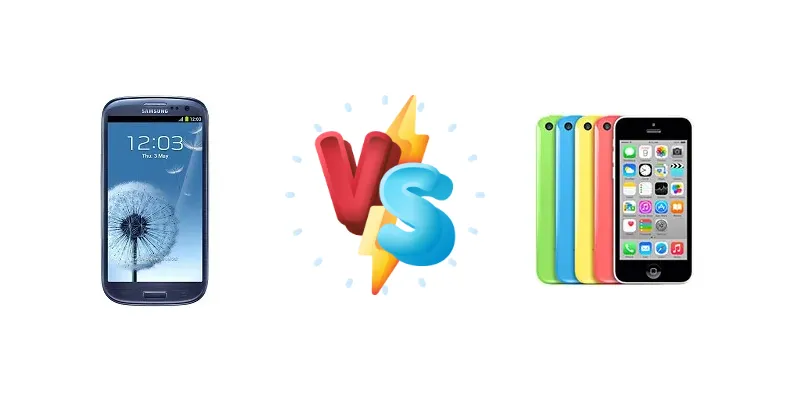
Remember when these phones ruled the world? The Samsung Galaxy S III and Apple iPhone 5c were flagship devices in their time, representing the pinnacle of mobile technology. Today, they're relics of a bygone era, but are they still usable? Let's dive into a detailed comparison to see which one holds up best.
🏆 Quick Verdict
The iPhone 5c edges out the Galaxy S III with slightly better battery life and a more consistent user experience, despite the S III's powerful quad-core processor. Both offer a nostalgic trip, but the 5c's iOS ecosystem and slightly improved endurance give it a narrow victory.
| Network |
|---|
| 2G bands | GSM 850 / 900 / 1800 / 1900 | GSM 850 / 900 / 1800 / 1900 - all versions |
| 3G bands | HSDPA 850 / 900 / 1900 / 2100 | HSDPA 850 / 900 / 1700 / 1900 / 2100 - A1532 (GSM), A1532 (CDMA), A1456 |
| 4G bands | - | 1, 2, 3, 4, 5, 8, 13, 17, 19, 20, 25 - A1532 GSM, A1532 CDMA |
| Speed | HSPA 21.1/5.76 Mbps | HSPA 42.2/5.76 Mbps, LTE Cat3 100/50 Mbps, EV-DO Rev.A 3.1 Mbps |
| Technology | GSM / HSPA | GSM / CDMA / HSPA / LTE |
| | - | 1, 2, 3, 5, 7, 8, 20, 38, 39, 40 - A1529 |
| Launch |
|---|
| Announced | 2012, May. Released 2012, May | 2013, September 10. Released 2013, September 20 |
| Status | Discontinued | Discontinued |
| Body |
|---|
| Build | Glass front (Gorilla Glass 2), plastic back, plastic frame | Glass front, plastic back, plastic frame |
| Dimensions | 136.6 x 70.6 x 8.6 mm (5.38 x 2.78 x 0.34 in) | 124.4 x 59.2 x 9 mm (4.90 x 2.33 x 0.35 in) |
| SIM | Micro-SIM | Nano-SIM |
| Weight | 133 g (4.69 oz) | 132 g (4.66 oz) |
| Display |
|---|
| Protection | Corning Gorilla Glass 2 | - |
| Resolution | 720 x 1280 pixels, 16:9 ratio (~306 ppi density) | 640 x 1136 pixels, 16:9 ratio (~326 ppi density) |
| Size | 4.8 inches, 63.5 cm2 (~65.9% screen-to-body ratio) | 4.0 inches, 44.1 cm2 (~59.9% screen-to-body ratio) |
| Type | Super AMOLED | IPS LCD |
| Platform |
|---|
| CPU | Quad-core 1.4 GHz Cortex-A9 | Dual-core 1.3 GHz Swift (ARM v7-based) |
| Chipset | Exynos 4412 Quad (32 nm) | Apple A6 (32 nm) |
| GPU | Mali-400MP4 | PowerVR SGX 543MP3 (triple-core graphics) |
| OS | Android 4.0.4 (Ice Cream Sandwich), 4.3 (Jelly Bean), TouchWiz UI | iOS 7, upgradable to iOS 10.3.3 |
| Memory |
|---|
| Card slot | microSDXC (dedicated slot) | No |
| Internal | 16GB 1GB RAM, 32GB 1GB RAM, 64GB 1GB RAM | 8GB 1GB RAM, 16GB 1GB RAM, 32GB 1GB RAM |
| Main Camera |
|---|
| Features | LED flash | LED flash, panorama, HDR |
| Single | 8 MP, f/2.6, 1/3.0", AF | 8 MP, f/2.4, 33mm (standard), 1/3.2", 1.4µm, AF |
| Video | 1080p@30fps | 1080p@30fps |
| Selfie camera |
|---|
| Features | - | face detection, FaceTime over Wi-Fi or Cellular |
| Single | 1.9 MP, f/2.6 | 1.2 MP |
| Video | 720p@30fps | 720p@30fps |
| Sound |
|---|
| 3.5mm jack | Yes | Yes |
| 35mm jack | Yes | Yes |
| Loudspeaker | Yes | Yes |
| | - | 16-bit/44.1kHz audio
|
| Comms |
|---|
| Bluetooth | 4.0, A2DP, EDR, aptX | 4.0, A2DP, LE |
| NFC | Yes | No |
| Positioning | GPS, A-GPS, GLONASS | GPS, GLONASS |
| Radio | Stereo FM radio, RDS | No |
| USB | microUSB 2.0 (MHL TV-out), OTG | Lightning, USB 2.0 |
| WLAN | Wi-Fi 802.11 a/b/g/n, dual-band, Wi-Fi Direct, DLNA, hotspot | Wi-Fi 802.11 a/b/g/n, dual-band |
| Features |
|---|
| Sensors | Accelerometer, gyro, proximity, compass, barometer | Accelerometer, gyro, proximity, compass |
| | S-Voice natural language commands and dictation | - |
| Battery |
|---|
| Stand-by | Up to 590 h (2G) / Up to 790 h (3G) | Up to 250 h (3G) |
| Talk time | Up to 21 h 40 min (2G) / Up to 11 h 40 min (3G) | Up to 10 h (3G) |
| Type | Removable Li-Ion 2100 mAh battery | Li-Po 1510 mAh, non-removable (5.73 Wh) |
| Misc |
|---|
| Colors | Pebble blue, Marble white, Amber brown, Garnet red, Sapphire black, Titanium grey, La Fleur | White, Blue, Green, Yellow, Pink |
| Models | GT-I9300, GT-I9300I, SHV-E210S, SHW-M440S | A1456, A1507, A1516, A1529, A1532, iPhone5,3, iPhone5,4 |
| Price | About 190 EUR | About 300 EUR |
| SAR | 0.55 W/kg (head) 1.49 W/kg (body) | 1.15 W/kg (head) 1.17 W/kg (body) |
| SAR EU | 0.21 W/kg (head) | 1.00 W/kg (head) 0.96 W/kg (body) |
| Tests |
|---|
| Audio quality |
Noise -90.3dB / Crosstalk -92.6dB |
Noise -93.9dB / Crosstalk -80.3dB |
| Battery life |
Endurance rating 50h
|
Endurance rating 52h
|
| Camera |
Photo / Video |
Photo / Video |
| Display |
Contrast ratio: Infinite (nominal) / 3.419:1 (sunlight) |
Contrast ratio: 1233:1 (nominal) / 3.512:1 (sunlight) |
| Loudspeaker |
Voice 75dB / Noise 66dB / Ring 75dB
|
Voice 66dB / Noise 65dB / Ring 66dB
|
| Performance | - |
Basemark X: 2225 |
Samsung I9300 Galaxy S III
- Powerful Quad-Core Processor
- Vibrant Super AMOLED Display
- Android Customization
- Larger Screen (4.8 inches)
- Dated Camera
- Older Software Support
- Battery Degradation Likely
- Plastic Build
Apple iPhone 5c
- Optimized iOS Performance
- Apple Ecosystem Integration
- Slightly Better Battery Life
- More Consistent Software Updates (Historically)
- Less Customization
- Smaller Screen (4 inches)
- Dated Camera
- Plastic Build
Display Comparison
Both phones feature displays that were impressive for their time. The Galaxy S III boasts a vibrant Super AMOLED display, known for its deep blacks and excellent contrast (though the 'infinite' contrast ratio is a marketing term). The iPhone 5c's Retina display offers accurate colors and good viewing angles. Sunlight readability is comparable, with the iPhone 5c having a slightly better rating (3.512:1 vs 3.419:1).
Camera Comparison
Camera quality on both devices is dated by today's standards. The Galaxy S III offers a slightly higher megapixel count, but image quality is generally comparable. Both struggle in low-light conditions. Video recording capabilities are similar, offering 1080p resolution.
Performance
The Galaxy S III's Exynos 4412 Quad processor was a powerhouse in 2012, featuring a quad-core design. However, the iPhone 5c's dual-core A6 chip, while seemingly less powerful on paper, benefits from Apple's optimized iOS, often resulting in smoother performance in everyday tasks. App compatibility is also a factor, with iOS generally having better support for older apps.
Battery Life
Battery life is surprisingly close. Both devices achieve an endurance rating of around 50-52 hours. The iPhone 5c's slightly better rating gives it a small advantage in this category.
Buying Guide
The Samsung Galaxy S III is for those who appreciate Android's customization options and a powerful processor, and don't mind an older device. The Apple iPhone 5c is ideal for users already invested in the Apple ecosystem or those seeking a simple, reliable phone with iOS.
Frequently Asked Questions
❓ Are these phones still secure to use?
Security updates for both devices have long ceased. Using them for sensitive tasks is not recommended. They are best suited for basic communication and entertainment.
❓ Can I still find apps for these phones?
Yes, but app compatibility is limited. Many newer apps will not be available. Both phones can still access their respective app stores, but the selection is significantly reduced.