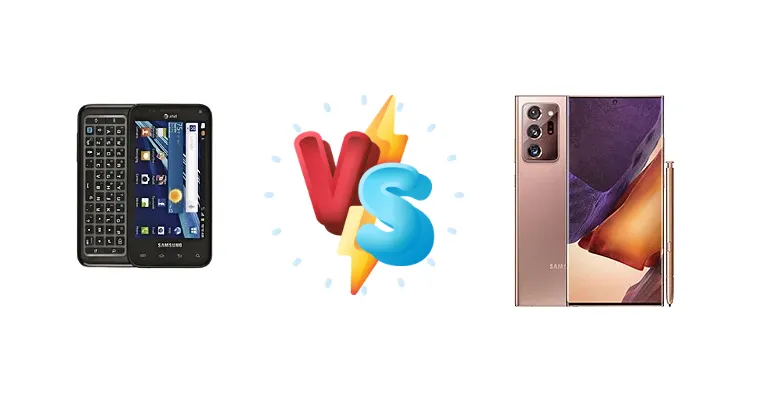
The Samsung Captivate Glide, a relic of 2010, offered a glimpse into the future of smartphones. Now, let's pit it against the powerhouse that is the Samsung Galaxy Note20 Ultra 5G, a device representing cutting-edge technology. This comparison will highlight just how far mobile technology has advanced.
🏆 Quick Verdict
The Galaxy Note20 Ultra 5G utterly dominates this comparison. While the Captivate Glide was impressive for its time, the Note20 Ultra boasts superior performance, a vastly improved camera, a stunning display, and significantly longer battery life. It's a generational upgrade.
| Network |
|---|
| 2G bands | GSM 850 / 900 / 1800 / 1900 | GSM 850 / 900 / 1800 / 1900 |
| 3G bands | HSDPA 850 / 1900 / 2100 | HSDPA 850 / 900 / 1700(AWS) / 1900 / 2100 |
| 4G bands | - | 1, 2, 3, 4, 5, 7, 8, 12, 13, 14, 18, 19, 20, 25, 26, 28, 29, 30, 38, 39, 40, 41, 46, 48, 66, 71 - SM-N986U |
| 5G bands | - | 2, 5, 41, 66, 71, 260, 261 SA/NSA/Sub6/mmWave - SM-N986U |
| Speed | HSPA 21.1/5.76 Mbps | HSPA 42.2/5.76 Mbps, LTE (7CA) Cat20 2000/200 Mbps, 5G |
| Technology | GSM / HSPA | GSM / CDMA / HSPA / EVDO / LTE / 5G |
| | - | 41, 66, 71 Sub6 - SM-N986W |
| Launch |
|---|
| Announced | 2011, October. Released 2011, November | 2020, August 05 |
| Status | Discontinued | Available. Released 2020, August 21 |
| Body |
|---|
| Build | - | Glass front (Gorilla Glass Victus), glass back (Gorilla Glass Victus), stainless steel frame |
| Dimensions | 124 x 64 x 13 mm (4.88 x 2.52 x 0.51 in) | 164.8 x 77.2 x 8.1 mm (6.49 x 3.04 x 0.32 in) |
| Keyboard | QWERTY | - |
| SIM | Mini-SIM | · Nano-SIM + eSIM· Nano-SIM + Nano-SIM |
| Weight | 147 g (5.19 oz) | 208 g (7.34 oz) |
| | - | IP68 dust/water resistant (up to 1.5m for 30 min)
Stylus, 9ms latency (Bluetooth integration, accelerometer, gyro) |
| Display |
|---|
| Protection | Corning Gorilla Glass | Corning Gorilla Glass Victus |
| Resolution | 480 x 800 pixels, 5:3 ratio (~233 ppi density) | 1440 x 3088 pixels, 19.3:9 ratio (~496 ppi density) |
| Size | 4.0 inches, 45.5 cm2 (~57.4% screen-to-body ratio) | 6.9 inches, 116.7 cm2 (~91.7% screen-to-body ratio) |
| Type | Super AMOLED | Dynamic AMOLED 2X, 120Hz, HDR10+ |
| | TouchWiz UI
| Always-on display
120Hz@FHD/60Hz@QHD refresh rate |
| Platform |
|---|
| CPU | Dual-core 1.0 GHz Cortex-A9 | Octa-core (2x2.73 GHz Mongoose M5 & 2x2.50 GHz Cortex-A76 & 4x2.0 GHz Cortex-A55) - GlobalOcta-core (1x3.0 GHz Kryo 585 & 3x2.42 GHz Cortex-A77 & 4x1.80 GHz Cortex-A55) - USA |
| Chipset | Nvidia Tegra 2 AP20H | Exynos 990 (7 nm+) - GlobalQualcomm SM8250 Snapdragon 865 5G+ (7 nm+) - USA |
| GPU | ULP GeForce | Mali-G77 MP11 - GlobalAdreno 650 - USA |
| OS | Android 2.3 (Gingerbread), upgradable to 4.0 (Ice Cream Sandwich) | Android 10, upgradable to Android 13, One UI 5 |
| Memory |
|---|
| Card slot | microSDHC (dedicated slot) | microSDXC (uses shared SIM slot) |
| Internal | 8GB 1GB RAM | 128GB 6GB RAM, 128GB 8GB RAM, 128GB 12GB RAM, 256GB 8GB RAM, 256GB 12GB RAM, 512GB 12GB RAM |
| | - | UFS 3.0 |
| Main Camera |
|---|
| Features | LED flash | Laser AF, LED flash, auto-HDR, panorama |
| Single | 8 MP, AF | 3.15 MP |
| Triple | - | 108 MP, f/1.8, 26mm (wide), 1/1.33", 0.8µm, PDAF, OIS
12 MP, f/3.0, 120mm (periscope telephoto), 1.0µm, PDAF, OIS, 5x optical zoom, 50x hybrid zoom
12 MP, f/2.2, 120˚, 13mm (ultrawide), 1/2.55", 1.4µm |
| Video | 720p@30fps | 8K@24fps, 4K@30/60fps, 1080p@30/60/240fps, 720p@960fps, HDR10+, stereo sound rec., gyro-EIS & OIS |
| Selfie camera |
|---|
| Features | - | HDR |
| Single | 1.3 MP | 10 MP, f/2.2, 26mm (wide), 1/3.2", 1.22µm, dual pixel PDAF |
| Video | - | 4K@30/60fps, 1080p@30fps |
| Sound |
|---|
| 3.5mm jack | Yes | No |
| 35mm jack | Yes | No |
| Loudspeaker | Yes | Yes, with stereo speakers |
| | - | 32-bit/384kHz audio
Tuned by AKG |
| Comms |
|---|
| Bluetooth | 3.0, A2DP | 5.0, A2DP, LE, aptX |
| NFC | - | Yes |
| Positioning | GPS, A-GPS | GPS, GLONASS, BDS, GALILEO |
| Radio | No | FM radio (Snapdragon model only; market/operator dependent) |
| USB | microUSB 2.0 | USB Type-C 3.2, OTG |
| WLAN | Wi-Fi 802.11 b/g/n, DLNA, hotspot | Wi-Fi 802.11 a/b/g/n/ac/6, dual-band, Wi-Fi Direct |
| Features |
|---|
| Sensors | Accelerometer, gyro, proximity, compass | Fingerprint (under display, ultrasonic), accelerometer, gyro, proximity, compass, barometer |
| | HDMI port
MP4/DivX/WMV/H.264 player
MP3/WAV/eAAC+ player
Organizer
Photo/video editor
Document viewer
Voice memo/dial/commands
Predictive text input (Swype) | Samsung Wireless DeX (desktop experience support)
ANT+
Bixby natural language commands and dictation
Samsung Pay (Visa, MasterCard certified)
Ultra Wideband (UWB) support |
| Battery |
|---|
| Charging | - | 25W wired, PD3.0
15W wireless (Qi)
4.5W reverse wireless |
| Stand-by | Up to 396 h | - |
| Talk time | Up to 8 h | - |
| Type | Removable Li-Ion 1650 mAh battery | Li-Ion 4500 mAh |
| Misc |
|---|
| Colors | Black | Mystic Bronze, Mystic Black, Mystic White |
| Models | - | SM-N986B, SM-N986B/DS, SM-N986U, SM-N986U1, SM-N986W, SM-N9860, SM-N986N, SC-53A |
| Price | About 110 EUR | € 381.00 / $ 248.44 |
| SAR | 0.20 W/kg (head) 0.54 W/kg (body) | 0.71 W/kg (head) 1.18 W/kg (body) |
| SAR EU | - | 0.34 W/kg (head) 1.47 W/kg (body) |
| Tests |
|---|
| Battery life |
Endurance rating 39h
|
Endurance rating 88h
|
| Camera | - |
Photo / Video |
| Display | - |
Contrast ratio: Infinite (nominal) |
| Loudspeaker | - |
-27.8 LUFS (Good)
|
| Performance | - |
AnTuTu: 508760 (v8)
GeekBench: 2603 (v5.1)
GFXBench: 42fps (ES 3.1 onscreen) |
Samsung i927 Captivate Glide
- Relatively compact size
- Good build quality for its time
- Early adopter of Samsung's design language
- Extremely outdated hardware
- Poor performance by modern standards
- Limited app compatibility
- Short battery life
- Low-resolution display
Samsung Galaxy Note20 Ultra 5G
- Exceptional camera system
- Powerful performance
- Stunning display with 120Hz refresh rate
- Long battery life
- Fast charging
- 5G connectivity
- S Pen support
- Large size and weight
- Premium price
- Software bloat (typical of Samsung devices)
Display Comparison
The Note20 Ultra's display is a revelation. Its 1024 nits max brightness and infinite contrast ratio provide exceptional visibility and color accuracy. The Captivate Glide's display, while adequate for its time, pales in comparison in terms of resolution, brightness, and overall quality. The Note20 Ultra also features a 120Hz refresh rate for smoother scrolling and animations.
Camera Comparison
The Note20 Ultra's camera system is a significant upgrade. It offers a versatile setup with multiple lenses, advanced features like Space Zoom, and superior image processing. The Captivate Glide's camera was basic by today's standards, lacking the resolution, dynamic range, and low-light performance of the Note20 Ultra.
Performance
The Note20 Ultra's Octa-core CPU (either Exynos or Snapdragon) and modern chipset offer a massive performance advantage over the Captivate Glide's Dual-core Cortex-A9 processor and Nvidia Tegra 2. Expect significantly faster app loading, smoother multitasking, and the ability to handle demanding games and applications with ease. The Note20 Ultra's 7nm process is also far more efficient.
Battery Life
The Note20 Ultra's 88h endurance rating is a testament to its improved battery technology and power efficiency. The Captivate Glide's 39h rating, while decent for its era, is significantly lower. The Note20 Ultra also supports faster charging (25W wired, 15W wireless) and reverse wireless charging.
Buying Guide
Who should buy the Samsung i927 Captivate Glide? Likely no one. It's an outdated device. Who should buy the Samsung Galaxy Note20 Ultra 5G? Users seeking a premium smartphone experience with a top-tier camera, powerful performance, and a vibrant display will find the Note20 Ultra a compelling choice.
Frequently Asked Questions
❓ Is the Captivate Glide still usable?
While technically usable, the Captivate Glide is severely outdated. App compatibility is limited, and performance is slow. It's not recommended for everyday use.
❓ What are the key differences between the Exynos and Snapdragon versions of the Note20 Ultra?
The Exynos version (Global) and Snapdragon version (USA) have different chipsets. Generally, the Snapdragon version offers slightly better performance and efficiency, but both are excellent.