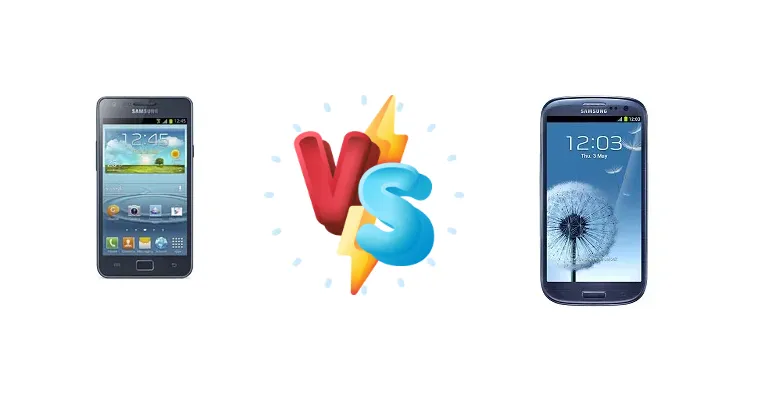
The Samsung Galaxy S II Plus and Galaxy S III were flagship devices in their time, offering cutting-edge features. While both are now considered vintage, they still hold appeal for those seeking a reliable and affordable Android experience. But which one offers the better value today? Let's dive into a detailed comparison.
🏆 Quick Verdict
The Galaxy S III clearly wins due to its significantly faster quad-core processor and improved display. While battery life is similar, the S III's superior performance and slightly better sunlight readability make it the preferable choice for most users, despite both being older devices.
| Network |
|---|
| 2G bands | GSM 850 / 900 / 1800 / 1900 | GSM 850 / 900 / 1800 / 1900 |
| 3G bands | HSDPA 850 / 900 / 1900 / 2100 | HSDPA 850 / 900 / 1900 / 2100 |
| Speed | HSPA 21.1/5.76 Mbps | HSPA 21.1/5.76 Mbps |
| Technology | GSM / HSPA | GSM / HSPA |
| Launch |
|---|
| Announced | 2013, January. Released 2013, February | 2012, May. Released 2012, May |
| Status | Discontinued | Discontinued |
| Body |
|---|
| Build | - | Glass front (Gorilla Glass 2), plastic back, plastic frame |
| Dimensions | 125.3 x 66.1 x 8.5 mm (4.93 x 2.60 x 0.33 in) | 136.6 x 70.6 x 8.6 mm (5.38 x 2.78 x 0.34 in) |
| SIM | Mini-SIM | Micro-SIM |
| Weight | 121 g (4.27 oz) | 133 g (4.69 oz) |
| Display |
|---|
| Protection | - | Corning Gorilla Glass 2 |
| Resolution | 480 x 800 pixels, 5:3 ratio (~217 ppi density) | 720 x 1280 pixels, 16:9 ratio (~306 ppi density) |
| Size | 4.3 inches, 52.6 cm2 (~63.5% screen-to-body ratio) | 4.8 inches, 63.5 cm2 (~65.9% screen-to-body ratio) |
| Type | Super AMOLED Plus | Super AMOLED |
| Platform |
|---|
| CPU | Dual-core 1.2 GHz | Quad-core 1.4 GHz Cortex-A9 |
| Chipset | Broadcom BC28155 | Exynos 4412 Quad (32 nm) |
| GPU | Broadcom VideoCore IV | Mali-400MP4 |
| OS | Android 4.1.2 (Jelly Bean), upgradable to 4.2.2 (Jelly Bean), TouchWiz UI 5 | Android 4.0.4 (Ice Cream Sandwich), 4.3 (Jelly Bean), TouchWiz UI |
| Memory |
|---|
| Card slot | microSDXC (dedicated slot) | microSDXC (dedicated slot) |
| Internal | 8GB 1GB RAM | 16GB 1GB RAM, 32GB 1GB RAM, 64GB 1GB RAM |
| Main Camera |
|---|
| Features | LED flash | LED flash |
| Single | 8 MP, f/2.6, 1/3.2", AF | 8 MP, f/2.6, 1/3.0", AF |
| Video | 1080p@30fps | 1080p@30fps |
| Selfie camera |
|---|
| Single | 2 MP | 1.9 MP, f/2.6 |
| Video | - | 720p@30fps |
| Sound |
|---|
| 3.5mm jack | Yes | Yes |
| 35mm jack | Yes | Yes |
| Loudspeaker | Yes | Yes |
| Comms |
|---|
| Bluetooth | 3.0, A2DPR, aptX | 4.0, A2DP, EDR, aptX |
| NFC | Yes (I9105P model only) | Yes |
| Positioning | GPS, GLONASS | GPS, A-GPS, GLONASS |
| Radio | Stereo FM radio, RDS | Stereo FM radio, RDS |
| USB | microUSB 2.0 | microUSB 2.0 (MHL TV-out), OTG |
| WLAN | Wi-Fi 802.11 a/b/g/n, dual band, Wi-Fi Direct, DLNA, hotspot | Wi-Fi 802.11 a/b/g/n, dual-band, Wi-Fi Direct, DLNA, hotspot |
| Features |
|---|
| Sensors | Accelerometer, gyro, proximity, compass | Accelerometer, gyro, proximity, compass, barometer |
| | - | S-Voice natural language commands and dictation |
| Battery |
|---|
| Stand-by | Up to 549 h (3G) | Up to 590 h (2G) / Up to 790 h (3G) |
| Talk time | Up to 9 h (3G) | Up to 21 h 40 min (2G) / Up to 11 h 40 min (3G) |
| Type | Li-Ion 1650 mAh, removable | Removable Li-Ion 2100 mAh battery |
| Misc |
|---|
| Colors | Chic White, Dark Blue | Pebble blue, Marble white, Amber brown, Garnet red, Sapphire black, Titanium grey, La Fleur |
| Models | GT-I9105P, GT-I9105 | GT-I9300, GT-I9300I, SHV-E210S, SHW-M440S |
| Price | About 210 EUR | About 190 EUR |
| SAR | - | 0.55 W/kg (head) 1.49 W/kg (body) |
| SAR EU | 0.33 W/kg (head) 0.33 W/kg (body) | 0.21 W/kg (head) |
| Tests |
|---|
| Audio quality |
Noise -83.3dB / Crosstalk -82.7dB |
Noise -90.3dB / Crosstalk -92.6dB |
| Battery life |
Endurance rating 50h
|
Endurance rating 50h
|
| Camera |
Photo / Video |
Photo / Video |
| Display |
Contrast ratio: Infinite (nominal) / 2.801:1 (sunlight) |
Contrast ratio: Infinite (nominal) / 3.419:1 (sunlight) |
| Loudspeaker |
Voice 65dB / Noise 61dB / Ring 66dB
|
Voice 75dB / Noise 66dB / Ring 75dB
|
Samsung I9105 Galaxy S II Plus
- Excellent battery life
- Compact and lightweight
- Affordable
- Outdated processor
- Lower display contrast in sunlight
- Limited app compatibility
Samsung I9300 Galaxy S III
- Faster quad-core processor
- Better sunlight display contrast
- Slightly improved camera
- More modern design
- Older device, potential for hardware issues
- Limited app compatibility compared to newer phones
- Larger size
Display Comparison
Both phones boast a Super AMOLED display, offering vibrant colors and deep blacks. However, the Galaxy S III's contrast ratio in sunlight (3.419:1) is noticeably better than the S II Plus (2.801:1), making it easier to view in bright conditions. The S III also generally has a slightly higher resolution, contributing to a sharper image.
Camera Comparison
While both phones offer Photo/Video capabilities, the Galaxy S III generally produces slightly better image quality, particularly in well-lit conditions. The S III's camera hardware and image processing algorithms were more advanced at the time. Low-light performance is comparable on both, and limited by the sensor technology of the era.
Performance
This is where the Galaxy S III shines. Its Exynos 4412 quad-core processor and 1.4 GHz CPU provide a significant performance boost over the S II Plus's dual-core 1.2 GHz Broadcom BC28155 chipset. Expect smoother multitasking, faster app loading times, and better overall responsiveness on the S III.
Battery Life
Both devices share the same endurance rating of 50 hours, suggesting similar battery performance in typical usage. However, the S III's more efficient processor might offer slightly better real-world battery life, especially under heavy load.
Buying Guide
The Galaxy S II Plus is a good option for users on a very tight budget who prioritize basic functionality and long battery life. The Galaxy S III is ideal for those who want a more responsive experience, better performance for older games, and a slightly improved display, even with its age.
Frequently Asked Questions
❓ Are these phones still worth buying in 2024?
They can be a good budget option for basic tasks, but be aware of their age and limited app compatibility. The Galaxy S III is generally the better choice.
❓ What operating system do these phones run?
Both phones originally shipped with Android 4.0 (Ice Cream Sandwich) and 4.1 (Jelly Bean) respectively. Custom ROMs may be available for newer Android versions, but support is limited.