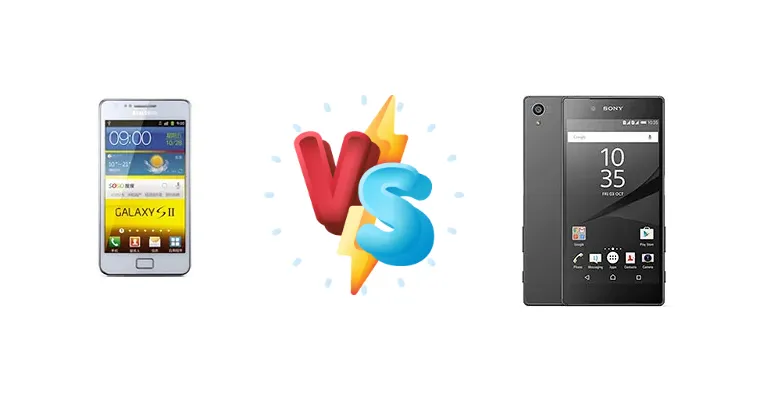
The Samsung Galaxy S II was a revolutionary phone in its time, setting a new standard for Android devices. Years later, the Sony Xperia Z5 arrived with cutting-edge technology. But how do these phones stack up against each other today? Let's dive into a detailed comparison.
🏆 Quick Verdict
The Sony Xperia Z5 is the clear winner. Its significantly more powerful processor, superior camera, and longer battery life outweigh the Galaxy S II's nostalgic appeal. While the S II holds historical significance, the Z5 offers a vastly improved user experience.
| Network |
|---|
| 2G bands | GSM 850 / 900 / 1800 / 1900 | GSM 850 / 900 / 1800 / 1900 |
| 3G bands | HSDPA 850 / 900 / 1900 / 2100 | HSDPA 850 / 900 / 1900 / 2100 - E6603, E6653 |
| 4G bands | - | 1, 2, 3, 4, 5, 7, 8, 12, 17, 20, 28, 38, 40 - E6603, E6653 |
| EDGE | No | - |
| GPRS | No | - |
| Speed | HSPA 21.1/5.76 Mbps | HSPA 42.2/5.76 Mbps, LTE Cat4 150/50 Mbps (E6603), LTE Cat6 300/50 Mbps (E6653) |
| Technology | GSM / HSPA | GSM / HSPA / LTE |
| Launch |
|---|
| Announced | 2011, Q3 | 2015, September 02. Released 2015, October 02 |
| Status | Discontinued | Discontinued |
| Body |
|---|
| Build | - | Glass front, glass back, aluminum frame |
| Dimensions | 125.3 x 66.1 x 8.5 mm (4.93 x 2.60 x 0.33 in) | 146 x 72 x 7.3 mm (5.75 x 2.83 x 0.29 in) |
| SIM | Mini-SIM | Nano-SIM |
| Weight | 116 g (4.09 oz) | 154 g (5.43 oz) |
| | - | IP68 dust/water resistant (up to 1.5m for 30 mins) |
| Display |
|---|
| Protection | Corning Gorilla Glass | Scratch-resistant glass, oleophobic coating |
| Resolution | 480 x 800 pixels, 5:3 ratio (~217 ppi density) | 1080 x 1920 pixels, 16:9 ratio (~428 ppi density) |
| Size | 4.3 inches, 52.6 cm2 (~63.5% screen-to-body ratio) | 5.2 inches, 73.2 cm2 (~69.6% screen-to-body ratio) |
| Type | Super AMOLED Plus | IPS LCD |
| | TouchWiz UI v4.0
| Triluminos display
X-Reality Engine |
| Platform |
|---|
| CPU | Dual-core 1.2 GHz Cortex-A9 | Octa-core (4x1.5 GHz Cortex-A53 & 4x2.0 GHz Cortex-A57) |
| Chipset | TI OMAP 4430 | Qualcomm MSM8994 Snapdragon 810 (20 nm) |
| GPU | PowerVR SGX540 | Adreno 430 |
| OS | Android 2.3.4 (Gingerbread), 4.0.4 (Ice Cream Sandwich), upgradable to 4.1.2 (Jelly Bean) | Android 5.1.1 (Lollipop), upgradable to 7.1.1 (Nougat) |
| Memory |
|---|
| Card slot | microSDXC (dedicated slot) | microSDXC (dedicated slot) |
| Internal | 16GB 1GB RAM | 32GB 3GB RAM |
| | - | eMMC 5.0 |
| Main Camera |
|---|
| Features | LED flash | LED flash, HDR, panorama |
| Single | 8 MP, 1/3.2", f/2.6, AF | 23 MP, f/2.0, 24mm (wide), 1/2.3", PDAF |
| Video | 1080p@30fps | 4K@30fps, 1080p@60fps, 720p@120fps, HDR |
| Selfie camera |
|---|
| Features | - | HDR |
| Single | 2 MP | 5.1 MP, f/2.4 |
| Video | | 1080p@30fps |
| Sound |
|---|
| 3.5mm jack | Yes | Yes |
| 35mm jack | Yes | Yes |
| Loudspeaker | Yes | Yes, with stereo speakers |
| | - | 24-bit/192kHz audio
|
| Comms |
|---|
| Bluetooth | 3.0, A2DP, aptX | 4.1, A2DP, aptX |
| NFC | Optional | Yes |
| Positioning | GPS, A-GPS | GPS, GLONASS/ BDS (market dependant) |
| Radio | Stereo FM radio, RDS | FM radio, RDS |
| USB | microUSB 2.0 (MHL TV-out), OTG | microUSB 2.0 (MHL 3 TV-out), OTG |
| WLAN | Wi-Fi 802.11 b/g/n, Wi-Fi Direct, DLNA, hotspot | Wi-Fi 802.11 a/b/g/n/ac, dual-band, Wi-Fi Direct, DLNA, hotspot |
| Features |
|---|
| Sensors | Accelerometer, gyro, proximity, compass | Fingerprint (side-mounted; EU model only), accelerometer, gyro, proximity, compass, barometer |
| | MP4/DivX/XviD/WMV/H.264 player
MP3/WAV/eAAC+/AC3/FLAC player
Photo/video editor
Document editor | ANT+ |
| Battery |
|---|
| Charging | - | 18W wired, QC2 |
| Music play | - | Up to 87 h |
| Stand-by | Up to 660 h (2G) / Up to 560 h (3G) | Up to 520 h (2G) / Up to 540 h (3G) |
| Talk time | Up to 18 h 40 min (2G) / Up to 9 h (3G) | Up to 13 h 10 min (2G) / Up to 17 h (3G) |
| Type | Removable Li-Ion 1650 mAh battery | Li-Ion 2900 mAh, non-removable |
| Misc |
|---|
| Colors | Black, White, Pink | White, Graphite Black, Gold, Green, Pink |
| Models | - | E6653, SO-01H, SOV32, E6603, 501SO |
| Price | About 220 EUR | About 150 EUR |
| SAR | - | 0.55 W/kg (head) 0.64 W/kg (body) |
| SAR EU | 0.25 W/kg (head) | 0.75 W/kg (head) 0.78 W/kg (body) |
| Tests |
|---|
| Audio quality | - |
Noise -95.5dB / Crosstalk -94.8dB |
| Battery life | - |
Endurance rating 48h
|
| Camera | - |
Photo / Video |
| Display | - |
Contrast ratio: 986 (nominal), 2.88(sunlight) |
| Loudspeaker | - |
Voice 65dB / Noise 62dB / Ring 66dB
|
| Performance | - |
Basemark OS II 2.0: 1580Basemark X: 24941 |
Samsung I9100G Galaxy S II
- Historical significance
- Compact size
- Super AMOLED display (for its time)
- Outdated processor
- Short battery life
- Lower resolution camera
- Smaller screen
Sony Xperia Z5
- Powerful processor
- Excellent camera
- Long battery life
- Larger, higher-resolution display
- Water resistance
- Snapdragon 810 throttling (potential)
- Design can feel dated
Display Comparison
The Xperia Z5 boasts a 5.2-inch Full HD (1920 x 1080) IPS display, offering vibrant colors and sharp details. The Galaxy S II has a 4.3-inch Super AMOLED display, which was impressive for its time, but now appears smaller and less detailed. The Z5's contrast ratio of 986 is excellent, and its sunlight readability is also strong. While the S II's AMOLED offered good contrast, the Z5's overall display quality is superior.
Camera Comparison
The Xperia Z5's camera is a major upgrade. It features a 20.7MP rear camera with fast autofocus and excellent image quality, even in low light. The Galaxy S II's 8MP camera was good for its time, but it struggles in challenging lighting conditions and lacks the detail and features of the Z5. The Z5 also offers superior video recording capabilities.
Performance
The Xperia Z5's Snapdragon 810 chipset with its octa-core processor (4x1.5 GHz Cortex-A53 & 4x2.0 GHz Cortex-A57) provides a massive performance advantage over the Galaxy S II's TI OMAP 4430 dual-core processor (1.2 GHz Cortex-A9). Apps launch faster, multitasking is smoother, and demanding games run significantly better on the Z5. The S II, while still functional, shows its age in terms of speed and responsiveness.
Battery Life
The Xperia Z5's battery life is significantly better, with an endurance rating of 48 hours. The Galaxy S II's battery life is considerably shorter, typically lasting a day with moderate use. The Z5's efficient processor and larger battery contribute to its impressive longevity.
Buying Guide
Who should buy the Samsung Galaxy S II? Primarily collectors or those seeking a retro Android experience. Who should buy the Sony Xperia Z5? Anyone looking for a reliable, capable smartphone with a good camera and battery life, especially at a budget price point (given its age).
Frequently Asked Questions
❓ Is the Galaxy S II still usable in 2024?
Yes, the Galaxy S II is still functional, but its performance is significantly limited compared to modern smartphones. It's best suited for basic tasks and nostalgia.
❓ What are the main differences between the Galaxy S II and the Xperia Z5?
The Xperia Z5 offers a much faster processor, a superior camera, longer battery life, and a larger, higher-resolution display. The Galaxy S II is primarily of historical interest.