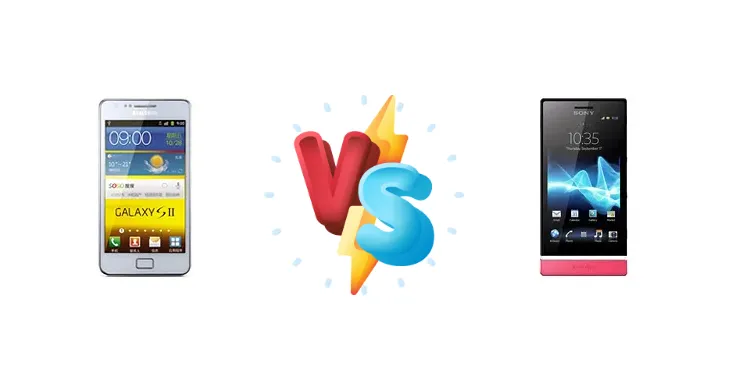
The Samsung Galaxy S II and Sony Xperia U were popular mid-range Android phones, each offering a unique set of features. But which one holds up better today? We'll dive deep into their specs, performance, and overall value to help you decide.
🏆 Quick Verdict
The Galaxy S II generally wins due to its superior processor and overall performance. While the Xperia U boasts a slightly better display in direct sunlight, the S II's more powerful chipset makes it the better choice for most users seeking a responsive Android experience.
| Network |
|---|
| 2G bands | GSM 850 / 900 / 1800 / 1900 | GSM 850 / 900 / 1800 / 1900 |
| 3G bands | HSDPA 850 / 900 / 1900 / 2100 | HSDPA 900 / 2100 - ST25i |
| EDGE | No | - |
| GPRS | No | - |
| Speed | HSPA 21.1/5.76 Mbps | HSPA 14.4/5.76 Mbps |
| Technology | GSM / HSPA | GSM / HSPA |
| | - | HSDPA 850 / 1900 / 2100 - ST25a |
| Launch |
|---|
| Announced | 2011, Q3 | 2012, February. Released 2012, May |
| Status | Discontinued | Discontinued |
| Body |
|---|
| Dimensions | 125.3 x 66.1 x 8.5 mm (4.93 x 2.60 x 0.33 in) | 112 x 54 x 12 mm (4.41 x 2.13 x 0.47 in) |
| SIM | Mini-SIM | Mini-SIM |
| Weight | 116 g (4.09 oz) | 110 g (3.88 oz) |
| Display |
|---|
| Protection | Corning Gorilla Glass | Scratch-resistant glass |
| Resolution | 480 x 800 pixels, 5:3 ratio (~217 ppi density) | 480 x 854 pixels, 16:9 ratio (~280 ppi density) |
| Size | 4.3 inches, 52.6 cm2 (~63.5% screen-to-body ratio) | 3.5 inches, 33.8 cm2 (~55.8% screen-to-body ratio) |
| Type | Super AMOLED Plus | TFT |
| | TouchWiz UI v4.0
| - |
| Platform |
|---|
| CPU | Dual-core 1.2 GHz Cortex-A9 | Dual-core 1.0 GHz Cortex-A9 |
| Chipset | TI OMAP 4430 | NovaThor U8500 |
| GPU | PowerVR SGX540 | Mali-400 |
| OS | Android 2.3.4 (Gingerbread), 4.0.4 (Ice Cream Sandwich), upgradable to 4.1.2 (Jelly Bean) | Android 2.3 (Gingerbread), upgradable to 4.0 (Ice Cream Sandwich) |
| Memory |
|---|
| Card slot | microSDXC (dedicated slot) | No |
| Internal | 16GB 1GB RAM | 8GB (4GB user available), 512MB RAM |
| Main Camera |
|---|
| Features | LED flash | LED flash, panorama |
| Single | 8 MP, 1/3.2", f/2.6, AF | 5 MP, AF |
| Video | 1080p@30fps | 720p@30fps |
| Selfie camera |
|---|
| Single | 2 MP | VGA |
| Video | | - |
| Sound |
|---|
| 3.5mm jack | Yes | Yes |
| 35mm jack | Yes | Yes |
| Loudspeaker | Yes | Yes |
| Comms |
|---|
| Bluetooth | 3.0, A2DP, aptX | 2.1, A2DP, EDR |
| NFC | Optional | - |
| Positioning | GPS, A-GPS | GPS, A-GPS |
| Radio | Stereo FM radio, RDS | Stereo FM radio, RDS |
| USB | microUSB 2.0 (MHL TV-out), OTG | microUSB 2.0, OTG |
| WLAN | Wi-Fi 802.11 b/g/n, Wi-Fi Direct, DLNA, hotspot | Wi-Fi 802.11 b/g/n, hotspot, DLNA |
| Features |
|---|
| Sensors | Accelerometer, gyro, proximity, compass | Accelerometer, proximity, compass |
| | MP4/DivX/XviD/WMV/H.264 player
MP3/WAV/eAAC+/AC3/FLAC player
Photo/video editor
Document editor | - |
| Battery |
|---|
| Music play | - | Up to 45 h |
| Stand-by | Up to 660 h (2G) / Up to 560 h (3G) | Up to 260 h (2G) / Up to 472 h (3G) |
| Talk time | Up to 18 h 40 min (2G) / Up to 9 h (3G) | Up to 6 h 36 min (2G) / Up to 5 h 36 min (3G) |
| Type | Removable Li-Ion 1650 mAh battery | Removable Li-Ion 1320 mAh battery |
| Misc |
|---|
| Colors | Black, White, Pink | Black, White/ exchangeable bottom caps in white, black, pink, yellow |
| Price | About 220 EUR | About 140 EUR |
| SAR | - | 1.09 W/kg (head) 0.93 W/kg (body) |
| SAR EU | 0.25 W/kg (head) | 1.62 W/kg (head) |
| Tests |
|---|
| Audio quality | - |
Noise -87.3dB / Crosstalk -87.7dB |
| Camera | - |
Photo / Video |
| Display | - |
Contrast ratio: 930:1 (nominal) / 1.758:1 (sunlight) |
| Loudspeaker | - |
Voice 65dB / Noise 65dB / Ring 72dB
|
Samsung I9100G Galaxy S II
- Superior Performance
- Larger Display
- Generally Better Camera
- More Common Software Updates (Historically)
- Older Device - Limited Support
- Potential for Battery Degradation
- Design Feels Dated
Sony Xperia U
- Compact and Lightweight
- Good Sunlight Display Visibility
- Distinctive Design
- Lower Performance
- Smaller Screen
- Limited Software Support
- Less Powerful Camera
Display Comparison
Both phones feature displays with a nominal contrast ratio of 930:1. However, the Xperia U shines in direct sunlight with a reported 1.758:1 contrast ratio, offering better visibility. The Galaxy S II has a larger screen (4.3 inches vs 3.5 inches) which is a significant advantage for media consumption.
Camera Comparison
Camera specifications are similar on paper (Photo/Video), but image quality often depends on software and processing. The Galaxy S II generally produces slightly better images due to its more mature software and processing capabilities. Both cameras are adequate for casual photography.
Performance
The Galaxy S II's TI OMAP 4430 chipset with a 1.2 GHz dual-core Cortex-A9 CPU provides a noticeable performance edge over the Xperia U's NovaThor U8500 and 1.0 GHz dual-core Cortex-A9. Expect smoother multitasking and faster app loading on the S II.
Battery Life
The Galaxy S II typically has a larger battery capacity (1650 mAh vs 1480 mAh on the Xperia U), which translates to longer battery life under normal usage. However, actual battery performance depends heavily on usage patterns.
Buying Guide
The Samsung Galaxy S II is ideal for users prioritizing performance and a larger screen. The Sony Xperia U might appeal to those who value a compact design and a vibrant display, particularly for outdoor use, but are less concerned with raw power.
Frequently Asked Questions
❓ Is the Galaxy S II still worth buying?
If you're on a tight budget and need a capable Android phone, the Galaxy S II can still be usable. However, be aware of its age and limited software support.
❓ Which phone is more compact?
The Sony Xperia U is significantly more compact and lightweight, making it easier to handle and carry.
❓ Which phone has better performance for gaming?
The Samsung Galaxy S II offers noticeably better performance for gaming due to its faster processor.