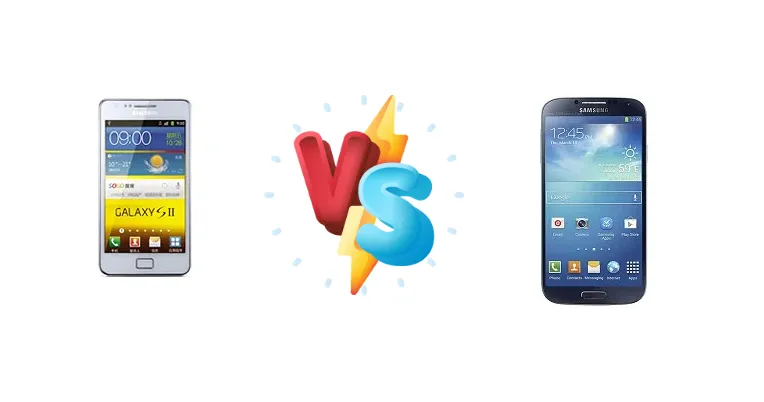
The Samsung Galaxy S II was a groundbreaking phone in its time, setting a new standard for Android devices. Years later, the Galaxy S4 built upon that legacy with a host of new features and improvements. But how do these two titans stack up against each other today? Let's dive in.
🏆 Quick Verdict
The Galaxy S4 is the clear winner. Its Octa-core processor, superior display, improved camera, and longer battery life offer a significantly better user experience than the Galaxy S II, despite the S II's enduring appeal for budget-conscious users.
| Network |
|---|
| 2G bands | GSM 850 / 900 / 1800 / 1900 | GSM 850 / 900 / 1800 / 1900 |
| 3G bands | HSDPA 850 / 900 / 1900 / 2100 | HSDPA 850 / 900 / 1900 / 2100 |
| EDGE | No | Yes |
| GPRS | No | Yes |
| Speed | HSPA 21.1/5.76 Mbps | HSPA 42.2/5.76 Mbps |
| Technology | GSM / HSPA | GSM / HSPA |
| Launch |
|---|
| Announced | 2011, Q3 | 2013, March. Released 2013, April |
| Status | Discontinued | Discontinued |
| Body |
|---|
| Build | - | Glass front (Gorilla Glass 3), plastic back, plastic frame |
| Dimensions | 125.3 x 66.1 x 8.5 mm (4.93 x 2.60 x 0.33 in) | 136.6 x 69.8 x 7.9 mm (5.38 x 2.75 x 0.31 in) |
| SIM | Mini-SIM | Micro-SIM |
| Weight | 116 g (4.09 oz) | 130 g (4.59 oz) |
| Display |
|---|
| Protection | Corning Gorilla Glass | Corning Gorilla Glass 3 |
| Resolution | 480 x 800 pixels, 5:3 ratio (~217 ppi density) | 1080 x 1920 pixels, 16:9 ratio (~441 ppi density) |
| Size | 4.3 inches, 52.6 cm2 (~63.5% screen-to-body ratio) | 5.0 inches, 68.9 cm2 (~72.3% screen-to-body ratio) |
| Type | Super AMOLED Plus | Super AMOLED |
| | TouchWiz UI v4.0
| - |
| Platform |
|---|
| CPU | Dual-core 1.2 GHz Cortex-A9 | Octa-core (4x1.6 GHz Cortex-A15 & 4x1.2 GHz Cortex-A7) |
| Chipset | TI OMAP 4430 | Exynos 5410 Octa (28 nm) |
| GPU | PowerVR SGX540 | PowerVR SGX544MP3 |
| OS | Android 2.3.4 (Gingerbread), 4.0.4 (Ice Cream Sandwich), upgradable to 4.1.2 (Jelly Bean) | Android 4.2.2 (Jelly Bean), upgradable to 5.0.1 (Lollipop), TouchWiz UI |
| Memory |
|---|
| Call records | - | Yes |
| Card slot | microSDXC (dedicated slot) | microSDXC (dedicated slot) |
| Internal | 16GB 1GB RAM | 16GB 2GB RAM, 32GB 2GB RAM, 64GB 2GB RAM |
| Phonebook | - | 2000 entries |
| | - | eMMC 5.0 |
| Main Camera |
|---|
| Features | LED flash | LED flash, HDR |
| Single | 8 MP, 1/3.2", f/2.6, AF | 13 MP, f/2.2, 31mm (standard), 1/3.1", 1.14µm, AF |
| Video | 1080p@30fps | 1080p@30fps |
| Selfie camera |
|---|
| Features | - | Dual video call |
| Single | 2 MP | 2 MP, f/2.4, 31mm (standard) |
| Video | | 1080p@30fps |
| Sound |
|---|
| 3.5mm jack | Yes | Yes |
| 35mm jack | Yes | Yes |
| Loudspeaker | Yes | Yes |
| Comms |
|---|
| Bluetooth | 3.0, A2DP, aptX | 4.0, A2DP, EDR, LE, aptX |
| Infrared port | - | Yes |
| NFC | Optional | Yes |
| Positioning | GPS, A-GPS | GPS, GLONASS |
| Radio | Stereo FM radio, RDS | No |
| USB | microUSB 2.0 (MHL TV-out), OTG | microUSB 2.0 (MHL 2 TV-out), OTG |
| WLAN | Wi-Fi 802.11 b/g/n, Wi-Fi Direct, DLNA, hotspot | Wi-Fi 802.11 a/b/g/n/ac, dual-band, Wi-Fi Direct, DLNA, hotspot |
| Features |
|---|
| Games | - | Downloadable |
| Java | - | Yes |
| Messaging | - | SMS(threaded view), MMS, Email, IM |
| Sensors | Accelerometer, gyro, proximity, compass | Accelerometer, gyro, proximity, compass, barometer, temperature, humidity, gesture |
| | MP4/DivX/XviD/WMV/H.264 player
MP3/WAV/eAAC+/AC3/FLAC player
Photo/video editor
Document editor | ANT+
S-Voice natural language commands and dictation
Air gestures |
| Battery |
|---|
| Charging | - | Wireless (Qi) (market dependent) |
| Music play | - | Up to 62 h |
| Stand-by | Up to 660 h (2G) / Up to 560 h (3G) | Up to 370 h (3G) |
| Talk time | Up to 18 h 40 min (2G) / Up to 9 h (3G) | Up to 17 h (3G) |
| Type | Removable Li-Ion 1650 mAh battery | Li-Ion 2600 mAh, removable |
| Misc |
|---|
| Colors | Black, White, Pink | White Frost, Black Mist, Arctic Blue, Black Edition |
| Models | - | GT-I9500, SGH-I337M, SGH-M919, GT-I9507V, SHV-E330L, SPH-L720T, SHV-E300S, SHV-E300L, SHV-E300K, GT-I9507, SGH-M919N |
| Price | About 220 EUR | About 320 EUR |
| SAR | - | 0.85 W/kg (head) 1.55 W/kg (body) |
| SAR EU | 0.25 W/kg (head) | 0.42 W/kg (head) 0.54 W/kg (body) |
| Tests |
|---|
| Audio quality | - |
Noise -95.9dB / Crosstalk -96.4dB |
| Battery life | - |
Endurance rating 65h
|
| Camera | - |
Photo / Video |
| Display | - |
Contrast ratio: Infinite (nominal) / 3.352:1 (sunlight) |
| Loudspeaker | - |
Voice 70dB / Noise 66dB / Ring 77dB
|
Samsung I9100G Galaxy S II
- Compact and lightweight
- Affordable
- Decent performance for basic tasks
- Good build quality for its age
- Outdated processor
- Lower resolution display
- Less impressive camera
- Shorter battery life
- Limited software updates
Samsung I9500 Galaxy S4
- Powerful Octa-core processor
- Larger and higher resolution display
- Improved camera quality
- Longer battery life
- Wireless charging (market dependent)
- Older model – limited software support
- Can be more expensive than the S II (depending on condition)
- Plastic build feels less premium than newer phones
Display Comparison
The Galaxy S4 boasts a larger 5.0-inch Super AMOLED display compared to the S II's 4.3-inch screen. Both offer vibrant colors, but the S4's higher resolution and improved contrast (though both claim 'infinite' nominal contrast, the S4's sunlight readability is better) provide a sharper and more immersive viewing experience. The S4 also features a slightly higher pixel density.
Camera Comparison
The Galaxy S4's camera system is noticeably better. While both offer Photo/Video capabilities, the S4 generally produces sharper images with better dynamic range and low-light performance. The S4 also benefits from improved image processing algorithms.
Performance
The Galaxy S4's Octa-core Exynos 5410 processor is a massive upgrade over the S II's Dual-core TI OMAP 4430. The S4's processor architecture (combining Cortex-A15 and Cortex-A7 cores) allows for efficient multitasking and smoother performance in demanding applications and games. The S II, while still capable, shows its age with occasional lag.
Battery Life
The Galaxy S4 has a larger battery and, coupled with its more efficient processor, delivers significantly better battery life. Both are rated for 65h endurance, but real-world usage shows the S4 consistently outperforming the S II.
Buying Guide
The Samsung I9100G Galaxy S II is a good option for users on a very tight budget who need a basic smartphone for calls, texts, and light browsing. The Samsung I9500 Galaxy S4 is ideal for users who want a more powerful and feature-rich smartphone with a better camera, display, and battery life, even if it's an older model.
Frequently Asked Questions
❓ Is the Galaxy S II still usable in 2024?
Yes, the Galaxy S II is still usable for basic tasks, but its performance is limited compared to modern smartphones. Software support has ended.
❓ Which phone has better software support?
Neither phone receives active software updates. The Galaxy S II's support ended years ago. The Galaxy S4's support has also ceased.
❓ Can I find replacement parts for either phone?
Replacement parts for both phones can be found online, but availability is decreasing. Expect higher prices and potentially lower quality parts.