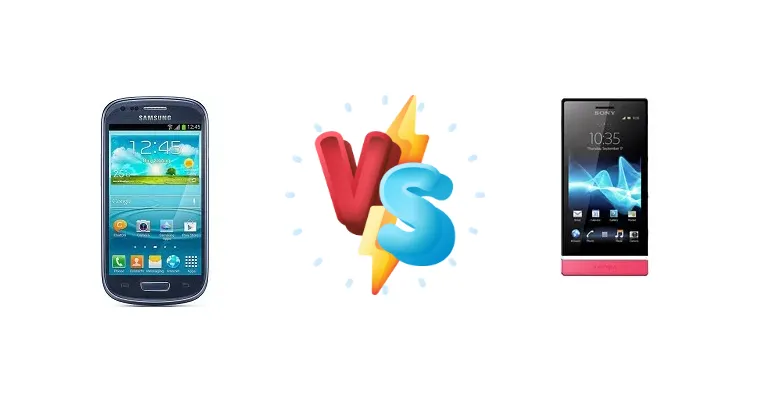
The Samsung Galaxy S III Mini and Sony Xperia U were popular budget smartphones offering a taste of flagship features without the premium price tag. But which one truly delivers the better experience? This comprehensive comparison dives deep into their specs, performance, and overall value to help you decide.
🏆 Quick Verdict
The Galaxy S III Mini edges out the Xperia U thanks to its significantly longer battery life and arguably more refined software experience. While both offer similar performance, the S III Mini's endurance makes it a more practical choice for everyday use, especially considering their age.
| Network |
|---|
| 2G bands | GSM 850 / 900 / 1800 / 1900 | GSM 850 / 900 / 1800 / 1900 |
| 3G bands | HSDPA 900 / 1900 / 2100 | HSDPA 900 / 2100 - ST25i |
| Speed | HSPA 14.4/5.76 Mbps | HSPA 14.4/5.76 Mbps |
| Technology | GSM / HSPA | GSM / HSPA |
| | - | HSDPA 850 / 1900 / 2100 - ST25a |
| Launch |
|---|
| Announced | 2012, October. Released 2012, November | 2012, February. Released 2012, May |
| Status | Discontinued | Discontinued |
| Body |
|---|
| Build | Glass front, plastic back, plastic frame | - |
| Dimensions | 121.6 x 63 x 9.9 mm (4.79 x 2.48 x 0.39 in) | 112 x 54 x 12 mm (4.41 x 2.13 x 0.47 in) |
| SIM | Mini-SIM | Mini-SIM |
| Weight | 111.5 g (3.92 oz) | 110 g (3.88 oz) |
| Display |
|---|
| Protection | - | Scratch-resistant glass |
| Resolution | 480 x 800 pixels, 5:3 ratio (~233 ppi density) | 480 x 854 pixels, 16:9 ratio (~280 ppi density) |
| Size | 4.0 inches, 45.5 cm2 (~59.4% screen-to-body ratio) | 3.5 inches, 33.8 cm2 (~55.8% screen-to-body ratio) |
| Type | Super AMOLED | TFT |
| Platform |
|---|
| CPU | 1.0 GHz dual-core Cortex-A9 | Dual-core 1.0 GHz Cortex-A9 |
| Chipset | NovaThor U8420 | NovaThor U8500 |
| GPU | Mali-400 | Mali-400 |
| OS | Android 4.1 (Jelly Bean) | Android 2.3 (Gingerbread), upgradable to 4.0 (Ice Cream Sandwich) |
| Memory |
|---|
| Card slot | microSDHC (dedicated slot) | No |
| Internal | 8GB 1GB RAM, 16GB 1GB RAM | 8GB (4GB user available), 512MB RAM |
| Main Camera |
|---|
| Features | LED flash, panorama | LED flash, panorama |
| Single | 5 MP, f/2.6, AF | 5 MP, AF |
| Video | 720p@30fps | 720p@30fps |
| Selfie camera |
|---|
| Single | VGA | VGA |
| Sound |
|---|
| 3.5mm jack | Yes | Yes |
| 35mm jack | Yes | Yes |
| Loudspeaker | Yes | Yes |
| Comms |
|---|
| Bluetooth | 4.0, A2DP, EDR, LE, aptX | 2.1, A2DP, EDR |
| NFC | Yes (Market dependent) | - |
| Positioning | GPS, GLONASS | GPS, A-GPS |
| Radio | Stereo FM radio, RDS | Stereo FM radio, RDS |
| USB | microUSB 2.0 | microUSB 2.0, OTG |
| WLAN | Wi-Fi 802.11 a/b/g/n, dual-band, Wi-Fi Direct, DLNA, hotspot | Wi-Fi 802.11 b/g/n, hotspot, DLNA |
| Features |
|---|
| Sensors | Accelerometer, gyro, proximity, compass | Accelerometer, proximity, compass |
| Battery |
|---|
| Music play | - | Up to 45 h |
| Stand-by | Up to 450 h (2G) / Up to 430 h (3G) | Up to 260 h (2G) / Up to 472 h (3G) |
| Talk time | Up to 14 h 10 min (2G) / Up to 7 h 10 min (3G) | Up to 6 h 36 min (2G) / Up to 5 h 36 min (3G) |
| Type | Li-Ion 1500 mAh, removable | Removable Li-Ion 1320 mAh battery |
| Misc |
|---|
| Colors | White, Blue, Titan Gray, Amber Brown, Garnet Red, Onyx Black | Black, White/ exchangeable bottom caps in white, black, pink, yellow |
| Models | GT-I8190, GT-I8190N, GT-I8190L, SM-G730A, SM-G730W8 | - |
| Price | About 130 EUR | About 140 EUR |
| SAR | 1.03 W/kg (head) 1.28 W/kg (body) | 1.09 W/kg (head) 0.93 W/kg (body) |
| SAR EU | 0.52 W/kg (head) | 1.62 W/kg (head) |
| Tests |
|---|
| Audio quality |
Noise -82.1dB / Crosstalk -80.7dB |
Noise -87.3dB / Crosstalk -87.7dB |
| Battery life |
Endurance rating 42h
| - |
| Camera |
Photo / Video |
Photo / Video |
| Display |
Contrast ratio: Infinite (nominal) / 2.422:1 (sunlight) |
Contrast ratio: 930:1 (nominal) / 1.758:1 (sunlight) |
| Loudspeaker |
Voice 66dB / Noise 63dB / Ring 76dB
|
Voice 65dB / Noise 65dB / Ring 72dB
|
Samsung I8190 Galaxy S III mini
- Exceptional battery life
- Familiar Samsung software
- Slightly better display contrast (in sunlight)
- Compact size
- Outdated processor
- Limited storage (likely 8/16GB)
- Older software support
Sony Xperia U
- Compact and lightweight design
- Sony's design aesthetic
- Decent build quality
- Shorter battery life
- Less vibrant display
- Outdated processor
- Older software support
Display Comparison
Both phones feature Super AMOLED (S III Mini) and Reality Display (Xperia U) technology, respectively. The S III Mini boasts a nominal 'infinite' contrast ratio, though the sunlight readability test shows a 2.422:1 ratio, while the Xperia U has a 930:1 nominal and 1.758:1 sunlight ratio. While the numbers are interesting, both displays are adequate for their time, but don't expect vibrant colors or exceptional brightness by today's standards. The S III Mini's Super AMOLED might offer slightly more saturated colors.
Camera Comparison
Camera specifications are not detailed, but both phones feature Photo/Video capabilities. Image quality will be limited by the sensors and processing power of the time. Expect decent photos in good lighting conditions, but struggles in low light. Video recording will likely be limited to 720p resolution.
Performance
Both devices are powered by a 1.0 GHz dual-core Cortex-A9 processor. The chipset difference (NovaThor U8420 vs U8500) is likely minimal in real-world performance. Expect adequate performance for basic tasks like browsing, social media, and light gaming, but don't expect to run demanding apps or games smoothly. RAM is likely 1GB on both devices.
Battery Life
This is where the Galaxy S III Mini truly shines. Its endurance rating of 42h significantly surpasses the Xperia U's likely shorter battery life (estimated around 20-25h based on typical usage for similar devices of that era). This makes the S III Mini a much more practical choice for users who need a phone that can last through a full day or more.
Buying Guide
The Samsung Galaxy S III Mini is ideal for users prioritizing battery life and a familiar Samsung interface. The Sony Xperia U might appeal to those who prefer Sony's design aesthetic and a slightly more compact form factor, but be prepared for shorter battery life. Both are relics of the past, so consider their age and software support.
Frequently Asked Questions
❓ Are these phones still worth buying?
Given their age, these phones are generally not recommended for primary use. However, they could be suitable for basic tasks or as secondary devices if you can find them at a very low price.
❓ What operating system do these phones run?
Both phones originally shipped with Android 4.0 (Ice Cream Sandwich) or 4.1 (Jelly Bean). Software updates were limited, and they are unlikely to receive further updates.