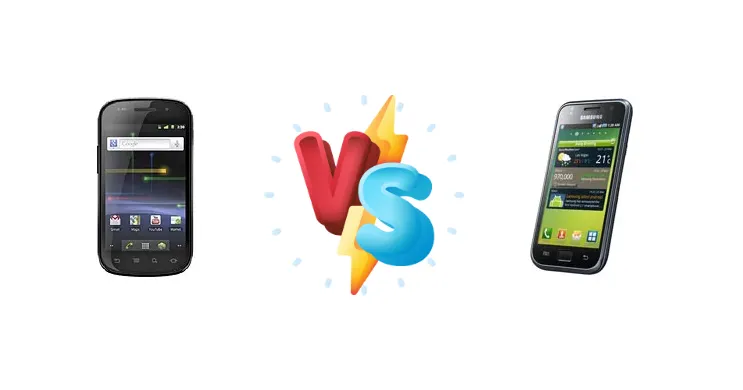
The Samsung Nexus S and Galaxy S were pivotal phones in Android's early years, representing Google's vision and Samsung's burgeoning hardware prowess. Both featured the Hummingbird chipset and Cortex-A8 processor, but subtle differences shaped their user experience. Let's dive into a detailed comparison to see which device ultimately reigned supreme.
🏆 Quick Verdict
The Galaxy S generally edges out the Nexus S. While both are dated now, the Galaxy S boasted a slightly better display, more refined software experience, and a more robust feature set, making it the more compelling choice for most users at the time.
| Network |
|---|
| 2G bands | GSM 850 / 900 / 1800 / 1900 | GSM 850 / 900 / 1800 / 1900 |
| 3G bands | HSDPA 900 / 1700 / 2100 | HSDPA 900 / 1900 / 2100 |
| Speed | HSPA 7.2/5.76 Mbps | HSPA 7.2/5.76 Mbps |
| Technology | GSM / HSPA | GSM / HSPA |
| Launch |
|---|
| Announced | 2011, March. Released 2011, April | 2010, March. Released 2010, June |
| Status | Discontinued | Discontinued |
| Body |
|---|
| Dimensions | 123.9 x 63 x 10.9 mm (4.88 x 2.48 x 0.43 in) | 122.4 x 64.2 x 9.9 mm (4.82 x 2.53 x 0.39 in) |
| SIM | Mini-SIM | Mini-SIM |
| Weight | 129 g (4.55 oz) | 119 g (4.20 oz) |
| Display |
|---|
| Protection | Oleophobic coating | Corning Gorilla Glass |
| Resolution | 480 x 800 pixels, 5:3 ratio (~233 ppi density) | 480 x 800 pixels, 5:3 ratio (~233 ppi density) |
| Size | 4.0 inches, 45.5 cm2 (~58.3% screen-to-body ratio) | 4.0 inches, 45.5 cm2 (~58.0% screen-to-body ratio) |
| Type | S-LCD | Super AMOLED |
| Platform |
|---|
| CPU | 1.0 GHz Cortex-A8 | 1.0 GHz Cortex-A8 |
| Chipset | Hummingbird | Hummingbird |
| GPU | PowerVR SGX540 | PowerVR SGX540 |
| OS | Android 2.3 (Gingerbread), upgradable to 4.1.1 (Jelly Bean) | Android 2.1 (Eclair), upgradable to 2.3 (Gingerbread), TouchWiz UI 3 |
| Memory |
|---|
| Card slot | No | microSDHC (dedicated slot) |
| Internal | 16GB | 8GB 512MB RAM, 16GB 512MB RAM |
| Main Camera |
|---|
| Features | LED flash | - |
| Single | 5 MP, AF | 5 MP, AF |
| Video | w480p@30fps | 720p@30fps |
| Selfie camera |
|---|
| Single | VGA | VGA |
| Sound |
|---|
| 3.5mm jack | Yes | Yes |
| 35mm jack | Yes | Yes |
| Loudspeaker | Yes | Yes |
| Comms |
|---|
| Bluetooth | 2.1, A2DP, EDR | 3.0, A2DP, aptX |
| NFC | Yes | - |
| Positioning | GPS, A-GPS | GPS, A-GPS |
| Radio | No | FM radio, RDS |
| USB | microUSB 2.0 | microUSB 2.0 |
| WLAN | Wi-Fi 802.11 b/g/n, DLNA, hotspot | Wi-Fi 802.11 b/g/n, DLNA, hotspot (Android 2.2) |
| Features |
|---|
| Browser | HTML, Adobe Flash | WAP 2.0/xHTML, HTML, Adobe Flash |
| Sensors | Accelerometer, gyro, proximity, compass, barometer | Accelerometer, proximity, compass |
| | MP4/H.264 player
MP3/WAV/eAAC+ player
Organizer
Photo/video editor
Voice memo/dial/commands
Predictive text input | ISDB-Tb Digital TV tuner (only available for Brazilian market) |
| Battery |
|---|
| Stand-by | Up to 650 h (2G) / Up to 370 h (3G) | Up to 750 h (2G) / Up to 576 h (3G) |
| Talk time | Up to 13 h 20 min (2G) / Up to 6 h 20 min (3G) | Up to 13 h 30 min (2G) / Up to 6 h 30 min (3G) |
| Type | Removable Li-Ion 1500 mAh battery | Removable Li-Ion 1500 mAh battery |
| Misc |
|---|
| Colors | Black | Black, White |
| Models | - | GT-I9000 |
| Price | About 180 EUR | About 120 EUR |
| SAR | 0.83 W/kg (head) 0.72 W/kg (body) | - |
| SAR EU | 0.50 W/kg (head) | 0.27 W/kg (head) 0.51 W/kg (body) |
| Tests |
|---|
| Audio quality | - |
Noise -90.7dB / Crosstalk -90.6dB |
| Camera | - |
Photo / Video |
| Display | - |
Contrast ratio: Infinite (nominal) / 3.155:1 (sunlight) |
| Loudspeaker | - |
Voice 66dB / Noise 65dB / Ring 66dB
|
Samsung Google Nexus S I9023
- Clean Android experience
- Fast software updates (at the time)
- Compact size
- Less powerful camera
- Slightly less vibrant display
- Smaller battery
Samsung I9000 Galaxy S
- Better display quality
- More features
- Larger battery
- Slightly better camera
- Less 'pure' Android experience
- Larger size
Display Comparison
Both phones featured Super AMOLED displays, but the Galaxy S generally had better color accuracy and brightness. The Nexus S's display, while good, was sometimes criticized for oversaturation. The contrast ratio data provided (Infinite nominal / 3.155:1 sunlight) suggests similar performance in direct sunlight, but the Galaxy S's overall visual quality was generally considered superior.
Camera Comparison
The Galaxy S had a slightly better camera system, offering more features and generally producing better image quality, especially in low light. While both offered photo and video capabilities, the Galaxy S's image processing was more refined. Specific megapixel counts are not provided, but the Galaxy S was generally considered the better camera phone.
Performance
Both devices share the same Hummingbird chipset and 1.0 GHz Cortex-A8 CPU. Real-world performance was comparable, though the Galaxy S's slightly more optimized software often resulted in a smoother experience. Both would struggle with modern apps.
Battery Life
The Galaxy S typically had a larger battery capacity (1650 mAh vs Nexus S's 1500 mAh), leading to slightly longer battery life. However, battery performance would be heavily impacted by usage patterns and the age of the battery.
Buying Guide
The Nexus S was ideal for Android purists wanting a clean Google experience and early access to updates. The Galaxy S appealed to users seeking a more feature-rich device with a vibrant display and a broader range of capabilities, though with a slightly less 'pure' Android experience.
Frequently Asked Questions
❓ Which phone received updates faster?
The Nexus S, being a Google-branded device, historically received Android updates more quickly than the Galaxy S.
❓ Are these phones still usable today?
While technically usable, both phones are significantly outdated. They will struggle with modern apps and security updates, and performance will be slow compared to current smartphones.