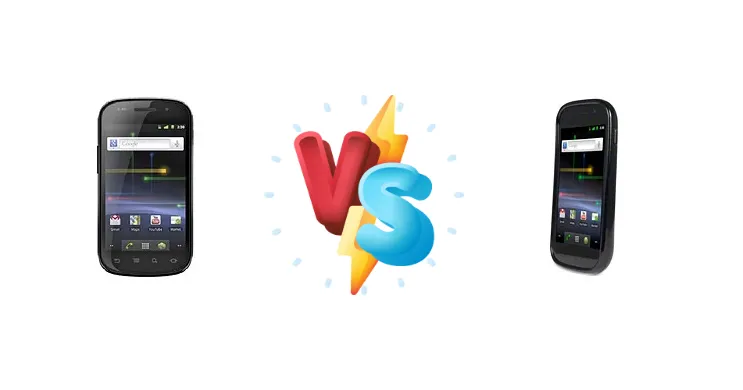
The Samsung Google Nexus S series represented a significant step forward in Android smartphones. But with two variations – the I9023 and the 4G – choosing the right one can be confusing. This comprehensive comparison breaks down the differences to help you decide which model best suits your needs.
🏆 Quick Verdict
The Nexus S 4G wins due to its 4G connectivity and slightly improved antenna. While both share the same processor, the 4G's network capabilities provide a noticeable advantage for users needing faster data speeds. The I9023 remains a solid option if 4G isn't a priority.
| Network |
|---|
| 2G bands | GSM 850 / 900 / 1800 / 1900 | CDMA 800 / 1900 |
| 3G bands | HSDPA 900 / 1700 / 2100 | CDMA2000 1xEV-DO |
| Speed | HSPA 7.2/5.76 Mbps | EV-DO Rev.A 3.1 Mbps |
| Technology | GSM / HSPA | CDMA / EVDO |
| Launch |
|---|
| Announced | 2011, March. Released 2011, April | 2011, March. Released 2011, May 08 |
| Status | Discontinued | Discontinued |
| Body |
|---|
| Dimensions | 123.9 x 63 x 10.9 mm (4.88 x 2.48 x 0.43 in) | 123.9 x 63 x 10.9 mm (4.88 x 2.48 x 0.43 in) |
| SIM | Mini-SIM | Mini-SIM |
| Weight | 129 g (4.55 oz) | 131 g (4.62 oz) |
| Display |
|---|
| Protection | Oleophobic coating | Oleophobic coating |
| Resolution | 480 x 800 pixels, 5:3 ratio (~233 ppi density) | 480 x 800 pixels, 5:3 ratio (~233 ppi density) |
| Size | 4.0 inches, 45.5 cm2 (~58.3% screen-to-body ratio) | 4.0 inches, 45.5 cm2 (~58.3% screen-to-body ratio) |
| Type | S-LCD | Super AMOLED |
| Platform |
|---|
| CPU | 1.0 GHz Cortex-A8 | 1.0 GHz Cortex-A8 |
| Chipset | Hummingbird | Hummingbird |
| GPU | PowerVR SGX540 | PowerVR SGX540 |
| OS | Android 2.3 (Gingerbread), upgradable to 4.1.1 (Jelly Bean) | Android 2.3 (Gingerbread) |
| Memory |
|---|
| Card slot | No | No |
| Internal | 16GB | 16GB 512MB RAM |
| Main Camera |
|---|
| Features | LED flash | LED flash |
| Single | 5 MP, AF | 5 MP, AF |
| Video | w480p@30fps | w480p@30fps |
| Selfie camera |
|---|
| Single | VGA | VGA |
| Sound |
|---|
| 3.5mm jack | Yes | Yes |
| 35mm jack | Yes | Yes |
| Loudspeaker | Yes | Yes, with stereo speakers |
| Comms |
|---|
| Bluetooth | 2.1, A2DP, EDR | 2.1, A2DP, EDR |
| NFC | Yes | Yes |
| Positioning | GPS, A-GPS | GPS, A-GPS |
| Radio | No | No |
| USB | microUSB 2.0 | microUSB 2.0 |
| WLAN | Wi-Fi 802.11 b/g/n, DLNA, hotspot | Wi-Fi 802.11 b/g/n, WiMAX, hotspot |
| Features |
|---|
| Browser | HTML, Adobe Flash | HTML, Adobe Flash |
| Sensors | Accelerometer, gyro, proximity, compass, barometer | Accelerometer, gyro, proximity, compass, barometer |
| | MP4/H.264 player
MP3/WAV/eAAC+ player
Organizer
Photo/video editor
Voice memo/dial/commands
Predictive text input | MP4/H.264 player
MP3/WAV/eAAC+ player
Organizer
Photo/video editor
Voice memo/dial/commands
Predictive text input
Near Field Communications |
| Battery |
|---|
| Stand-by | Up to 650 h (2G) / Up to 370 h (3G) | Up to 428 h |
| Talk time | Up to 13 h 20 min (2G) / Up to 6 h 20 min (3G) | Up to 6 h |
| Type | Removable Li-Ion 1500 mAh battery | Removable Li-Ion 1500 mAh battery |
| Misc |
|---|
| Colors | Black | Black |
| Price | About 180 EUR | About 150 EUR |
| SAR | 0.83 W/kg (head) 0.72 W/kg (body) | 0.64 W/kg (head) 0.95 W/kg (body) |
| SAR EU | 0.50 W/kg (head) | - |
Samsung Google Nexus S I9023
- Classic Android experience
- Compact size
- Good value on the used market
- No 4G connectivity
- Limited storage
- Outdated hardware
Samsung Google Nexus S 4G
- 4G connectivity
- Slightly improved antenna
- Potentially faster data speeds
- Limited storage
- Outdated hardware
- Battery life impacted by 4G usage
Display Comparison
Both devices feature a 4.0-inch Super AMOLED display with a resolution of 800 x 480 pixels. While the display quality is similar, the Nexus S 4G's antenna improvements can sometimes result in slightly better visibility in challenging network conditions. Color accuracy and viewing angles are comparable on both.
Camera Comparison
Both devices feature a 5MP rear camera. Image quality is comparable, though low-light performance is limited on both. Video recording is capped at 720p on both models. Don't expect flagship-level camera performance from either device.
Performance
Performance is largely identical. Both phones are powered by a 1.0 GHz Cortex-A8 Hummingbird chipset and have 512MB of RAM. Expect similar app loading times and multitasking capabilities. However, the 4G's network capabilities can impact perceived speed when browsing or downloading data.
Battery Life
The Nexus S 4G typically has a slightly larger battery (1500mAh vs 1410mAh on the I9023), but the impact on battery life is minimal due to the increased power consumption of 4G connectivity. Expect a full day of moderate use on either device.
Buying Guide
The Samsung Google Nexus S I9023 is ideal for users prioritizing a classic Android experience and don't require 4G connectivity. The Nexus S 4G is the better choice for those needing faster data speeds and a more modern network connection, assuming 4G coverage is available in their area.
Frequently Asked Questions
❓ What does the '4G' in Nexus S 4G mean?
It signifies that the device supports 4G LTE network connectivity, allowing for faster data speeds compared to the Nexus S I9023, which only supports 3G.
❓ Are these phones still worth buying in 2024?
Both phones are quite old. While they can still function, their performance is limited by outdated hardware and software. They are best suited for users seeking a basic Android experience on a budget or for nostalgic purposes.