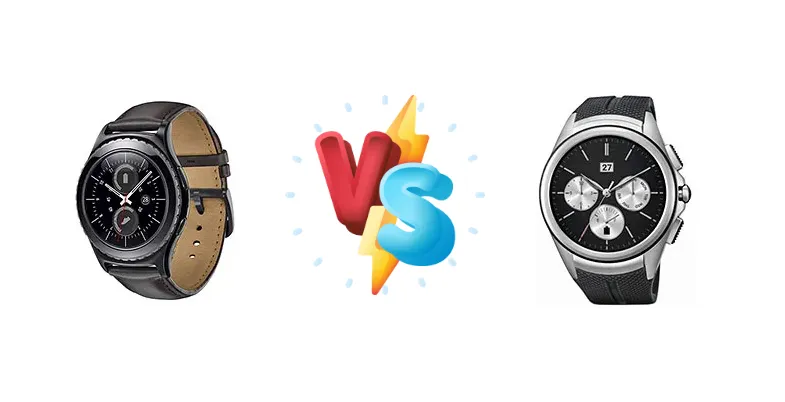
Released around the same timeframe, the Samsung Gear S2 Classic and the LG Watch Urbane 2nd Edition LTE represent distinct approaches to the early smartwatch market. The Gear S2 Classic prioritized a timeless, rotating bezel-driven interface and wireless charging, while the Urbane 2nd Edition aimed for standalone connectivity with its integrated LTE capability. This comparison dissects their core differences to determine which smartwatch holds up better today.
🏆 Quick Verdict
For the average user seeking a stylish and functional smartwatch, the Samsung Gear S2 Classic emerges as the stronger choice. Its refined design, intuitive rotating bezel, and convenient wireless charging outweigh the LG Watch Urbane 2nd Edition LTE’s standalone connectivity, which is less relevant given advancements in smartphone integration and battery life concerns.
| Network |
|---|
| 2G bands | N/A | GSM 850 / 900 / 1800 / 1900 |
| 3G bands | - | HSDPA 850 / 1900 / 2100 - AT&T |
| 4G bands | - | 2, 5 - AT&T |
| EDGE | No | - |
| GPRS | No | - |
| Speed | - | HSPA, LTE |
| Technology | No cellular connectivity | GSM / HSPA / LTE |
| Launch |
|---|
| Announced | 2015, August. Released 2015, October | 2015, October. Released 2016, March |
| Status | Discontinued | Discontinued |
| Body |
|---|
| Build | Glass front (Gorilla Glass 3), stainless steel frame | Glass front (Gorilla Glass 3), stainless steel frame |
| Dimensions | 43.6 x 39.9 x 11.4 mm (1.72 x 1.57 x 0.45 in) | 44.5 x 44.5 x 14.2 mm (1.75 x 1.75 x 0.56 in) |
| SIM | No | Nano-SIM |
| Weight | 42 g (1.48 oz) | 92.7 g (3.28 oz) |
| | IP68 dust/water resistant (up to 1.5m for 30 min)
Compatible with standard 20mm straps | IP67 dust/water resistant (up to 1m for 30 min)
Non-removable strap |
| Display |
|---|
| Protection | Corning Gorilla Glass 3 | Corning Gorilla Glass 3 |
| Resolution | 360 x 360 pixels (~302 ppi density) | 480 x 480 pixels (~348 ppi density) |
| Size | 1.2 inches | 1.38 inches |
| Type | Super AMOLED | P-OLED |
| | Always-on display
Rotating bezel | - |
| Platform |
|---|
| CPU | Dual-core 1.0 GHz Cortex-A7 | Quad-core 1.2 GHz Cortex-A7 |
| Chipset | Exynos 3250 Dual | Qualcomm Snapdragon 400 (28 nm) |
| GPU | Mali-400MP2 | Adreno 305 |
| OS | Tizen OS 2.3.2 | Android Wear OS 2.1 |
| Memory |
|---|
| Card slot | No | No |
| Internal | 4GB 512MB RAM | 4GB 768MB RAM |
| | - | eMMC 4.5 |
| Main Camera |
|---|
| Features | - | Quad-LED flash, panorama, HDR |
| Quad | - | 16 MP, f/1.8, 27mm (wide), AF
5 MP, 115˚ (ultrawide)
2 MP, (macro)
QVGA, (depth) |
| Video | - | 1080p@30fps |
| Selfie camera |
|---|
| Features | - | Dual-LED flash, HDR |
| Single | - | 16 MP, f/2.0, 27mm (wide) |
| Video | - | 1080p@30fps |
| Sound |
|---|
| 3.5mm jack | No | No |
| 35mm jack | No | No |
| Loudspeaker | No | Yes |
| Comms |
|---|
| Bluetooth | 4.1, A2DP, LE | 4.1, LE |
| NFC | Yes | Yes |
| Positioning | No | GPS |
| Radio | No | No |
| USB | No | No |
| WLAN | Wi-Fi 802.11 b/g/n | Wi-Fi 802.11 b/g/n |
| Features |
|---|
| Sensors | Accelerometer, gyro, heart rate, barometer | Accelerometer, gyro, proximity, heart rate, barometer |
| | S-Voice natural language commands and dictation
MP3/M4A/AAC/WAV player
Photo viewer
Voice memo/dial/commands
Samsung Pay | - |
| Battery |
|---|
| Charging | Wireless (Qi) | 18W wired, 50% in 60 min (advertised) |
| Stand-by | Up to 48 h (3G) | - |
| Type | Li-Ion 250 mAh, non-removable | Li-Ion 570 mAh, non-removable |
| Misc |
|---|
| Colors | Black, 18K rose gold, Platinum, ceramic bracelet | Space Black, Opal Blue, Opal Blue, Signature Brown |
| Models | SM-R720, SM-R732 | LC8 |
| Price | About 200 EUR | About 270 EUR |
| SAR | - | 0.85 W/kg (head) 0.80 W/kg (body) |
Samsung Gear S2 classic
- Elegant, classic watch design
- Intuitive rotating bezel interface
- Convenient wireless charging
- Less powerful processor
- Lacks standalone LTE connectivity
LG Watch Urbane 2nd Edition LTE
- Standalone LTE connectivity
- More powerful Snapdragon 400 processor
- Faster wired charging (18W)
- Potentially shorter battery life due to LTE
- Less refined design compared to Gear S2 Classic
Display Comparison
Neither device boasts cutting-edge display technology by today’s standards. Both likely utilized AMOLED panels, common for wearables at the time, prioritizing contrast and power efficiency. However, specific details like resolution and brightness are unavailable. The Urbane 2nd Edition’s larger size *potentially* allowed for a slightly larger display, but this is speculative. The Gear S2 Classic’s focus on a traditional watch face likely prioritized legibility over sheer screen real estate.
Camera Comparison
Neither device was designed with photography in mind, and details on camera capabilities are scarce. Any camera present on either device would have been limited in resolution and image quality. Focusing on camera performance for these models is largely irrelevant given their primary function as smartwatches.
Performance
The LG Watch Urbane 2nd Edition LTE holds a clear advantage in raw processing power. Its Qualcomm Snapdragon 400, a quad-core 1.2 GHz Cortex-A7, significantly outperforms the Samsung Gear S2 Classic’s Exynos 3250 Dual, a dual-core 1.0 GHz Cortex-A7. The Snapdragon 400, fabricated on a 28nm process, offered more headroom for multitasking and running more complex applications. However, the Exynos 3250’s optimization for Samsung’s Tizen OS might have mitigated some of the performance gap in everyday use. The Urbane 2nd Edition’s LTE modem also adds a significant processing load, further highlighting the need for the more powerful chipset.
Battery Life
Battery life is a critical differentiator. The LG Watch Urbane 2nd Edition LTE’s 18W wired charging (50% in 60 minutes advertised) is a significant advantage over the Gear S2 Classic’s wireless (Qi) charging, which is inherently slower. However, the LTE connectivity of the Urbane 2nd Edition is a substantial power drain. While specific mAh capacities are unknown, the Urbane 2nd Edition likely required more frequent charging due to its cellular radio, potentially negating the benefit of faster wired charging for users who actively utilize LTE functionality. The Gear S2 Classic, with its more efficient chipset and lack of LTE, likely offered longer battery life between charges for typical usage.
Buying Guide
Buy the Samsung Gear S2 Classic if you value a premium, classic watch aesthetic, a user-friendly interface, and the convenience of wireless charging. It’s ideal for users who primarily want notifications and fitness tracking synced to their smartphone. Buy the LG Watch Urbane 2nd Edition LTE if you absolutely require standalone cellular connectivity for calls and data without your phone, and are willing to trade off battery life and potentially deal with a less refined user experience.
Frequently Asked Questions
❓ Does the Exynos 3250 chip in the Gear S2 Classic overheat during prolonged use, such as GPS tracking during a run?
While the Exynos 3250 isn't a powerhouse, its dual-core architecture and Tizen OS optimization likely prevented significant overheating during typical smartwatch tasks. Users reported acceptable performance during fitness tracking, though extended, intensive use could lead to some warmth. The Snapdragon 400 in the Urbane 2nd Edition, while more powerful, could also experience thermal throttling under sustained load, especially when utilizing the LTE radio.
❓ Is the LTE connectivity on the LG Watch Urbane 2nd Edition still functional on modern cellular networks?
This is a significant concern. The Urbane 2nd Edition was released in 2015, and carrier support for older LTE bands has diminished. Many users report that the LTE functionality is no longer reliable or functional on current networks, rendering this feature largely obsolete. This drastically reduces the Urbane 2nd Edition’s value proposition.
❓ Can either of these smartwatches be updated to Wear OS or other modern smartwatch platforms?
No. The Samsung Gear S2 Classic runs Tizen, and the LG Watch Urbane 2nd Edition ran Android Wear (now Wear OS) at launch, but both are effectively abandoned by their respective manufacturers. Official updates ceased years ago, and while custom ROMs exist for some devices, they are often unstable and require advanced technical knowledge to install.