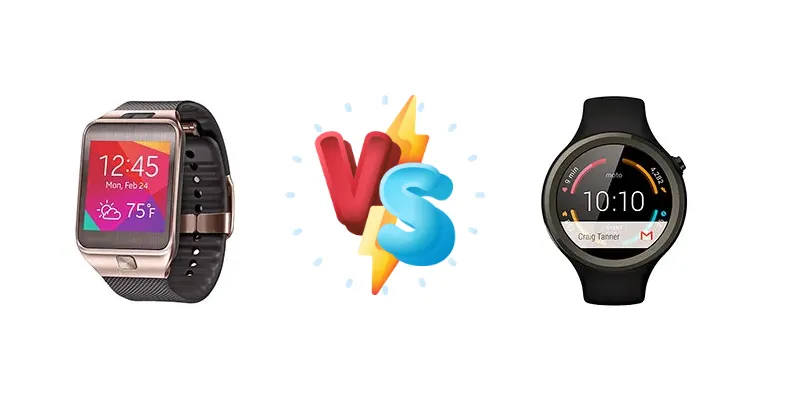
The Samsung Gear 2 and Motorola Moto 360 Sport (1st gen) represent early attempts at blending smartwatch functionality with fitness tracking. Released in different eras, they targeted similar users – those seeking a wrist-worn companion for notifications and activity monitoring. This comparison dissects their core hardware to determine which device holds up better today, focusing on performance and usability.
🏆 Quick Verdict
For the average user prioritizing a more responsive experience and potentially broader app compatibility, the Motorola Moto 360 Sport emerges as the better choice. Its quad-core Snapdragon 400 chipset offers a performance advantage over the Gear 2’s dual-core Exynos, and the addition of Qi wireless charging adds convenience.
| Network |
|---|
| 2G bands | N/A | N/A |
| 3G bands | - | HSDPA 850 / 900 / 2100 |
| 4G bands | - | 1, 3, 5, 7, 8, 38, 40, 41 |
| EDGE | No | No |
| GPRS | No | No |
| Speed | - | HSPA, LTE-A |
| Technology | No cellular connectivity | No cellular connectivity |
| Launch |
|---|
| Announced | 2014, April. Released 2014, April | 2015, September. Released 2016, January |
| Status | Discontinued | Discontinued |
| Body |
|---|
| Build | - | Glass front, plastic frame, plastic back |
| Dimensions | 58.4 x 36.9 x 10 mm (2.30 x 1.45 x 0.39 in) | 45 x 45 x 11.5 mm (1.77 x 1.77 x 0.45 in) |
| SIM | No | No |
| Weight | 68 g (2.40 oz) | 54 g (1.90 oz) |
| | IP67 dust/water resistant (up to 1m for 30 min) | IP67 dust/water resistant (up to 1m for 30 min) |
| Display |
|---|
| Protection | - | Corning Gorilla Glass 3 |
| Resolution | 320 x 320 pixels (~278 ppi density) | 360 x 325 pixels (~263 ppi density) |
| Size | 1.63 inches | 1.37 inches |
| Type | Super AMOLED | IPS LCD |
| Platform |
|---|
| CPU | Dual-core 1.0 GHz Cortex-A7 | Quad-core 1.2 GHz Cortex-A7 |
| Chipset | Exynos 3250 Dual | Qualcomm MSM8926 Snapdragon 400 (28 nm) |
| GPU | Mali-400MP2 | Adreno 305 |
| OS | Tizen OS | Android Wear OS 2.1 |
| Memory |
|---|
| Card slot | No | No |
| Internal | 4GB 512MB RAM | 4GB 512MB RAM |
| | - | eMMC 4.5 |
| Main Camera |
|---|
| Features | - | LED flash, HDR, panorama |
| Quad | - | 48 MP, f/1.7, 26mm (wide), 1/2.0", 0.8µm, PDAF
8 MP, f/2.2, 119˚ (ultrawide), 1/4.0", 1.12µm
2 MP, f/2.4, (macro)
2 MP, f/2.4, (depth) |
| Single | 2 MP, AF | - |
| Video | 720p | 4K@30fps, 1080p@30/60fps, gyro-EIS |
| Selfie camera |
|---|
| Features | - | HDR |
| Single | - | 32 MP, f/2.4, 26mm (wide), 1/2.8", 0.8µm |
| Video | - | 1080p@30fps |
| | No | - |
| Sound |
|---|
| 3.5mm jack | No | No |
| 35mm jack | No | No |
| Loudspeaker | Yes | No |
| Comms |
|---|
| Bluetooth | 4.0, LE | 4.0, LE, aptX |
| Infrared port | Yes | - |
| NFC | No | No |
| Positioning | No | GPS |
| Radio | No | No |
| USB | No | No |
| WLAN | No | Wi-Fi 802.11 b/g |
| Features |
|---|
| Sensors | Accelerometer, gyro, heart rate | Accelerometer, altimeter, gyro, heart rate |
| | MP3 player
MP4/H.264 player
Photo viewer
S-Voice
Voice memo/dial/commands | MP3 player
Photo viewer
Voice dial/commands |
| Battery |
|---|
| Charging | - | Wireless (Qi) |
| Type | Li-Ion 300 mAh, non-removable | Li-Ion 300 mAh, non-removable |
| Misc |
|---|
| Colors | Charcoal Black, Gold Brown, Wild Orange | Black |
| Models | SM-R380 | CPH2113 |
| Price | About 230 EUR | About 200 EUR |
| SAR | 0.02 W/kg (head) 0.12 W/kg (body) | - |
| SAR EU | 0.02 W/kg (head) 0.09 W/kg (body) | - |
Samsung Gear 2
- Iconic, early smartwatch design.
- Potential for deeper Samsung ecosystem integration.
- Compact form factor (likely).
- Slower processor compared to the Moto 360 Sport.
- Lacks wireless charging.
- Potentially limited app support due to age.
Motorola Moto 360 Sport (1st gen)
- Faster quad-core Snapdragon 400 processor.
- Convenient Qi wireless charging.
- More modern processor architecture.
- Round display may offer less information density.
- Software support is likely limited.
- Sport band may not be ideal for all occasions.
Display Comparison
Neither device’s display specifications are provided, but considering the release timeframe, both likely utilized AMOLED technology. The Moto 360 Sport’s round display was a key differentiator, offering a more traditional watch aesthetic. The Gear 2, with its rectangular screen, prioritized information density. Without specific resolution or brightness data, it’s difficult to definitively declare a winner, but the Moto 360 Sport’s design likely appealed to a broader audience seeking a classic watch look.
Camera Comparison
Neither device is known for its camera capabilities, and detailed camera specs are unavailable. Given the focus on fitness and notifications, camera quality was likely a secondary concern. It’s safe to assume both featured basic cameras suitable for quick snapshots, but not for serious photography.
Performance
The Motorola Moto 360 Sport’s Qualcomm MSM8926 Snapdragon 400, featuring a quad-core 1.2 GHz Cortex-A7 CPU, demonstrably outperforms the Samsung Gear 2’s Exynos 3250 Dual with its dual-core 1.0 GHz Cortex-A7. The higher core count and clock speed translate to snappier app launches and smoother multitasking. While both utilize the Cortex-A7 architecture, the Snapdragon 400’s fabrication process (28nm) suggests potentially better power efficiency compared to the Exynos 3250. This difference would be noticeable in sustained usage, impacting overall responsiveness.
Battery Life
Battery capacity data is missing for both devices. However, the Moto 360 Sport’s inclusion of Qi wireless charging is a significant advantage. Wireless charging offers convenience and eliminates the need for proprietary cables. While the Gear 2 likely relied on a physical charging dock, the Moto 360 Sport’s wireless capability provides greater flexibility. Without mAh figures, it’s impossible to determine which device offers superior battery life, but the convenience of wireless charging tips the scales in favor of the Motorola device.
Buying Guide
Buy the Samsung Gear 2 if you are a collector of early smartwatch technology or specifically need compatibility with the Samsung ecosystem. Its design, while dated, is iconic. Buy the Motorola Moto 360 Sport (1st gen) if you prioritize a smoother user experience, wireless charging, and a more modern processor architecture for potentially better long-term software support, even if that support is limited by its age.
Frequently Asked Questions
❓ Does the Exynos 3250 in the Gear 2 struggle with modern app performance?
Yes, the dual-core Exynos 3250 is significantly less powerful than the quad-core Snapdragon 400 in the Moto 360 Sport. While basic smartwatch functions will operate, demanding apps or complex watch faces may experience lag or slowdowns. The Gear 2’s age also means fewer developers are optimizing for its platform.
❓ Is the wireless charging on the Moto 360 Sport compatible with all Qi chargers?
Generally, yes. The Moto 360 Sport supports the Qi wireless charging standard, meaning it should work with most Qi-compatible chargers. However, charging speeds may vary depending on the charger’s output and the device’s charging circuitry. Some older or non-standard Qi chargers may not function correctly.
❓ Which smartwatch is better suited for running and other fitness activities?
Both devices offer basic fitness tracking capabilities. However, the Moto 360 Sport’s more responsive processor and potentially better battery life (due to the Snapdragon 400’s efficiency) could provide a smoother experience during workouts. The sport band design is also more geared towards active use.