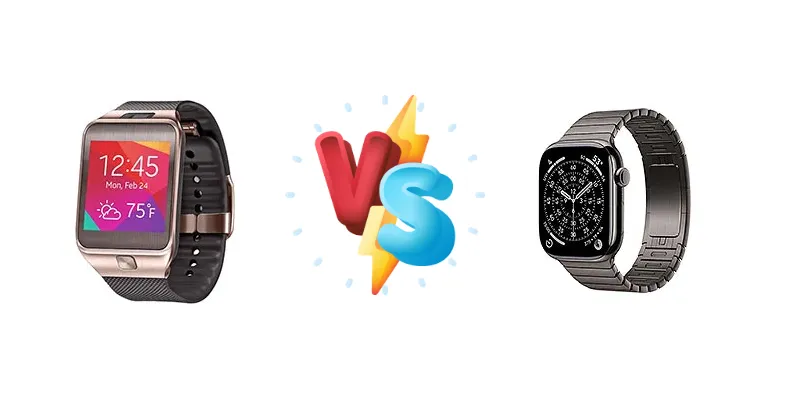
The Samsung Gear 2 and Apple Watch Series 11 represent pivotal moments in the evolution of wearable technology. Released in 2014, these devices weren't just accessories; they were attempts to redefine how we interact with information and our daily lives. This comparison revisits these early smartwatches, analyzing their strengths and weaknesses in the context of their time and the technology available.
🏆 Quick Verdict
For the average user seeking a smartwatch with a more established ecosystem and faster charging, the Apple Watch Series 11 is the better choice. While the Gear 2 offered a unique design, the Apple S10 chipset and wireless charging provide a more refined and convenient experience.
| Network |
|---|
| 2G bands | N/A | GSM 850 / 900 / 1800 / 1900 |
| 3G bands | - | HSDPA 850 / 900 / 1700(AWS) / 1900 / 2100 - International, China, HK |
| 4G bands | - | 1, 2, 3, 4, 5, 6, 7, 8, 18, 19, 20, 25, 26, 28, 39, 40, 41, 66 - International, China, HK |
| 5G bands | - | SA/NSA |
| EDGE | No | - |
| GPRS | No | - |
| Speed | - | HSPA, LTE, 5G |
| Technology | No cellular connectivity | GSM / HSPA / LTE / 5G |
| Launch |
|---|
| Announced | 2014, April. Released 2014, April | 2025, September 09 |
| Status | Discontinued | Available. Released 2025, September 19 |
| Body |
|---|
| Build | - | Sapphire crystal front, ceramic/sapphire crystal back, titanium frame (grade 5) |
| Dimensions | 58.4 x 36.9 x 10 mm (2.30 x 1.45 x 0.39 in) | 46 x 39 x 9.7 mm (1.81 x 1.54 x 0.38 in) |
| SIM | No | eSIM |
| Weight | 68 g (2.40 oz) | 34.6 g (42mm), 43.1 g (46mm) (1.52 oz) |
| | IP67 dust/water resistant (up to 1m for 30 min) | - |
| Display |
|---|
| Protection | - | Sapphire crystal glass |
| Resolution | 320 x 320 pixels (~278 ppi density) | 496 x 416 pixels (~330 ppi density) |
| Size | 1.63 inches | 1.96 inches |
| Type | Super AMOLED | Retina LTPO3 OLED, 2000 nits (peak) |
| Platform |
|---|
| CPU | Dual-core 1.0 GHz Cortex-A7 | Dual-core |
| Chipset | Exynos 3250 Dual | Apple S10 |
| GPU | Mali-400MP2 | PowerVR |
| OS | Tizen OS | watchOS 26, upgradable to watchOS 26.1 |
| Memory |
|---|
| Card slot | No | No |
| Internal | 4GB 512MB RAM | 64GB |
| Main Camera |
|---|
| Single | 2 MP, AF | - |
| Video | 720p | - |
| Sound |
|---|
| 3.5mm jack | No | - |
| 35mm jack | No | No |
| Loudspeaker | Yes | Yes |
| Comms |
|---|
| Bluetooth | 4.0, LE | 5.3, A2DP, LE |
| Infrared port | Yes | - |
| NFC | No | Yes |
| Positioning | No | GPS, GLONASS, GALILEO, QZSS, BDS |
| Radio | No | No |
| USB | No | No |
| WLAN | No | Wi-Fi 802.11 b/g/n, dual-band |
| Features |
|---|
| Sensors | Accelerometer, gyro, heart rate | Accelerometer, gyro, heart rate, barometer, always-on altimeter, compass, SpO2, VO2max, temperature (body), temperature (water) |
| | MP3 player
MP4/H.264 player
Photo viewer
S-Voice
Voice memo/dial/commands | - |
| Battery |
|---|
| Charging | - | Wireless, 0-80% in 30 min |
| Type | Li-Ion 300 mAh, non-removable | Li-Ion |
| Misc |
|---|
| Colors | Charcoal Black, Gold Brown, Wild Orange | Slate, Gold, Natural |
| Models | SM-R380 | A3335, A3337, A3452, A3453 |
| Price | About 230 EUR | € 818.00 |
| SAR | 0.02 W/kg (head) 0.12 W/kg (body) | 1.19 W/kg (head) |
| SAR EU | 0.02 W/kg (head) 0.09 W/kg (body) | 0.97 W/kg (head) |
Samsung Gear 2
- Unique rotating bezel for intuitive navigation
- Customizable watch faces and straps
- Integration with the Samsung ecosystem
- Proprietary charging connector
- Less refined user interface compared to watchOS
- Potentially slower performance due to chipset architecture
Apple Watch Series 11
- Wireless charging with fast 0-80% charge time
- Seamless integration with iOS devices
- Polished and intuitive watchOS interface
- Limited customization options compared to the Gear 2
- Dependence on the Apple ecosystem
- First-generation device with potential software quirks
Display Comparison
Neither Samsung nor Apple provided detailed display specifications for these early models. However, the Gear 2’s Super AMOLED display likely offered superior contrast ratios and vibrant colors compared to the Apple Watch Series 11’s OLED panel. Bezels were substantial on both devices, typical for the era. Color accuracy, while important today, was less of a focus for early adopters.
Camera Comparison
Neither device focused heavily on camera capabilities. Both lacked cameras entirely, reflecting the primary focus on notifications, fitness tracking, and basic interactions. The absence of a camera simplifies the design and conserves battery life, a crucial consideration for early smartwatches.
Performance
The Apple Watch Series 11’s Apple S10 chipset, while dual-core like the Samsung Gear 2’s Exynos 3250 Dual, benefits from Apple’s tight hardware-software integration. This likely translates to smoother animations and faster app loading times. The Exynos 3250, based on the Cortex-A7 architecture, was a capable processor for its time, but the S10’s architecture is optimized for wearable use cases. RAM specifications are unavailable for either device, but the S10’s efficiency likely allowed for better multitasking.
Battery Life
Battery life was a significant concern for both devices. The Apple Watch Series 11’s wireless charging, achieving 0-80% in 30 minutes, offered a significant convenience advantage over the Gear 2’s proprietary charging method. While mAh ratings are unavailable, the S10’s power efficiency likely contributed to comparable or slightly better real-world battery performance, despite the faster charging capability.
Buying Guide
Buy the Samsung Gear 2 if you prioritize a more customizable experience and a unique, physical rotating bezel for navigation. It's ideal for users already invested in the Samsung ecosystem. Buy the Apple Watch Series 11 if you value seamless integration with iOS, a more polished user interface, and the convenience of wireless charging. It’s the better option for iPhone users seeking a first-generation smartwatch.
Frequently Asked Questions
❓ Does the Exynos 3250 in the Gear 2 suffer from overheating during prolonged use?
While not a widespread issue, the Exynos 3250, being an older chipset, is more susceptible to thermal throttling under sustained load compared to the Apple S10. Users engaging in extended fitness tracking or app usage might experience some performance slowdown.
❓ Is the Apple Watch Series 11 still compatible with the latest versions of watchOS?
No, the Apple Watch Series 11 is no longer supported by Apple’s latest watchOS updates. This means it will not receive new features or security patches, potentially limiting its functionality and security over time.
❓ Can I use the Samsung Gear 2 with an iPhone?
No, the Samsung Gear 2 is designed to work exclusively with Android devices. There is no native compatibility with iOS.
❓ What type of apps were available for these smartwatches at launch?
App ecosystems were nascent at launch. Both devices offered basic notification support, fitness tracking apps, and limited third-party app options. The Apple Watch benefited from a slightly faster adoption rate of developers, but the selection was still limited compared to modern smartwatches.