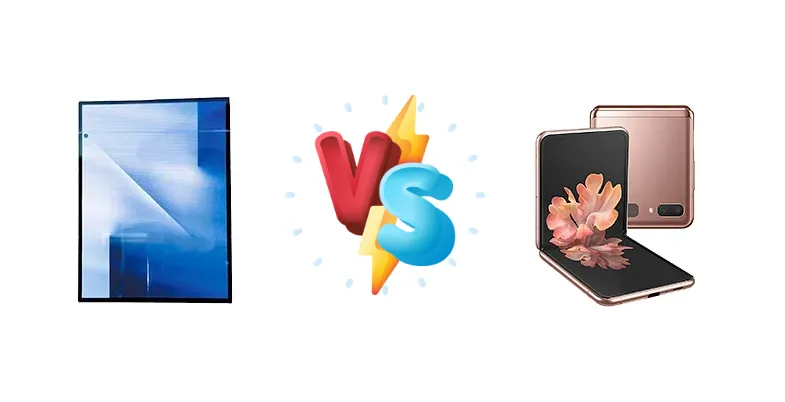
Samsung's foldable lineup offers distinct experiences. The Z Flip 5G prioritizes pocketability and style, while the Z TriFold aims for a tablet-like experience with a larger, multi-tasking focused display. This comparison dissects the core differences – specifically the generational leap in processing power and its impact on daily use.
🏆 Quick Verdict
For users prioritizing raw performance and future-proofing, the Samsung Galaxy Z TriFold is the clear winner. Its Snapdragon 8 Elite Gen 5 delivers a substantial upgrade over the Z Flip 5G’s Snapdragon 865, justifying the price premium for demanding users. However, the Z Flip 5G remains a compelling option for those valuing portability and affordability.
| Network |
|---|
| 2G bands | GSM 850 / 900 / 1800 / 1900 | GSM 850 / 900 / 1800 / 1900 |
| 3G bands | HSDPA 850 / 900 / 1700(AWS) / 1900 / 2100 | HSDPA 850 / 900 / 1700(AWS) / 1900 / 2100 - International, Canada |
| 4G bands | LTE | 1, 2, 3, 4, 5, 7, 8, 12, 13, 14, 18, 19, 20, 25, 26, 28, 29, 30, 38, 39, 40, 41, 66, 71 - International |
| 5G bands | SA/NSA/Sub6 | 1, 41, 77, 78, 79 Sub6 - China, Hong Kong |
| Speed | HSPA, LTE, 5G | HSPA 42.2/5.76 Mbps, LTE (6CA) Cat20 2000/200 Mbps, 5G |
| Technology | GSM / CDMA / HSPA / EVDO / LTE / 5G | GSM / CDMA / HSPA / EVDO / LTE / 5G |
| | - | 41, 66, 71 Sub6 - Canada |
| Launch |
|---|
| Announced | Not announced yet | 2020, July 22 |
| Status | Rumored | Available. Released 2020, August 07 |
| Body |
|---|
| Build | - | Plastic front, glass back (Gorilla Glass 6), aluminum frame |
| Dimensions | Unfolded thickness: 4.2 mm Folded thickness: 14 mm | Unfolded: 167.3 x 73.6 x 7.2 mm Folded: 87.4 x 73.6 x 17.3 mm |
| SIM | Nano-SIM + eSIM | Nano-SIM + eSIM |
| Weight | - | 183 g (6.46 oz) |
| Display |
|---|
| Resolution | 2232 x 3184 pixels (~389 ppi density) | 1080 x 2636 pixels (~425 ppi density) |
| Size | 10.0 inches, 303.2 cm2 | 6.7 inches, 101.6 cm2 (~82.5% screen-to-body ratio) |
| Type | Foldable LTPO OLED, 120Hz, HDR10+, 1600 nits (peak) | Foldable Dynamic AMOLED, HDR10+ |
| | - | Cover display:
Super AMOLED, 1.1 inches, 112 x 300 pixels |
| Platform |
|---|
| CPU | Octa-core (2x4.6 GHz Oryon V3 Phoenix L + 6x3.62 GHz Oryon V3 Phoenix M) | Octa-core (1x3.09 GHz Cortex-A77 & 3x2.40 GHz Cortex-A77 & 4x1.80 GHz Cortex-A55) |
| Chipset | Qualcomm SM8850-AC Snapdragon 8 Elite Gen 5 (3 nm) | Qualcomm SM8250 Snapdragon 865 5G+ (7 nm+) |
| GPU | Adreno 840 | Adreno 650 |
| OS | Android 16 | Android 10, upgradable to Android 13, One UI 5 |
| Memory |
|---|
| Card slot | No | No |
| Internal | 512GB 16GB RAM, 1TB 16GB RAM | 256GB 8GB RAM |
| | - | UFS 3.0 |
| Main Camera |
|---|
| Dual | - | 12 MP, f/1.8, 27mm (wide), 1/2.55", 1.4µm, dual pixel PDAF, OIS
12 MP, f/2.2, 123˚ (ultrawide), 1.12µm |
| Features | LED flash, HDR, panorama | LED flash, HDR, panorama |
| Triple | 200 MP, f/1.7, 24mm (wide), 1/1.3", 0.6µm, multi-directional PDAF, OIS
50 MP (ultrawide)
third unspecified camera | - |
| Video | 8K@30fps, 4K@60fps, 1080p@60/120/240fps (gyro-EIS), 10-bit HDR, HDR10+ | 4K@30/60fps, 1080p@60/240fps, 720p@960fps, HDR10+ |
| Selfie camera |
|---|
| Features | HDR | HDR |
| Single | Yes | 10 MP, f/2.4, 26mm (wide), 1.22µm |
| Video | 4K@30/60fps, 1080p@30/60fps, gyro-EIS | 4K@30fps |
| Sound |
|---|
| 3.5mm jack | - | No |
| 35mm jack | No | No |
| Loudspeaker | Yes, with stereo speakers | Yes |
| | - | 32-bit/384kHz audio
Tuned by AKG |
| Comms |
|---|
| Bluetooth | 6.0, A2DP, LE, aptX HD | 5.0, A2DP, LE |
| NFC | Yes | Yes |
| Positioning | GPS, GALILEO, GLONASS, BDS, QZSS | GPS, GLONASS, GALILEO, BDS |
| Radio | No | No |
| USB | USB Type-C 3.2, OTG | USB Type-C 2.0, OTG |
| WLAN | Wi-Fi 802.11 a/b/g/n/ac/6e/7, tri-band, Wi-Fi Direct | Wi-Fi 802.11 a/b/g/n/ac/6, dual-band, Wi-Fi Direct |
| Features |
|---|
| Sensors | Fingerprint, accelerometer, gyro, proximity, compass | Fingerprint (side-mounted), accelerometer, gyro, proximity, compass, barometer |
| | - | Samsung Pay (Visa, MasterCard certified) |
| Battery |
|---|
| Charging | 45W wired | 15W wired
9W wireless |
| Type | 5600 mAh | Li-Po 3300 mAh |
| Misc |
|---|
| Colors | Black; other colors | Mystic Grey, Mystic Bronze, Mystic White |
| Models | - | SM-F707B, SM-F707N, SM-F7070, SM-F707U, SM-F707U1, SM-F707W |
| Price | - | About 800 EUR |
| SAR | - | 0.80 W/kg (head) 1.01 W/kg (body) |
| SAR EU | - | 0.80 W/kg (head) 1.45 W/kg (body) |
Samsung Galaxy Z TriFold
- Significantly faster processor with Snapdragon 8 Elite Gen 5
- 45W wired charging for rapid power-ups
- Likely larger, higher-resolution display
- Superior image processing capabilities
- Higher price point
- Larger and heavier form factor
Samsung Galaxy Z Flip 5G
- More affordable price
- Highly portable and pocketable design
- Stylish and compact form factor
- Acceptable performance for everyday tasks
- Slower Snapdragon 865 processor
- Slower 15W wired and 9W wireless charging
- Less future-proofed chipset
Display Comparison
While both devices feature foldable displays, specifics beyond that are missing. However, the Z TriFold’s larger form factor suggests a higher resolution internal display. The Snapdragon 8 Elite’s improved ISP could also translate to better image processing for the displays. The Z Flip 5G, being an older model, likely utilizes a lower peak brightness and potentially a less efficient panel, impacting outdoor visibility and battery life. The Z TriFold likely benefits from a more advanced hinge mechanism for durability.
Camera Comparison
Without specific camera specs, it’s difficult to make a direct comparison. However, the Snapdragon 8 Elite’s advanced ISP (Image Signal Processor) in the Z TriFold will undoubtedly provide superior image processing capabilities. This includes better noise reduction, dynamic range, and faster autofocus. The Z TriFold likely features a more advanced camera system overall, benefiting from the chipset’s enhanced capabilities. The Z Flip 5G’s camera, while decent, will be limited by the older chipset and potentially less sophisticated sensors.
Performance
The core difference lies in the chipsets. The Z TriFold’s Qualcomm SM8850-AC Snapdragon 8 Elite Gen 5 (3nm) represents a significant architectural leap over the Z Flip 5G’s Snapdragon 865 (7nm+). The 8 Elite’s Oryon V3 Phoenix cores (2x4.6 GHz + 6x3.62 GHz) offer substantially higher clock speeds and improved efficiency compared to the 865’s Cortex-A77 cores (1x3.09 GHz + 3x2.40 GHz + 4x1.80 GHz). This translates to faster app loading, smoother multitasking, and significantly improved gaming performance. The 3nm process node of the 8 Elite also means less heat generation under sustained load, reducing throttling. The Z Flip 5G, while capable, will struggle with demanding tasks compared to the Z TriFold.
Battery Life
The Z TriFold’s 45W wired charging is a major advantage over the Z Flip 5G’s 15W wired and 9W wireless charging. This means significantly faster top-ups, crucial for a device with a larger display and more demanding processor. While battery capacity isn’t specified, the Z TriFold’s larger size suggests a larger battery. However, the more efficient Snapdragon 8 Elite could offset the Z Flip 5G’s potentially smaller battery, offering comparable or even better real-world battery life despite the power difference.
Buying Guide
Buy the Samsung Galaxy Z TriFold if you need a device that can seamlessly transition between smartphone and tablet, demanding peak performance for gaming or content creation, and require the fastest possible charging speeds. Buy the Samsung Galaxy Z Flip 5G if you prefer a highly portable, stylish foldable that excels at quick tasks, social media, and offers a more accessible entry point into the foldable market.
Frequently Asked Questions
❓ Will the Snapdragon 865 in the Z Flip 5G struggle with graphically intensive games like Genshin Impact?
Yes, the Snapdragon 865 will likely exhibit noticeable frame drops and throttling in demanding games like Genshin Impact, especially at higher settings. While playable, the experience won't be as smooth or consistent as on the Z TriFold with its Snapdragon 8 Elite Gen 5.
❓ How much faster is the 45W charging on the Z TriFold compared to the Z Flip 5G's 15W charging?
The 45W charging on the Z TriFold can potentially charge the device from 0-100% in around 60-75 minutes, while the Z Flip 5G’s 15W charging will likely take over 2 hours. This difference is substantial and provides a significant convenience factor for users who frequently need to top up their battery.
❓ Is the difference in performance between the two chipsets noticeable for everyday tasks like browsing and social media?
For basic tasks like browsing and social media, the difference may not be immediately apparent. However, the Z TriFold will feel snappier and more responsive when switching between apps or handling multiple tasks simultaneously due to the superior processing power and memory bandwidth of the Snapdragon 8 Elite Gen 5.
❓ Does the Z Flip 5G still receive software updates and security patches?
While the Z Flip 5G is an older model, Samsung typically provides several years of software updates and security patches for its devices. However, it will likely receive updates for a shorter duration compared to the Z TriFold.