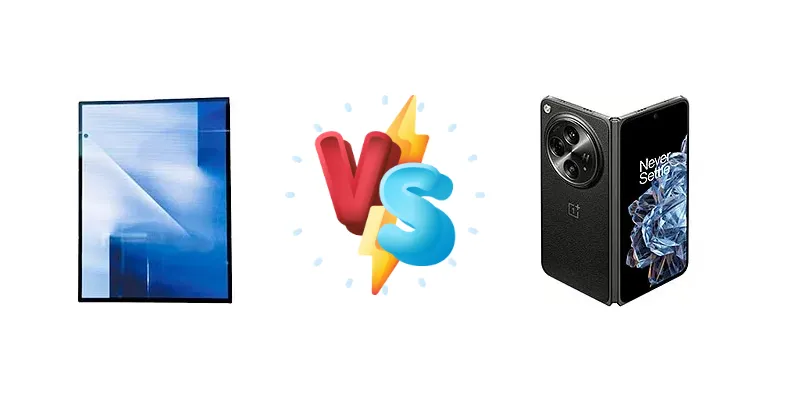
The foldable market is heating up, with Samsung continuing to refine its multi-fold design and OnePlus entering the arena with a compelling alternative. This comparison pits the Samsung Galaxy Z TriFold, powered by the latest Qualcomm Snapdragon 8 Elite Gen 5, against the OnePlus Open, leveraging the established Snapdragon 8 Gen 2 platform. We'll dissect the key differences to determine which foldable best suits your needs.
🏆 Quick Verdict
For users prioritizing raw processing power and future-proofing, the Samsung Galaxy Z TriFold’s Snapdragon 8 Elite Gen 5 offers a clear advantage. However, the OnePlus Open delivers a more balanced experience with significantly faster 67W charging and exceptional battery endurance, making it the better choice for everyday users.
| Network |
|---|
| 2G bands | GSM 850 / 900 / 1800 / 1900 | GSM 850 / 900 / 1800 / 1900 |
| 3G bands | HSDPA 850 / 900 / 1700(AWS) / 1900 / 2100 | HSDPA 800 / 850 / 900 / 1700(AWS) / 1900 / 2100 |
| 4G bands | LTE | 1, 2, 3, 4, 5, 7, 8, 12, 13, 17, 18, 19, 20, 25, 26, 28, 30, 32, 38, 39, 40, 41, 46, 48, 66, 71 |
| 5G bands | SA/NSA/Sub6 | 1, 2, 3, 5, 7, 8, 12, 20, 25, 28, 30, 38, 40, 41, 66, 71, 75, 77, 78 SA/NSA |
| Speed | HSPA, LTE, 5G | HSPA, LTE, 5G |
| Technology | GSM / CDMA / HSPA / EVDO / LTE / 5G | GSM / HSPA / LTE / 5G |
| Launch |
|---|
| Announced | Not announced yet | 2023, October 19 |
| Status | Rumored | Available. Released 2023, October 26 |
| Body |
|---|
| Build | - | Glass front (Ceramic Guard) (folded), plastic front (unfolded), glass back or eco leather back, aluminum frame |
| Dimensions | Unfolded thickness: 4.2 mm Folded thickness: 14 mm | Unfolded: 153.4 x 143.1 x 5.8 mmFolded: 153.4 x 73.3 x 11.7 mm |
| SIM | Nano-SIM + eSIM | Nano-SIM + Nano-SIM + eSIM (max 2 at a time) |
| Weight | - | 239 g or 245 g (8.43 oz) |
| Display |
|---|
| Resolution | 2232 x 3184 pixels (~389 ppi density) | 2268 x 2440 pixels (~426 ppi density) |
| Size | 10.0 inches, 303.2 cm2 | 7.82 inches, 196.7 cm2 (~89.6% screen-to-body ratio) |
| Type | Foldable LTPO OLED, 120Hz, HDR10+, 1600 nits (peak) | Foldable LTPO3 Flexi-fluid AMOLED, 1B colors, Dolby Vision, 120Hz, 2800 nits (peak) |
| Platform |
|---|
| CPU | Octa-core (2x4.6 GHz Oryon V3 Phoenix L + 6x3.62 GHz Oryon V3 Phoenix M) | Octa-core (1x3.2 GHz Cortex-X3 & 2x2.8 GHz Cortex-A715 & 2x2.8 GHz Cortex-A710 & 3x2.0 GHz Cortex-A510) |
| Chipset | Qualcomm SM8850-AC Snapdragon 8 Elite Gen 5 (3 nm) | Qualcomm SM8550-AB Snapdragon 8 Gen 2 (4 nm) |
| GPU | Adreno 840 | Adreno 740 |
| OS | Android 16 | Android 13, upgradable to Android 15, OxygenOS 15 |
| Memory |
|---|
| Card slot | No | No |
| Internal | 512GB 16GB RAM, 1TB 16GB RAM | 512GB 16GB RAM, 1TB 16GB RAM |
| Main Camera |
|---|
| Features | LED flash, HDR, panorama | Hasselblad Color Calibration, LED flash, HDR, panorama |
| Triple | 200 MP, f/1.7, 24mm (wide), 1/1.3", 0.6µm, multi-directional PDAF, OIS
50 MP (ultrawide)
third unspecified camera | 48 MP, f/1.7, 24mm (wide), 1/1.43", 1.12µm, multi-directional PDAF, OIS
64 MP, f/2.6, 70mm (telephoto), 1/2.0", 0.7µm, PDAF, OIS, 3x optical zoom
48 MP, f/2.2, 14mm, 114˚ (ultrawide), 1/2.0", 0.8µm, PDAF |
| Video | 8K@30fps, 4K@60fps, 1080p@60/120/240fps (gyro-EIS), 10-bit HDR, HDR10+ | 4K@30/60fps, 1080p@30/60/120/240/480fps gyro-EIS, HDR10+, Dolby Vision |
| Selfie camera |
|---|
| Features | HDR | HDR |
| Single | Yes | 20MP, f/2.2, 20mm (ultrawide), 1/4.0", 0.7µm
Cover camera:
32MP, f/2.4, 22mm (ultrawide), 1/3.14", 0.7µm |
| Video | 4K@30/60fps, 1080p@30/60fps, gyro-EIS | 4K@30fps, 1080p@30fps, gyro-EIS |
| Sound |
|---|
| 35mm jack | No | No |
| Loudspeaker | Yes, with stereo speakers | Yes, with stereo speakers (Dolby Atmos enhanced) |
| Comms |
|---|
| Bluetooth | 6.0, A2DP, LE, aptX HD | 5.3, A2DP, LE, aptX HD |
| Infrared port | - | Yes |
| NFC | Yes | Yes |
| Positioning | GPS, GALILEO, GLONASS, BDS, QZSS | GPS (L1+L5), GLONASS, BDS, GALILEO (E1+E5a), QZSS |
| Radio | No | No |
| USB | USB Type-C 3.2, OTG | USB Type-C 3.1, OTG |
| WLAN | Wi-Fi 802.11 a/b/g/n/ac/6e/7, tri-band, Wi-Fi Direct | Wi-Fi 802.11 a/b/g/n/ac/6e/7, tri-band |
| Features |
|---|
| Sensors | Fingerprint, accelerometer, gyro, proximity, compass | Fingerprint (side-mounted), accelerometer, gyro, proximity, compass |
| Battery |
|---|
| Charging | 45W wired | 67W wired, PD, 100% in 42 min
Reverse wired |
| Type | 5600 mAh | Li-Po 4805 mAh |
| Misc |
|---|
| Colors | Black; other colors | Emerald Dusk, Voyager Black, Apex Edition |
| Models | - | CPH2551 |
| Price | - | $ 1,059.99 / € 926.54 |
| SAR | - | 0.98 W/kg (head) 0.76 W/kg (body) |
Samsung Galaxy Z TriFold
- Cutting-edge Snapdragon 8 Elite Gen 5 processor
- Potentially superior display technology (LTPO, color accuracy)
- Samsung’s established foldable expertise
- Likely lower battery life compared to OnePlus Open
- Slower 45W charging
- Potential for higher price
OnePlus Open
- Exceptional battery life (11:59h active use, 96h endurance)
- Faster 67W charging with reverse wired capability
- Bright 1238 nit display
- Less powerful Snapdragon 8 Gen 2 processor
- May not match Z TriFold in raw performance
- New entrant to the foldable market
Display Comparison
The OnePlus Open boasts a measured peak brightness of 1238 nits, suggesting a vibrant and easily viewable display even in direct sunlight. While the Z TriFold’s display specifications are not provided, Samsung’s history with foldable displays indicates a high-quality panel likely utilizing LTPO technology for adaptive refresh rates. The key difference will likely be in color calibration and potentially crease visibility, areas where Samsung has traditionally excelled. Without specific data on the Z TriFold’s panel, it’s difficult to definitively declare a winner, but the OnePlus Open’s measured brightness provides a concrete advantage.
Camera Comparison
The context data for both devices is limited regarding camera specifics. However, given the competitive nature of these flagships, both are expected to feature multi-camera systems with optical image stabilization (OIS). The Z TriFold’s advantage may lie in Samsung’s advanced image processing algorithms and potentially larger sensor sizes, though this is speculative. The OnePlus Open’s camera performance will likely focus on delivering natural-looking images with accurate color reproduction. Without detailed sensor specifications, it’s impossible to declare a clear winner, but the Z TriFold’s brand reputation in camera technology suggests a potential edge.
Performance
The Samsung Galaxy Z TriFold’s Qualcomm SM8850-AC Snapdragon 8 Elite Gen 5, featuring the Oryon V3 Phoenix CPU cores (2x4.6 GHz L + 6x3.62 GHz M), represents a significant leap in mobile processing. The Oryon architecture, designed by Nuvia, promises substantial gains in both single-core and multi-core performance compared to the Snapdragon 8 Gen 2 in the OnePlus Open. The 3nm process node of the 8 Elite Gen 5 also translates to improved thermal efficiency, potentially mitigating throttling during sustained workloads. The OnePlus Open’s Snapdragon 8 Gen 2 (1x3.2 GHz Cortex-X3, 2x2.8 GHz Cortex-A715, 2x2.8 GHz Cortex-A710, 3x2.0 GHz Cortex-A510) is still a powerhouse, but the Z TriFold is expected to deliver noticeably faster performance in CPU-intensive tasks.
Battery Life
The OnePlus Open shines in battery performance, boasting an active use score of 11:59h and an endurance rating of 96h. This indicates exceptional battery life, allowing for extended use without frequent charging. The Z TriFold’s battery capacity is not specified, but its more powerful processor and potentially higher screen resolution could lead to increased power consumption. The OnePlus Open’s 67W wired charging, capable of a full charge in 42 minutes, is significantly faster than the Z TriFold’s 45W charging. The inclusion of reverse wired charging on the OnePlus Open adds further versatility.
Buying Guide
Buy the Samsung Galaxy Z TriFold if you demand the absolute best performance for demanding tasks like video editing, high-end gaming, or running complex applications, and are willing to prioritize that over battery life. Buy the OnePlus Open if you value all-day battery life, rapid charging, and a more streamlined user experience without sacrificing significant performance, making it ideal for content consumption and general productivity.
Frequently Asked Questions
❓ Will the Snapdragon 8 Elite Gen 5 in the Z TriFold overheat during extended gaming sessions?
The 3nm process node of the Snapdragon 8 Elite Gen 5 is designed to improve thermal efficiency. However, the increased performance also generates more heat. Samsung will likely employ advanced cooling solutions to mitigate throttling, but sustained, demanding tasks may still result in some heat buildup. The OnePlus Open’s Snapdragon 8 Gen 2, being a 4nm chip, will likely run cooler under similar loads.
❓ How does the 67W charging on the OnePlus Open compare to the 45W charging on the Z TriFold in real-world usage?
The OnePlus Open’s 67W charging is significantly faster, achieving a full charge in 42 minutes. The Z TriFold’s 45W charging will take considerably longer. This difference is crucial for users who prioritize quick top-ups throughout the day. The OnePlus Open’s faster charging also reduces the time the device spends generating heat while charging.
❓ Is the difference in CPU performance between the Snapdragon 8 Elite Gen 5 and Snapdragon 8 Gen 2 noticeable for everyday tasks?
For typical everyday tasks like browsing, social media, and email, the difference in CPU performance will likely be minimal. However, users who frequently engage in demanding tasks like video editing, 3D rendering, or playing graphically intensive games will experience a noticeable improvement with the Z TriFold’s Snapdragon 8 Elite Gen 5.