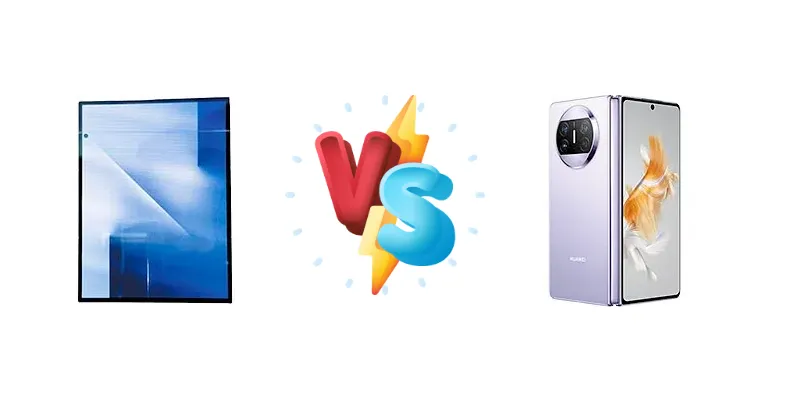
The foldable phone market is maturing, with Samsung and Huawei consistently pushing boundaries. The Samsung Galaxy Z TriFold represents the latest in processing power with the Snapdragon 8 Elite Gen 5, while the Huawei Mate X3 leverages a more established, albeit older, Snapdragon 8+ Gen 1, focusing on refined design and battery optimization. This comparison dissects the key differences to determine which foldable delivers the best experience.
🏆 Quick Verdict
For users prioritizing raw performance and future-proofing, the Samsung Galaxy Z TriFold is the clear winner. Its Snapdragon 8 Elite Gen 5 offers a significant leap in CPU and GPU capabilities. However, the Huawei Mate X3 provides a compelling alternative with its faster 66W wired and 50W wireless charging, and comparable battery endurance, making it ideal for power users who value longevity.
| Network |
|---|
| 2G bands | GSM 850 / 900 / 1800 / 1900 | GSM 850 / 900 / 1800 / 1900 |
| 3G bands | HSDPA 850 / 900 / 1700(AWS) / 1900 / 2100 | HSDPA 800 / 850 / 900 / 1700(AWS) / 1900 / 2100 |
| 4G bands | LTE | 1, 2, 3, 4, 5, 7, 8, 12, 17, 18, 19, 20, 26, 28, 34, 38, 39, 40, 41 |
| 5G bands | SA/NSA/Sub6 | - |
| Speed | HSPA, LTE, 5G | HSPA, LTE |
| Technology | GSM / CDMA / HSPA / EVDO / LTE / 5G | GSM / CDMA / HSPA / EVDO / LTE |
| | - | CDMA2000 1xEV-DO |
| Launch |
|---|
| Announced | Not announced yet | 2023, March 23 |
| Status | Rumored | Available. Released 2023, April 08 |
| Body |
|---|
| Build | - | Glass front, glass back or eco leather back, aluminum frame |
| Dimensions | Unfolded thickness: 4.2 mm Folded thickness: 14 mm | Unfolded: 156.9 x 141.5 x 5.3 mmFolded: 156.9 x 72.4 x 11.1 mm |
| SIM | Nano-SIM + eSIM | Nano-SIM + Nano-SIM |
| Weight | - | 239 g or 241 g (8.43 oz) |
| | - | IPX8 dust/water resistant (up to 1.5m for 30 min) |
| Display |
|---|
| Protection | - | Kunlun Glass (cover display only) |
| Resolution | 2232 x 3184 pixels (~389 ppi density) | 2224 x 2496 pixels (~426 ppi density) |
| Size | 10.0 inches, 303.2 cm2 | 7.85 inches, 197.5 cm2 (~88.9% screen-to-body ratio) |
| Type | Foldable LTPO OLED, 120Hz, HDR10+, 1600 nits (peak) | Foldable OLED, 1B colors, 120Hz |
| | - | Cover display:
OLED, 120Hz, 6.4 inches, 1080 x 2504 pixels |
| Platform |
|---|
| CPU | Octa-core (2x4.6 GHz Oryon V3 Phoenix L + 6x3.62 GHz Oryon V3 Phoenix M) | Octa-core (1x3.19 GHz Cortex-X2 & 3x2.75 GHz Cortex-A710 & 4x2.0 GHz Cortex-A510) |
| Chipset | Qualcomm SM8850-AC Snapdragon 8 Elite Gen 5 (3 nm) | Qualcomm SM8475 Snapdragon 8+ Gen 1 4G (4 nm) |
| GPU | Adreno 840 | Adreno 730 |
| OS | Android 16 | HarmonyOS 3.1 (China), EMUI 13.1 (Europe), no Google Play Services |
| Memory |
|---|
| Card slot | No | Nano Memory (uses shared SIM slot) |
| Internal | 512GB 16GB RAM, 1TB 16GB RAM | 256GB 12GB RAM, 512GB 12GB RAM, 1TB 12GB RAM |
| | - | UFS |
| Main Camera |
|---|
| Features | LED flash, HDR, panorama | Laser AF, color spectrum sensor, LED flash, panorama, HDR |
| Triple | 200 MP, f/1.7, 24mm (wide), 1/1.3", 0.6µm, multi-directional PDAF, OIS
50 MP (ultrawide)
third unspecified camera | 50 MP, f/1.8, 23mm (wide), PDAF, OIS
12 MP, f/3.4, 125mm (periscope telephoto), PDAF, OIS, 5x optical zoom
13 MP, f/2.2, 13mm (ultrawide), AF |
| Video | 8K@30fps, 4K@60fps, 1080p@60/120/240fps (gyro-EIS), 10-bit HDR, HDR10+ | 4K@30/60fps, 1080p@30/60fps, gyro-EIS |
| Selfie camera |
|---|
| Features | HDR | HDR, panorama |
| Single | Yes | 8 MP, f/2.4, (wide)
Cover camera:
8 MP, f/2.4, (wide) |
| Video | 4K@30/60fps, 1080p@30/60fps, gyro-EIS | 4K@30fps, 1080p@30fps |
| Sound |
|---|
| 3.5mm jack | - | No |
| 35mm jack | No | No |
| Loudspeaker | Yes, with stereo speakers | Yes, with stereo speakers |
| Comms |
|---|
| Bluetooth | 6.0, A2DP, LE, aptX HD | 5.2, A2DP, LE |
| Infrared port | - | Yes |
| NFC | Yes | Yes |
| Positioning | GPS, GALILEO, GLONASS, BDS, QZSS | GPS (L1+L5), GLONASS (B1I+B1c+B2a), BDS (B1I+B1c+B2a), GALILEO (E1+E5a), QZSS (L1+L5), NavIC |
| Radio | No | No |
| USB | USB Type-C 3.2, OTG | USB Type-C 3.1, DisplayPort 1.2, OTG |
| WLAN | Wi-Fi 802.11 a/b/g/n/ac/6e/7, tri-band, Wi-Fi Direct | Wi-Fi 802.11 a/b/g/n/ac/6, dual-band, Wi-Fi Direct |
| Features |
|---|
| Sensors | Fingerprint, accelerometer, gyro, proximity, compass | Fingerprint (side-mounted), accelerometer, gyro, proximity, compass, barometer, altimeter |
| | - | BDS Satellite Message |
| Battery |
|---|
| Charging | 45W wired | 66W wired
50W wireless
7.5W reverse wireless |
| Type | 5600 mAh | Market-dependent versions:· Li-Po 4800 mAh (Global)· Si/C Li-Ion 5060 mAh (China only) |
| Misc |
|---|
| Colors | Black; other colors | Black, White, Violet, Dark Green, Gold |
| Models | - | ALT-AL00, ALT-L29 |
| Price | - | About 1500 EUR |
| Tests |
|---|
| Battery life | - |
Endurance rating 81h
|
| Camera | - |
Photo / Video |
| Display | - |
Contrast ratio: Infinite (nominal) |
| Loudspeaker | - |
-26.3 LUFS (Good)
|
| Performance | - |
AnTuTu: 993592 (v9)
GeekBench: 4283 (v5.5), 4512 (v6)
GFXBench: 41fps (ES 3.1 onscreen) |
Samsung Galaxy Z TriFold
- Unmatched processing power with Snapdragon 8 Elite Gen 5
- Potentially superior thermal management due to 3nm process
- Likely benefits from Samsung's display expertise (LTPO)
- Slower charging speed (45W)
- Battery capacity unknown, potential for lower endurance
- Higher price expected
Huawei Mate X3
- Excellent battery life (81h endurance)
- Faster charging speeds (66W wired, 50W wireless)
- Proven Snapdragon 8+ Gen 1 performance
- Older chipset, less future-proof
- Less powerful CPU and GPU compared to Z TriFold
- May exhibit more throttling under sustained load
Display Comparison
The Huawei Mate X3 boasts a measured peak brightness of 926 nits, a strong figure for outdoor visibility. While the Z TriFold’s display specs are not provided, Samsung typically employs LTPO technology in its foldable displays, suggesting adaptive refresh rates for improved efficiency. The Mate X3’s ‘Infinite’ contrast ratio is a marketing term, but indicative of a high-quality OLED panel. The Z TriFold’s display quality will likely be comparable, but without specific data, it’s difficult to definitively declare a winner. Bezels and hinge design are also critical, but not specified in the provided data.
Camera Comparison
Both devices are listed as having Photo/Video capabilities, but lack specific details. Without sensor size, aperture, or OIS information, a direct comparison is impossible. However, given Huawei’s historical strength in mobile photography, the Mate X3 likely prioritizes image processing and computational photography. The Z TriFold, benefiting from the Snapdragon 8 Elite’s improved ISP, should also deliver excellent image quality, but the lack of specifics prevents a conclusive assessment. We can safely assume both will omit truly useful macro sensors.
Performance
The Samsung Galaxy Z TriFold’s Qualcomm SM8850-AC Snapdragon 8 Elite Gen 5, built on a 3nm process, is a substantial upgrade over the Huawei Mate X3’s 4nm Snapdragon 8+ Gen 1. The Z TriFold’s octa-core CPU, featuring Oryon V3 Phoenix cores clocked up to 4.6 GHz, promises significantly faster processing speeds compared to the Mate X3’s Cortex-X2 and A710 configuration. The 3nm node translates to improved thermal efficiency, potentially mitigating throttling during sustained workloads. While the Mate X3 is no slouch, the Z TriFold is geared towards users who need maximum performance.
Battery Life
The Huawei Mate X3’s endurance rating of 81 hours is impressive, suggesting excellent power management despite using an older chipset. It supports 66W wired charging, 50W wireless charging, and 7.5W reverse wireless charging – a comprehensive charging solution. The Z TriFold offers 45W wired charging, slower than the Mate X3. While the Z TriFold’s battery capacity is unknown, the Snapdragon 8 Elite’s efficiency could partially offset the slower charging speed. The Mate X3’s charging versatility gives it a clear advantage for users who frequently top up their devices.
Buying Guide
Buy the Samsung Galaxy Z TriFold if you demand the absolute best in mobile processing power for demanding tasks like gaming, video editing, or running complex applications. Buy the Huawei Mate X3 if you prioritize all-day battery life, faster charging speeds, and a refined foldable experience without necessarily needing the latest and greatest chipset.
Frequently Asked Questions
❓ Will the Snapdragon 8 Elite Gen 5 in the Z TriFold significantly improve gaming performance compared to the Mate X3?
Yes, the Snapdragon 8 Elite Gen 5’s Oryon V3 cores and advanced GPU architecture represent a substantial leap in performance. Expect higher frame rates, smoother gameplay, and improved graphics fidelity in demanding mobile games compared to the Snapdragon 8+ Gen 1 in the Mate X3.
❓ How much faster is the 66W charging on the Mate X3 compared to the 45W charging on the Z TriFold in real-world usage?
The 66W charging on the Mate X3 will noticeably reduce charging times. While exact figures depend on battery capacity, expect a 0-100% charge to be approximately 30-45 minutes faster on the Mate X3 compared to the Z TriFold.
❓ Does the Snapdragon 8+ Gen 1 in the Mate X3 still offer sufficient performance for everyday tasks and multitasking?
Absolutely. The Snapdragon 8+ Gen 1 remains a very capable chipset for everyday tasks, social media, and even moderate gaming. It won’t match the Z TriFold’s peak performance, but it provides a smooth and responsive user experience for the vast majority of users.
❓ Given the lack of detailed camera specs, can we expect similar image quality from both devices?
While both phones are capable, Huawei historically excels in computational photography. The Mate X3 likely prioritizes software enhancements for image quality. The Z TriFold, with its newer ISP, should also perform well, but without sensor details, a direct comparison is speculative.