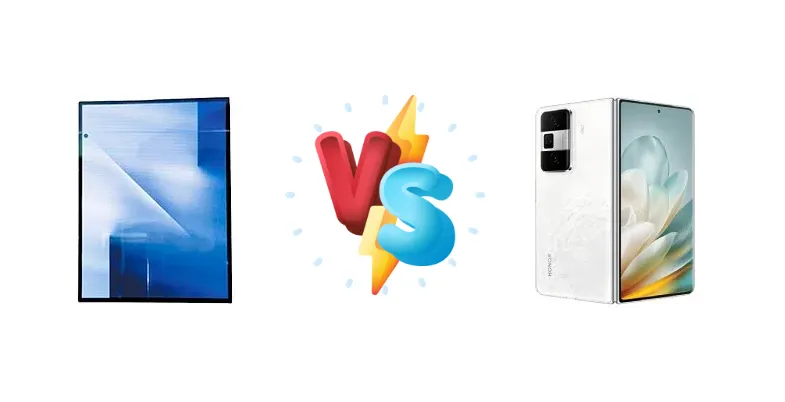
The foldable phone market is heating up, with Samsung continuing to refine its multi-fold design and Honor aggressively entering the space with compelling alternatives. This comparison pits the Samsung Galaxy Z TriFold, powered by the cutting-edge Snapdragon 8 Elite Gen 5, against the Honor Magic Vs3, featuring the established Snapdragon 8 Gen 2. We’ll dissect the key differences to determine which device delivers the best experience for power users and foldable enthusiasts.
🏆 Quick Verdict
For users prioritizing raw processing power and future-proofing, the Samsung Galaxy Z TriFold takes the lead thanks to its Snapdragon 8 Elite Gen 5. However, the Honor Magic Vs3 offers a more balanced package with faster charging speeds and potentially better thermal management, making it a strong contender for everyday use.
| Network |
|---|
| 2G bands | GSM 850 / 900 / 1800 / 1900 | GSM 850 / 900 / 1800 / 1900 |
| 3G bands | HSDPA 850 / 900 / 1700(AWS) / 1900 / 2100 | HSDPA 800 / 850 / 900 / 1700(AWS) / 1900 / 2100 |
| 4G bands | LTE | 1, 2, 3, 4, 5, 7, 8, 12, 17, 18, 19, 20, 26, 28, 34, 38, 39, 40, 41, 66 |
| 5G bands | SA/NSA/Sub6 | 1, 3, 5, 8, 28, 38, 41, 77, 78 SA/NSA |
| Speed | HSPA, LTE, 5G | HSPA, LTE, 5G |
| Technology | GSM / CDMA / HSPA / EVDO / LTE / 5G | GSM / CDMA / HSPA / CDMA2000 / LTE / 5G |
| Launch |
|---|
| Announced | Not announced yet | 2024, July 12 |
| Status | Rumored | Available. Released 2024, July 19 |
| Body |
|---|
| Dimensions | Unfolded thickness: 4.2 mm Folded thickness: 14 mm | Unfolded: 156.8 x 145.2 x 4.65 mm or 4.8 mmFolded: 156.8 x 74.0 x 9.8 mm or 10.1 mm |
| SIM | Nano-SIM + eSIM | · Nano-SIM + eSIM· Nano-SIM + Nano-SIM |
| Weight | - | 229 g or 231 g (8.08 oz) |
| Display |
|---|
| Protection | - | King Kong Rhinoceros |
| Resolution | 2232 x 3184 pixels (~389 ppi density) | 2156 x 2344 pixels (~402 ppi density) |
| Size | 10.0 inches, 303.2 cm2 | 7.92 inches, 201.6 cm2 (~88.6% screen-to-body ratio) |
| Type | Foldable LTPO OLED, 120Hz, HDR10+, 1600 nits (peak) | Foldable LTPO AMOLED, 1B colors, Dolby Vision, 120Hz |
| Platform |
|---|
| CPU | Octa-core (2x4.6 GHz Oryon V3 Phoenix L + 6x3.62 GHz Oryon V3 Phoenix M) | Octa-core (1x3.2 GHz Cortex-X3 & 2x2.8 GHz Cortex-A715 & 2x2.8 GHz Cortex-A710 & 3x2.0 GHz Cortex-A510) |
| Chipset | Qualcomm SM8850-AC Snapdragon 8 Elite Gen 5 (3 nm) | Qualcomm SM8550-AB Snapdragon 8 Gen 2 (4 nm) |
| GPU | Adreno 840 | Adreno 740 |
| OS | Android 16 | Android 14, MagicOS 8.0.1 |
| Memory |
|---|
| Card slot | No | No |
| Internal | 512GB 16GB RAM, 1TB 16GB RAM | 256GB 12GB RAM, 512GB 12GB RAM, 1TB 16GB RAM |
| Main Camera |
|---|
| Features | LED flash, HDR, panorama | Laser AF, LED flash, HDR, panorama |
| Triple | 200 MP, f/1.7, 24mm (wide), 1/1.3", 0.6µm, multi-directional PDAF, OIS
50 MP (ultrawide)
third unspecified camera | 50 MP, f/1.9, (wide), 1/1.56", PDAF, OIS
8 MP, f/3.4, (periscope telephoto), PDAF, OIS, 5x optical zoom
40 MP, f/2.2, 112˚, (ultrawide), AF |
| Video | 8K@30fps, 4K@60fps, 1080p@60/120/240fps (gyro-EIS), 10-bit HDR, HDR10+ | 4K@30/60fps (10-bit), 1080p@30/60fps, gyro-EIS, OIS |
| Selfie camera |
|---|
| Features | HDR | HDR |
| Single | Yes | 16 MP, f/2.2, 90˚, (wide)
Cover camera:
16 MP, f/2.2, 90˚, (wide) |
| Video | 4K@30/60fps, 1080p@30/60fps, gyro-EIS | 4K@30fps, 1080p@30fps, gyro-EIS |
| Sound |
|---|
| 35mm jack | No | No |
| Loudspeaker | Yes, with stereo speakers | Yes, with stereo speakers |
| Comms |
|---|
| Bluetooth | 6.0, A2DP, LE, aptX HD | 5.3, A2DP, LE, aptX HD, LDAC |
| Infrared port | - | Yes |
| NFC | Yes | Yes |
| Positioning | GPS, GALILEO, GLONASS, BDS, QZSS | GPS (L1+L5), GLONASS (L1), BDS (B1I+B1c+B2a), GALILEO (E1+E5a) |
| Radio | No | No |
| USB | USB Type-C 3.2, OTG | USB Type-C 3.1, OTG, Display Port 1.2 |
| WLAN | Wi-Fi 802.11 a/b/g/n/ac/6e/7, tri-band, Wi-Fi Direct | Wi-Fi 802.11 a/b/g/n/ac/6e/7, dual-band, Wi-Fi Direct |
| Features |
|---|
| Sensors | Fingerprint, accelerometer, gyro, proximity, compass | Fingerprint (side-mounted), accelerometer, gyro, proximity, compass, barometer |
| Battery |
|---|
| Charging | 45W wired | 66W wired
50W wireless
5W reverse wired |
| Type | 5600 mAh | Li-Po 5000 mAh |
| Misc |
|---|
| Colors | Black; other colors | Velvet Black, Snow, Tundra Green |
| Models | - | FLC-AN00 |
| Price | - | About 980 EUR |
Samsung Galaxy Z TriFold
- Unmatched CPU performance with Snapdragon 8 Elite Gen 5
- Potential for superior sustained performance due to 3nm process
- Likely faster RAM (LPDDR5x)
- Slower charging speed (45W)
- Potentially higher price
- May run hotter under sustained load
Honor Magic Vs3
- Faster charging (66W wired, 50W wireless)
- Potentially better thermal management with Snapdragon 8 Gen 2
- Competitive price point
- Less powerful CPU compared to Snapdragon 8 Elite Gen 5
- 4nm process may result in slightly lower efficiency
- May not match Z TriFold in peak performance
Display Comparison
While both devices are foldables, specifics are missing. However, the Z TriFold’s positioning suggests a focus on maximizing screen real estate, potentially with a higher resolution inner display. The Honor Magic Vs3 likely prioritizes durability and crease reduction. The Snapdragon 8 Elite Gen 5’s ISP will be crucial for driving a high-resolution foldable display, while the 8 Gen 2 will need to efficiently manage power consumption across multiple panels. Expect both to utilize LTPO technology for variable refresh rates, but the Z TriFold may push peak brightness higher to compensate for the larger surface area.
Camera Comparison
Without specific camera specs, we can infer that both devices will feature flagship-level camera systems. The Snapdragon 8 Elite Gen 5’s advanced ISP will likely enable more sophisticated image processing, potentially with improved low-light performance and dynamic range. The Honor Magic Vs3, leveraging the 8 Gen 2’s ISP, will also deliver excellent image quality, but may focus more on computational photography techniques. Expect both to feature OIS on the main sensor, but sensor size and lens apertures will be key differentiators. We anticipate both will avoid heavily relying on low-resolution auxiliary cameras.
Performance
The core difference lies in the chipsets. The Samsung Galaxy Z TriFold’s Snapdragon 8 Elite Gen 5, built on a 3nm process with Oryon V3 Phoenix cores, represents a significant leap in CPU performance, boasting clock speeds up to 4.6 GHz. This contrasts with the Honor Magic Vs3’s Snapdragon 8 Gen 2 (4nm), which utilizes standard ARM Cortex cores. The 3nm node of the 8 Elite Gen 5 promises superior power efficiency and transistor density, translating to higher sustained performance and reduced thermal throttling. While the 8 Gen 2 is no slouch, the Oryon architecture in the Z TriFold is designed for peak performance, benefiting users engaged in intensive tasks. The Z TriFold will likely pair this with faster LPDDR5x RAM, further enhancing responsiveness.
Battery Life
The Honor Magic Vs3’s charging capabilities are a clear advantage, offering 66W wired charging, 50W wireless, and 5W reverse wired. This significantly surpasses the Z TriFold’s 45W wired charging. While battery capacity is unknown for both, the faster charging on the Magic Vs3 will translate to quicker top-ups. The Snapdragon 8 Elite Gen 5’s improved power efficiency may partially offset the charging disparity, but the Magic Vs3’s wireless charging option provides added convenience. The 8 Gen 2’s 4nm process also contributes to better thermal efficiency, potentially leading to less battery drain during prolonged use.
Buying Guide
Buy the Samsung Galaxy Z TriFold if you demand the absolute best performance for demanding tasks like video editing, high-end gaming, and multitasking, and are willing to pay a premium. Buy the Honor Magic Vs3 if you prioritize a more efficient experience with faster charging, potentially better sustained performance under load, and a more competitive price point, making it ideal for daily use and media consumption.
Frequently Asked Questions
❓ Will the Snapdragon 8 Elite Gen 5 in the Z TriFold overheat during extended gaming sessions?
While the 3nm process aims to mitigate thermal issues, the Snapdragon 8 Elite Gen 5's higher clock speeds could generate more heat. Samsung will likely employ advanced cooling solutions, but sustained gaming at maximum settings may still result in some throttling. The Honor Magic Vs3's Snapdragon 8 Gen 2, with its 4nm process, may offer more consistent performance over longer periods.
❓ How much faster is the 66W charging on the Honor Magic Vs3 compared to the 45W charging on the Z TriFold?
The 66W charging on the Magic Vs3 will significantly reduce charging times. Expect a 0-100% charge to be approximately 30-45 minutes, compared to potentially 50-60 minutes on the Z TriFold. The addition of 50W wireless charging on the Magic Vs3 provides a convenient alternative, while the Z TriFold lacks wireless charging.
❓ Does the Oryon CPU architecture in the Z TriFold translate to a noticeable difference in everyday tasks?
For basic tasks like browsing and social media, the difference may be minimal. However, the Oryon architecture will shine in demanding applications like video editing, 3D rendering, and resource-intensive games. Users who frequently engage in these activities will experience a tangible performance boost.