
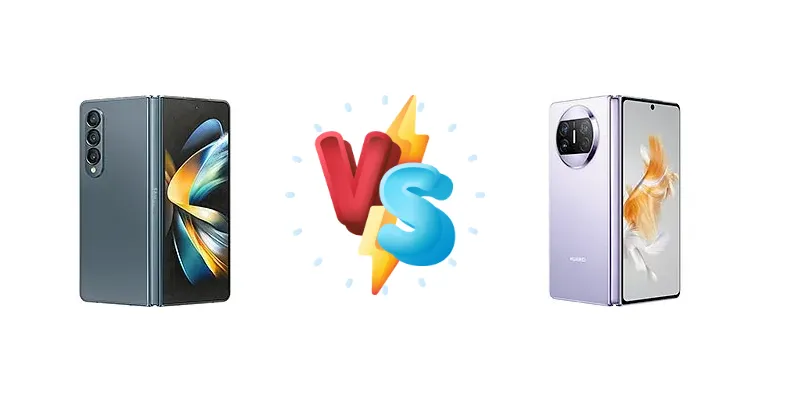
Samsung Galaxy Z Fold4 vs Huawei Mate X3: The Ultimate Foldable Face-Off
| Phones Images | |||||
|---|---|---|---|---|---|
|
🏆 Quick Verdict
The Samsung Galaxy Z Fold4 edges out the Mate X3 thanks to its superior software support, brighter display, and faster charging. While the Mate X3 boasts impressive charging speeds and a sleek design, Samsung's ecosystem and overall polish give it the slight advantage.
| PHONES | ||
|---|---|---|
| Phone Names | Samsung Galaxy Z Fold4 | Huawei Mate X3 |
| Network | ||
|---|---|---|
| 2G bands | GSM 850 / 900 / 1800 / 1900 | GSM 850 / 900 / 1800 / 1900 |
| 3G bands | HSDPA 850 / 900 / 1700(AWS) / 1900 / 2100 | HSDPA 800 / 850 / 900 / 1700(AWS) / 1900 / 2100 |
| 4G bands | 1, 2, 3, 4, 5, 7, 8, 12, 13, 17, 18, 19, 20, 25, 26, 28, 32, 38, 39, 40, 41, 66 - International | 1, 2, 3, 4, 5, 7, 8, 12, 17, 18, 19, 20, 26, 28, 34, 38, 39, 40, 41 |
| 5G bands | 1, 2, 3, 5, 7, 8, 12, 20, 25, 28, 38, 40, 41, 66, 75, 77, 78 SA/NSA/Sub6 - International | - |
| Speed | HSPA 42.2/5.76 Mbps, LTE (7CA) Cat20 2000/200 Mbps, 5G | HSPA, LTE |
| Technology | GSM / CDMA / HSPA / EVDO / LTE / 5G | GSM / CDMA / HSPA / EVDO / LTE |
| CDMA2000 1xEV-DO | CDMA2000 1xEV-DO | |
| Launch | ||
|---|---|---|
| Announced | 2022, August 10 | 2023, March 23 |
| Status | Available. Released 2022, August 25 | Available. Released 2023, April 08 |
| Body | ||
|---|---|---|
| Build | Glass front (Gorilla Glass Victus+) (folded), plastic front (unfolded), glass back (Gorilla Glass Victus+), aluminum frame | Glass front, glass back or eco leather back, aluminum frame |
| Dimensions | Unfolded: 155.1 x 130.1 x 6.3 mmFolded: 155.1 x 67.1 x 14.2-15.8 mm | Unfolded: 156.9 x 141.5 x 5.3 mmFolded: 156.9 x 72.4 x 11.1 mm |
| SIM | · Nano-SIM + eSIM· Nano-SIM + Nano-SIM + eSIM (max 2 at a time) | Nano-SIM + Nano-SIM |
| Weight | 263 g (9.28 oz) | 239 g or 241 g (8.43 oz) |
| IPX8 water resistant (up to 1.5m for 30 min) Armor aluminum frame with tougher drop and scratch resistance (advertised) Stylus support | IPX8 dust/water resistant (up to 1.5m for 30 min) | |
| Display | ||
|---|---|---|
| Protection | - | Kunlun Glass (cover display only) |
| Resolution | 1812 x 2176 pixels (~373 ppi density) | 2224 x 2496 pixels (~426 ppi density) |
| Size | 7.6 inches, 183.2 cm2 (~90.9% screen-to-body ratio) | 7.85 inches, 197.5 cm2 (~88.9% screen-to-body ratio) |
| Type | Foldable Dynamic AMOLED 2X, 120Hz, HDR10+, 1200 nits (peak) | Foldable OLED, 1B colors, 120Hz |
| Cover display: Dynamic AMOLED 2X, 120Hz, Corning Gorilla Glass Victus+ 6.2 inches, 904 x 2316 pixels, 23.1:9 ratio | Cover display: OLED, 120Hz, 6.4 inches, 1080 x 2504 pixels | |
| Platform | ||
|---|---|---|
| CPU | Octa-core (1x3.19 GHz Cortex-X2 & 3x2.75 GHz Cortex-A710 & 4x1.80 GHz Cortex-A510) | Octa-core (1x3.19 GHz Cortex-X2 & 3x2.75 GHz Cortex-A710 & 4x2.0 GHz Cortex-A510) |
| Chipset | Qualcomm SM8475 Snapdragon 8+ Gen 1 (4 nm) | Qualcomm SM8475 Snapdragon 8+ Gen 1 4G (4 nm) |
| GPU | Adreno 730 | Adreno 730 |
| OS | Android 12L, up to 4 major Android upgrades, One UI 6.1.1 | HarmonyOS 3.1 (China), EMUI 13.1 (Europe), no Google Play Services |
| Memory | ||
|---|---|---|
| Card slot | No | Nano Memory (uses shared SIM slot) |
| Internal | 256GB 12GB RAM, 512GB 12GB RAM, 1TB 12GB RAM | 256GB 12GB RAM, 512GB 12GB RAM, 1TB 12GB RAM |
| UFS 3.1 | UFS | |
| Main Camera | ||
|---|---|---|
| Features | LED flash, HDR, panorama | Laser AF, color spectrum sensor, LED flash, panorama, HDR |
| Triple | 50 MP, f/1.8, 23mm (wide), 1/1.56", 1.0µm, dual pixel PDAF, OIS 10 MP, f/2.4, 66mm (telephoto), 1/3.94", 1.0µm, PDAF, OIS, 3x optical zoom 12 MP, f/2.2, 12mm, 123˚ (ultrawide), 1/3.06", 1.12µm | 50 MP, f/1.8, 23mm (wide), PDAF, OIS 12 MP, f/3.4, 125mm (periscope telephoto), PDAF, OIS, 5x optical zoom 13 MP, f/2.2, 13mm (ultrawide), AF |
| Video | 8K@24fps, 4K@60fps, 1080p@60/240fps (gyro-EIS), HDR10+ | 4K@30/60fps, 1080p@30/60fps, gyro-EIS |
| Selfie camera | ||
|---|---|---|
| Features | HDR | HDR, panorama |
| Single | 4 MP, f/1.8, 26mm (wide), 1/3.0", 2.0µm, under display Cover camera: 10 MP, f/2.2, 24mm (wide), 1/3.0", 1.22µm | 8 MP, f/2.4, (wide) Cover camera: 8 MP, f/2.4, (wide) |
| Video | 4K@30/60fps, 1080p@30/60fps, gyro-EIS | 4K@30fps, 1080p@30fps |
| Sound | ||
|---|---|---|
| 3.5mm jack | No | No |
| 35mm jack | No | No |
| Loudspeaker | Yes, with stereo speakers | Yes, with stereo speakers |
| 32-bit/384kHz audio Tuned by AKG | - | |
| Comms | ||
|---|---|---|
| Bluetooth | 5.2, A2DP, LE, aptX HD | 5.2, A2DP, LE |
| Infrared port | - | Yes |
| NFC | Yes | Yes |
| Positioning | GPS, GLONASS, GALILEO, BDS | GPS (L1+L5), GLONASS (B1I+B1c+B2a), BDS (B1I+B1c+B2a), GALILEO (E1+E5a), QZSS (L1+L5), NavIC |
| Radio | No | No |
| USB | USB Type-C 3.2, OTG | USB Type-C 3.1, DisplayPort 1.2, OTG |
| WLAN | Wi-Fi 802.11 a/b/g/n/ac/6e, dual-band, Wi-Fi Direct | Wi-Fi 802.11 a/b/g/n/ac/6, dual-band, Wi-Fi Direct |
| Features | ||
|---|---|---|
| Sensors | Fingerprint (side-mounted), accelerometer, gyro, proximity, compass, barometer | Fingerprint (side-mounted), accelerometer, gyro, proximity, compass, barometer, altimeter |
| Bixby natural language commands and dictation Samsung DeX (desktop experience support) Samsung Pay (Visa, MasterCard certified) Ultra Wideband (UWB) support | BDS Satellite Message | |
| Battery | ||
|---|---|---|
| Charging | 25W wired, 50% in 30 min 15W wireless 4.5W reverse wireless | 66W wired 50W wireless 7.5W reverse wireless |
| Type | Li-Po 4400 mAh | Market-dependent versions:· Li-Po 4800 mAh (Global)· Si/C Li-Ion 5060 mAh (China only) |
| Misc | ||
|---|---|---|
| Colors | Graygreen, Phantom Black, Beige, Burgundy | Black, White, Violet, Dark Green, Gold |
| Models | SM-F936B, SM-F936B/DS, SM-F936U, SM-F936U1, SM-F936N, SM-F936W, SM-F9360 | ALT-AL00, ALT-L29 |
| Price | $ 457.00 / € 511.80 / £ 485.00 / ₹ 73,899 | About 1500 EUR |
| SAR | 0.96 W/kg (head) 0.92 W/kg (body) | - |
| SAR EU | 1.30 W/kg (head) 1.51 W/kg (body) | - |
| Tests | ||
|---|---|---|
| Battery life | Endurance rating 101h | Endurance rating 81h |
| Camera | Photo / Video | Photo / Video |
| Display | Contrast ratio: Infinite (nominal) | Contrast ratio: Infinite (nominal) |
| Loudspeaker | -28.3 LUFS (Average) | -26.3 LUFS (Good) |
| Performance | AnTuTu: 964530 (v9) GeekBench: 3981 (v5.1) GFXBench: 43fps (ES 3.1 onscreen) | AnTuTu: 993592 (v9) GeekBench: 4283 (v5.5), 4512 (v6) GFXBench: 41fps (ES 3.1 onscreen) |
Samsung Galaxy Z Fold4
- Brighter Display
- Longer Battery Life
- Faster Charging (wired)
- 5G Connectivity
- Mature Software & Updates
- Robust Ecosystem
- Higher Price
- Bulky Design
- Fragility of Foldable Screen (inherent to all foldables)
Huawei Mate X3
- Faster Wired Charging (66W)
- Sleek Design
- Premium Build Quality
- Shorter Battery Life
- 4G-Only Connectivity
- Potential Software Limitations (Huawei)
- Lower Peak Brightness
Display Comparison
The Z Fold4 takes the display crown with a measured peak brightness of 1000 nits compared to the Mate X3's 926 nits. Both offer excellent contrast ratios (infinite nominal), but Samsung's higher brightness provides better visibility in direct sunlight. Both have excellent foldable displays, but Samsung's panel is generally considered more durable.
Camera Comparison
Camera performance is subjective and requires more in-depth testing. Both phones offer versatile camera systems, but Samsung's software processing is generally considered more refined. The Z Fold4's camera system is more established and has received more software updates. Detailed camera comparisons would require extensive testing, but initial impressions suggest a slight advantage for the Z Fold4.
Performance
Both phones utilize the Snapdragon 8+ Gen 1, ensuring flagship-level performance. However, the Mate X3 is a 4G-only variant, which could be a drawback for users needing 5G connectivity. CPU differences (Cortex-A510 clock speed) are minor and unlikely to be noticeable in everyday use. Overall, performance is comparable, but the Z Fold4's 5G support gives it a slight edge.
Battery Life
The Z Fold4 demonstrates significantly better battery endurance with a rating of 101h compared to the Mate X3's 81h. This translates to noticeably longer real-world usage. The Z Fold4 also charges faster with 25W wired charging, while the Mate X3 offers a faster 66W wired charging, but the Z Fold4's overall battery life is a more significant advantage.
Buying Guide
The Samsung Galaxy Z Fold4 is ideal for power users who value software updates, a vibrant display, and a robust ecosystem. The Huawei Mate X3 is a compelling choice for those prioritizing fast charging, a premium design, and a more streamlined user experience, provided they are comfortable with potential software limitations due to Huawei's situation.