
Samsung Galaxy Z Fold4 vs. Apple iPhone 14 Pro Max: The Ultimate Showdown
| Phones Images | |||||
|---|---|---|---|---|---|
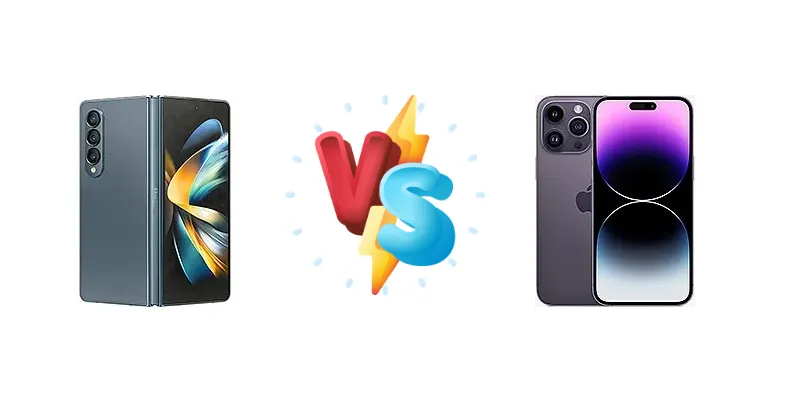
|
🏆 Quick Verdict
The iPhone 14 Pro Max offers superior battery life and a brighter display, alongside Apple's seamless ecosystem. However, the Z Fold4's unique foldable design and multitasking capabilities provide a distinct advantage for productivity-focused users. It's a trade-off between portability and innovation.
| PHONES | ||
|---|---|---|
| Phone Names | Samsung Galaxy Z Fold4 | Apple iPhone 14 Pro Max |
| Network | ||
|---|---|---|
| 2G bands | GSM 850 / 900 / 1800 / 1900 | GSM 850 / 900 / 1800 / 1900 |
| 3G bands | HSDPA 850 / 900 / 1700(AWS) / 1900 / 2100 | HSDPA 850 / 900 / 1700(AWS) / 1900 / 2100 |
| 4G bands | 1, 2, 3, 4, 5, 7, 8, 12, 13, 17, 18, 19, 20, 25, 26, 28, 32, 38, 39, 40, 41, 66 - International | 1, 2, 3, 4, 5, 7, 8, 12, 13, 17, 18, 19, 20, 25, 26, 28, 30, 32, 34, 38, 39, 40, 41, 42, 46, 48, 66 - A2894, A2896 |
| 5G bands | 1, 2, 3, 5, 7, 8, 12, 20, 25, 28, 38, 40, 41, 66, 75, 77, 78 SA/NSA/Sub6 - International | 1, 2, 3, 5, 7, 8, 12, 20, 25, 26, 28, 30, 38, 40, 41, 48, 66, 70, 77, 78, 79 SA/NSA/Sub6 - A2894, A2896 |
| Speed | HSPA 42.2/5.76 Mbps, LTE (7CA) Cat20 2000/200 Mbps, 5G | HSPA, LTE, 5G, EV-DO Rev.A 3.1 Mbps |
| Technology | GSM / CDMA / HSPA / EVDO / LTE / 5G | GSM / CDMA / HSPA / EVDO / LTE / 5G |
| CDMA2000 1xEV-DO | 1, 2, 3, 5, 7, 8, 12, 20, 25, 26, 28, 30, 38, 40, 41, 48, 66, 70, 77, 78, 79 SA/NSA/Sub6 - A2895 | |
| Launch | ||
|---|---|---|
| Announced | 2022, August 10 | 2022, September 07 |
| Status | Available. Released 2022, August 25 | Available. Released 2022, September 16 |
| Body | ||
|---|---|---|
| Build | Glass front (Gorilla Glass Victus+) (folded), plastic front (unfolded), glass back (Gorilla Glass Victus+), aluminum frame | Glass front, glass back, stainless steel frame |
| Dimensions | Unfolded: 155.1 x 130.1 x 6.3 mmFolded: 155.1 x 67.1 x 14.2-15.8 mm | 160.7 x 77.6 x 7.9 mm (6.33 x 3.06 x 0.31 in) |
| SIM | · Nano-SIM + eSIM· Nano-SIM + Nano-SIM + eSIM (max 2 at a time) | · Nano-SIM + eSIM + eSIM (max 2 at a time; International)· eSIM + eSIM (8 or more, max 2 at a time; USA)· Nano-SIM + Nano-SIM (China) |
| Weight | 263 g (9.28 oz) | 240 g (8.47 oz) |
| IPX8 water resistant (up to 1.5m for 30 min) Armor aluminum frame with tougher drop and scratch resistance (advertised) Stylus support | IP68 dust/water resistant (up to 6m for 30 min) Apple Pay (Visa, MasterCard, AMEX certified) | |
| Display | ||
|---|---|---|
| Protection | - | Ceramic Shield glass |
| Resolution | 1812 x 2176 pixels (~373 ppi density) | 1290 x 2796 pixels, 19.5:9 ratio (~460 ppi density) |
| Size | 7.6 inches, 183.2 cm2 (~90.9% screen-to-body ratio) | 6.7 inches, 110.2 cm2 (~88.3% screen-to-body ratio) |
| Type | Foldable Dynamic AMOLED 2X, 120Hz, HDR10+, 1200 nits (peak) | LTPO Super Retina XDR OLED, 120Hz, HDR10, Dolby Vision, 1000 nits (typ), 2000 nits (HBM) |
| Cover display: Dynamic AMOLED 2X, 120Hz, Corning Gorilla Glass Victus+ 6.2 inches, 904 x 2316 pixels, 23.1:9 ratio | Always-On display | |
| Platform | ||
|---|---|---|
| CPU | Octa-core (1x3.19 GHz Cortex-X2 & 3x2.75 GHz Cortex-A710 & 4x1.80 GHz Cortex-A510) | Hexa-core (2x3.46 GHz Everest + 4x2.02 GHz Sawtooth) |
| Chipset | Qualcomm SM8475 Snapdragon 8+ Gen 1 (4 nm) | Apple A16 Bionic (4 nm) |
| GPU | Adreno 730 | Apple GPU (5-core graphics) |
| OS | Android 12L, up to 4 major Android upgrades, One UI 6.1.1 | iOS 16, upgradable to iOS 26.1 |
| Memory | ||
|---|---|---|
| Card slot | No | No |
| Internal | 256GB 12GB RAM, 512GB 12GB RAM, 1TB 12GB RAM | 128GB 6GB RAM, 256GB 6GB RAM, 512GB 6GB RAM, 1TB 6GB RAM |
| UFS 3.1 | NVMe | |
| Main Camera | ||
|---|---|---|
| Features | LED flash, HDR, panorama | Dual-LED dual-tone flash, HDR (photo/panorama) |
| Single | - | 12 MP, f/1.9, 23mm (wide), 1/3.6", PDAF, OIS (unconfirmed) SL 3D, (depth/biometrics sensor) |
| Triple | 50 MP, f/1.8, 23mm (wide), 1/1.56", 1.0µm, dual pixel PDAF, OIS 10 MP, f/2.4, 66mm (telephoto), 1/3.94", 1.0µm, PDAF, OIS, 3x optical zoom 12 MP, f/2.2, 12mm, 123˚ (ultrawide), 1/3.06", 1.12µm | 48 MP, f/1.8, 24mm (wide), 1/1.28", 1.22µm, dual pixel PDAF, sensor-shift OIS 12 MP, f/2.8, 77mm (telephoto), 1/3.5", 1.0µm, PDAF, OIS, 3x optical zoom 12 MP, f/2.2, 13mm, 120˚ (ultrawide), 1/2.55", 1.4µm, dual pixel PDAF TOF 3D LiDAR scanner (depth) |
| Video | 8K@24fps, 4K@60fps, 1080p@60/240fps (gyro-EIS), HDR10+ | 4K@24/25/30/60fps, 1080p@25/30/60/120/240fps, 10-bit HDR, Dolby Vision HDR (up to 60fps), ProRes, stereo sound rec. |
| Selfie camera | ||
|---|---|---|
| Features | HDR | HDR |
| Single | 4 MP, f/1.8, 26mm (wide), 1/3.0", 2.0µm, under display Cover camera: 10 MP, f/2.2, 24mm (wide), 1/3.0", 1.22µm | 12 MP, f/1.9, 23mm (wide), 1/3.6", 1.0µm, PDAF, OIS SL 3D, (depth/biometrics sensor) |
| Video | 4K@30/60fps, 1080p@30/60fps, gyro-EIS | 4K@24/25/30/60fps, 1080p@25/30/60/120fps, gyro-EIS |
| Sound | ||
|---|---|---|
| 3.5mm jack | No | No |
| 35mm jack | No | No |
| Loudspeaker | Yes, with stereo speakers | Yes, with stereo speakers |
| 32-bit/384kHz audio Tuned by AKG | - | |
| Comms | ||
|---|---|---|
| Bluetooth | 5.2, A2DP, LE, aptX HD | 5.3, A2DP, LE |
| NFC | Yes | Yes |
| Positioning | GPS, GLONASS, GALILEO, BDS | GPS (L1+L5), GLONASS, GALILEO, BDS, QZSS |
| Radio | No | No |
| USB | USB Type-C 3.2, OTG | Lightning, USB 2.0 |
| WLAN | Wi-Fi 802.11 a/b/g/n/ac/6e, dual-band, Wi-Fi Direct | Wi-Fi 802.11 a/b/g/n/ac/6, dual-band, hotspot |
| Features | ||
|---|---|---|
| Sensors | Fingerprint (side-mounted), accelerometer, gyro, proximity, compass, barometer | Face ID, accelerometer, gyro, proximity, compass, barometer |
| Bixby natural language commands and dictation Samsung DeX (desktop experience support) Samsung Pay (Visa, MasterCard certified) Ultra Wideband (UWB) support | Ultra Wideband (UWB) support Emergency SOS via satellite (SMS sending/receiving) | |
| Battery | ||
|---|---|---|
| Charging | 25W wired, 50% in 30 min 15W wireless 4.5W reverse wireless | Wired, PD2.0, 50% in 30 min 15W wireless (MagSafe) 15W wireless (Qi2) - requires iOS 17.2 update |
| Type | Li-Po 4400 mAh | Li-Ion 4323 mAh (16.68 Wh) |
| Misc | ||
|---|---|---|
| Colors | Graygreen, Phantom Black, Beige, Burgundy | Space Black, Silver, Gold, Deep Purple |
| Models | SM-F936B, SM-F936B/DS, SM-F936U, SM-F936U1, SM-F936N, SM-F936W, SM-F9360 | A2894, A2651, A2893, A2895, A2896, iphone15,3 |
| Price | $ 457.00 / € 511.80 / £ 485.00 / ₹ 73,899 | € 530.79 / $ 489.81 / £ 446.75 |
| SAR | 0.96 W/kg (head) 0.92 W/kg (body) | 1.15 W/kg (head) 1.07 W/kg (body) |
| SAR EU | 1.30 W/kg (head) 1.51 W/kg (body) | 0.99 W/kg (head) 0.98 W/kg (body) |
| Tests | ||
|---|---|---|
| Battery life | Endurance rating 101h | Endurance rating 121h |
| Camera | Photo / Video | Photo / Video |
| Display | Contrast ratio: Infinite (nominal) | Contrast ratio: Infinite (nominal) |
| Loudspeaker | -28.3 LUFS (Average) | -24.3 LUFS (Very good) |
| Performance | AnTuTu: 964530 (v9) GeekBench: 3981 (v5.1) GFXBench: 43fps (ES 3.1 onscreen) | AnTuTu: 955884 (v9) GeekBench: 5423 (v5.1) GFXBench: 54fps (ES 3.1 onscreen) |
Samsung Galaxy Z Fold4
- Unique foldable design
- Large, immersive display when unfolded
- Powerful Snapdragon 8+ Gen 1 chipset
- Versatile camera system
- Reverse wireless charging
- More expensive than iPhone
- Foldable screen durability concerns
- Slightly shorter battery life
- Bulkier and heavier than iPhone
Apple iPhone 14 Pro Max
- Exceptional camera quality (especially video)
- Brighter display
- Longer battery life
- Seamless iOS ecosystem
- Premium build quality
- Less innovative design
- No expandable storage
- Charging speed could be faster
- MagSafe/Qi2 wireless charging requires iOS 17.2 or later
Display Comparison
The iPhone 14 Pro Max takes the display crown with a measured peak brightness of 1760 nits, significantly brighter than the Z Fold4's 1000 nits. Both offer excellent contrast ratios (nominal 'infinite'), but the iPhone's superior brightness makes it more visible in direct sunlight. The Z Fold4's foldable display is a marvel of engineering, offering a larger screen real estate when unfolded, but it's more prone to creasing and potential durability concerns.
Camera Comparison
The iPhone 14 Pro Max consistently delivers exceptional image quality, particularly in video recording. Its computational photography is top-tier. The Z Fold4's camera system is very good, but doesn't quite reach the iPhone's level of consistency and detail. The Z Fold4 offers more versatility with its multiple lenses, but the iPhone's video capabilities are a standout.
Performance
Both phones boast incredibly powerful chipsets. The iPhone 14 Pro Max's A16 Bionic is renowned for its raw processing power and efficiency. The Snapdragon 8+ Gen 1 in the Z Fold4 is also exceptionally fast, handling demanding tasks with ease. Real-world performance differences are minimal for most users, but the A16 Bionic often edges out in benchmark tests. iOS optimization also contributes to a consistently smooth experience.
Battery Life
The iPhone 14 Pro Max wins decisively in battery life, boasting an endurance rating of 121 hours compared to the Z Fold4's 101 hours. While both offer all-day battery life for moderate users, the iPhone provides more headroom for heavy usage.
Buying Guide
The Samsung Galaxy Z Fold4 is ideal for power users, multitaskers, and those seeking a unique, foldable form factor. The iPhone 14 Pro Max is perfect for users deeply invested in the Apple ecosystem, prioritizing camera quality, and desiring long battery life in a premium, traditional smartphone design.