
Samsung Galaxy Z Fold3 vs. Z Fold2: Which Folding Phone Reigns Supreme?
| Phones Images | |||||
|---|---|---|---|---|---|
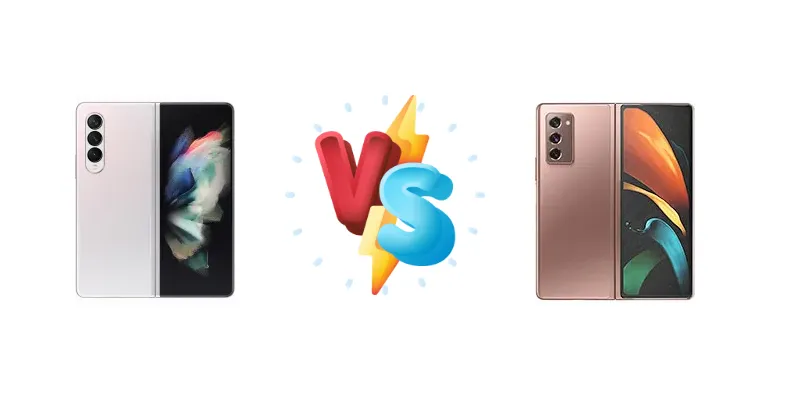
|
🏆 Quick Verdict
For most users, the Samsung Galaxy Z Fold3 is the better buy. The Snapdragon 888 delivers a noticeably smoother experience, especially for demanding tasks and gaming. However, those prioritizing maximum battery life and already owning a Z Fold2 may find the improvements incremental.
| PHONES | ||
|---|---|---|
| Phone Names | Samsung Galaxy Z Fold3 5G | Samsung Galaxy Z Fold2 5G |
| Network | ||
|---|---|---|
| 2G bands | GSM 850 / 900 / 1800 / 1900 | GSM 850 / 900 / 1800 / 1900 |
| 3G bands | HSDPA 850 / 900 / 1700(AWS) / 1900 / 2100 | HSDPA 850 / 900 / 1700(AWS) / 1900 / 2100 - SM-F916B |
| 4G bands | 1, 2, 3, 4, 5, 7, 8, 12, 13, 17, 18, 19, 20, 25, 26, 28, 32, 38, 39, 40, 41, 46, 48, 66 - Europe | 1, 2, 3, 4, 5, 7, 8, 12, 13, 17, 18, 19, 20, 25, 26, 28, 38, 39, 40, 41, 66 - SM-F916B |
| 5G bands | 1, 3, 5, 7, 8, 20, 28, 38, 40, 41, 66, 77, 78 SA/NSA/Sub6 - International | 1, 3, 5, 7, 8, 28, 40, 41, 77, 78 Sub6 - SM-F916B |
| Speed | HSPA 42.2/5.76 Mbps, LTE (7CA) Cat20 2000/200 Mbps, 5G | HSPA 42.2/5.76 Mbps, LTE (7CA) Cat20 2000/200 Mbps, 5G |
| Technology | GSM / CDMA / HSPA / EVDO / LTE / 5G | GSM / CDMA / HSPA / EVDO / LTE / 5G |
| 2, 5, 25, 41, 66, 71, 78, 260, 261 SA/NSA/Sub6/mmWave - USA | 2, 3, 4, 5, 7, 8, 12, 13, 18, 19, 20, 26, 28, 38, 39, 40, 41, 46, 48, 66 - SM-F916U1 | |
| Launch | ||
|---|---|---|
| Announced | 2021, August 11 | 2020, August 05 |
| Status | Available. Released 2021, August 27 | Available. Released 2020, September 18 |
| Body | ||
|---|---|---|
| Build | Glass front (Gorilla Glass Victus) (folded), plastic front (unfolded), glass back (Gorilla Glass Victus), aluminum frame | Glass front (folded), plastic front (unfolded), glass back, aluminum frame |
| Dimensions | Unfolded: 158.2 x 128.1 x 6.4 mmFolded: 158.2 x 67.1 x 14.4-16 mm | Unfolded: 159.2 x 128.2 x 6.9 mmFolded: 159.2 x 68 x 13.8-16.8 mm |
| SIM | Nano-SIM + eSIM | Nano-SIM + eSIM |
| Weight | 271 g (9.56 oz) | 282 g (9.95 oz) |
| IPX8 water resistant (up to 1.5m for 30 min) Armor aluminum frame with tougher drop and scratch resistance (advertised) Stylus support | - | |
| Display | ||
|---|---|---|
| Resolution | 1768 x 2208 pixels (~374 ppi density) | 1768 x 2208 pixels (~373 ppi density) |
| Size | 7.6 inches, 179.9 cm2 (~88.8% screen-to-body ratio) | 7.6 inches, 180.8 cm2 (~88.6% screen-to-body ratio) |
| Type | Foldable Dynamic AMOLED 2X, 120Hz, HDR10+, 1200 nits (peak) | Foldable Dynamic AMOLED 2X, 120Hz, HDR10+ |
| Cover display: Dynamic AMOLED 2X, 120Hz, Corning Gorilla Glass Victus 6.2 inches, 832 x 2268 pixels, 25:9 ratio | Cover display: Super AMOLED, Corning Gorilla Glass Victus 6.23 inches, 816 x 2260 pixels, 25:9 ratio | |
| Platform | ||
|---|---|---|
| CPU | Octa-core (1x2.84 GHz Cortex-X1 & 3x2.42 GHz Cortex-A78 & 4x1.80 GHz Cortex-A55) | Octa-core (1x3.09 GHz Cortex-A77 & 3x2.42 GHz Cortex-A77 & 4x1.80 GHz Cortex-A55) |
| Chipset | Qualcomm SM8350 Snapdragon 888 5G (5 nm) | Qualcomm SM8250 Snapdragon 865 5G+ (7 nm+) |
| GPU | Adreno 660 | Adreno 650 |
| OS | Android 11, up to 4 major Android upgrades, One UI 6.1 | Android 10, upgradable to Android 13, One UI 5.1.1 |
| Memory | ||
|---|---|---|
| Card slot | No | No |
| Internal | 256GB 12GB RAM, 512GB 12GB RAM | 256GB 12GB RAM, 512GB 12GB RAM |
| UFS 3.1 | UFS 3.1 | |
| Main Camera | ||
|---|---|---|
| Features | LED flash, HDR, panorama | LED flash, HDR, panorama |
| Triple | 12 MP, f/1.8, 26mm (wide), 1/1.76", 1.8µm, dual pixel PDAF, OIS 12 MP, f/2.4, 52mm (telephoto), 1/3.6", 1.0µm, PDAF, OIS, 2x optical zoom 12 MP, f/2.2, 123˚, 12mm (ultrawide), 1.12µm | 12 MP, f/1.8, 26mm (wide), 1/1.76", 1.8µm, dual pixel PDAF, OIS 12 MP, f/2.4, 52mm (telephoto), 1/3.6", 1.0µm, PDAF, OIS, 2x optical zoom 12 MP, f/2.2, 123˚, 12mm (ultrawide), 1.12µm |
| Video | 4K@60fps, 1080p@60/240fps (gyro-EIS), HDR10+ | 4K@60fps, 1080p@60/240fps (gyro-EIS), 720p@960fps (gyro-EIS), HDR10+ |
| Selfie camera | ||
|---|---|---|
| Features | HDR | HDR |
| Single | 4 MP, f/1.8, 2.0µm, under display Cover camera: 10 MP, f/2.2, 26mm (wide), 1/3", 1.22µm | 10 MP, f/2.2, 26mm (wide), 1/3", 1.22µm Cover camera: 10 MP, f/2.2, 26mm (wide), 1/3", 1.22µm |
| Video | 4K@30fps, 1080p@30fps, gyro-EIS | 4K@30fps, 1080p@30fps, gyro-EIS |
| Sound | ||
|---|---|---|
| 3.5mm jack | No | No |
| 35mm jack | No | No |
| Loudspeaker | Yes, with stereo speakers | Yes, with stereo speakers |
| 32-bit/384kHz audio Tuned by AKG | 32-bit/384kHz audio Tuned by AKG | |
| Comms | ||
|---|---|---|
| Bluetooth | 5.2, A2DP, LE, aptX HD | 5.0, A2DP, LE, aptX HD |
| NFC | Yes | Yes |
| Positioning | GPS, GLONASS, GALILEO, BDS | GPS, GLONASS, GALILEO, BDS |
| Radio | No | No |
| USB | USB Type-C 3.2 | USB Type-C 3.2 |
| WLAN | Wi-Fi 802.11 a/b/g/n/ac/6e, dual-band, Wi-Fi Direct | Wi-Fi 802.11 a/b/g/n/ac/6, dual-band, Wi-Fi Direct |
| Features | ||
|---|---|---|
| Sensors | Fingerprint (side-mounted), accelerometer, gyro, proximity, compass, barometer | Fingerprint (side-mounted), accelerometer, gyro, proximity, compass, barometer |
| Bixby natural language commands and dictation Samsung DeX (desktop experience support) Samsung Pay (Visa, MasterCard certified) Ultra Wideband (UWB) support | Bixby natural language commands and dictation Samsung DeX (desktop experience support) Samsung Pay (Visa, MasterCard certified) Ultra Wideband (UWB) support | |
| Battery | ||
|---|---|---|
| Charging | 25W wired 11W wireless 4.5W reverse wireless | 25W wired 11W wireless 4.5W reverse wireless |
| Type | Li-Po 4400 mAh | Li-Po 4500 mAh |
| Misc | ||
|---|---|---|
| Colors | Phantom Black, Phantom Silver, Phantom Green, Thom Browne Edition, Wooyoungmi Edition | Mystic Bronze, Mystic Black, Thom Browne Edition, Aston Martin Racing Edition |
| Models | SM-F926B, SM-F926B/DS, SM-F926U, SM-F926U1, SM-F926W, SM-F9260, SM-F926N | SM-F916B, SM-F916U, SM-F916U1, SM-F916N, SM-F9160, SM-F916W, SCG05 |
| Price | € 453.57 / $ 367.74 / £ 449.99 | About 960 EUR |
| SAR | 0.73 W/kg (head) 1.22 W/kg (body) | - |
| SAR EU | 1.04 W/kg (head) 1.44 W/kg (body) | 0.86 W/kg (head) 1.45 W/kg (body) |
| Tests | ||
|---|---|---|
| Battery life | Endurance rating 75h | Endurance rating 81h |
| Camera | Photo / Video | Photo / Video |
| Loudspeaker | -25.6 LUFS (Very good) | -25.2 LUFS (Very good) |
| Performance | AnTuTu: 635918 (v8), 752218 (v9) GeekBench: 12719 (v4.4), 3239 (v5.1) GFXBench: 38fps (ES 3.1 onscreen) | AnTuTu: 564907 (v8) GeekBench: 12607 (v4.4), 2715 (v5.1) GFXBench: 33fps (ES 3.1 onscreen) |
Samsung Galaxy Z Fold3 5G
- Significantly faster processor for demanding tasks
- Brighter display for improved outdoor visibility
- Under-display camera maximizes screen real estate
- Improved image processing capabilities
- Shorter battery life compared to the Z Fold2
- Potential for more thermal throttling under sustained load
Samsung Galaxy Z Fold2 5G
- Longer battery life for all-day use
- More efficient processor
- Potentially lower price point
- Proven reliability
- Slower processor for demanding tasks
- Dimmer display compared to the Z Fold3
Display Comparison
The Z Fold3 boasts a brighter display, reaching a measured 922 nits compared to the Z Fold2’s 714 nits. This translates to improved visibility in direct sunlight. Both utilize dynamic AMOLED technology, but the Z Fold3’s increased brightness and potentially refined color calibration (though not specified in the data) offer a more vibrant viewing experience. While both feature 120Hz refresh rates, the Z Fold3 benefits from under-display camera technology, maximizing screen real estate, though image quality from that camera is a separate consideration. The Z Fold3’s brightness advantage is particularly beneficial for outdoor use.
Camera Comparison
Both devices feature a similar 'Photo / Video' camera setup, lacking specific details in the provided data. However, the Z Fold3’s newer image signal processor (ISP) within the Snapdragon 888 likely provides improved image processing capabilities, resulting in better dynamic range, noise reduction, and overall image quality. Without detailed sensor specifications, it’s difficult to make a definitive judgment, but the Z Fold3’s processing advantage is a likely win. The inclusion of features like Single Take mode, enhanced in the Z Fold3, further differentiates the camera experience.
Performance
The Z Fold3’s Snapdragon 888 5G (5nm) represents a substantial leap over the Z Fold2’s Snapdragon 865 5G+ (7nm+). The 5nm process node allows for greater transistor density and improved thermal efficiency, though the 888 is known to run warmer. The Z Fold3’s CPU features a Cortex-X1 prime core clocked at 2.84GHz, a significant upgrade from the Z Fold2’s Cortex-A77 prime core at 3.09GHz. While the clock speed is slightly lower, the architectural improvements of the X1 core deliver superior performance. This translates to faster app loading times, smoother multitasking, and improved gaming performance. The Z Fold3’s GPU also benefits from the newer architecture, offering a more capable graphics experience.
Battery Life
Despite both supporting 25W wired, 11W wireless, and 4.5W reverse wireless charging, the Z Fold2 holds a slight edge in endurance with a rating of 81 hours, compared to the Z Fold3’s 75 hours. This is likely due to the more efficient 7nm+ manufacturing process of the Snapdragon 865+ and the Z Fold3’s more power-hungry Snapdragon 888. While the difference isn’t massive, users prioritizing battery life will find the Z Fold2 more appealing. The Z Fold3’s increased performance comes at the cost of reduced battery stamina.
Buying Guide
Buy the Samsung Galaxy Z Fold3 5G if you need a significant performance boost for multitasking, gaming, or content creation, and are willing to accept slightly reduced battery life. Buy the Samsung Galaxy Z Fold2 5G if you prioritize longer battery endurance, are on a tighter budget, and don't require the latest and greatest processing power. The Z Fold2 remains a very capable device, especially given potential price drops.