
Samsung Galaxy Z Fold3 5G vs. Z Flip4: A Deep Dive into Samsung's Foldable Lineup
| Phones Images | |||||
|---|---|---|---|---|---|
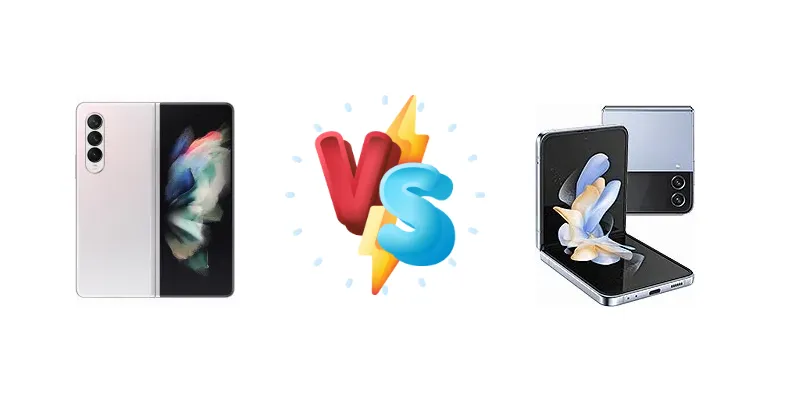
|
🏆 Quick Verdict
For the average user prioritizing battery life and pocketability, the Samsung Galaxy Z Flip4 is the clear winner. Its Snapdragon 8+ Gen 1 chipset delivers superior efficiency, resulting in a 92-hour endurance rating compared to the Z Fold3’s 75 hours. However, power users demanding a larger screen for multitasking and productivity will still find the Z Fold3 compelling.
| PHONES | ||
|---|---|---|
| Phone Names | Samsung Galaxy Z Fold3 5G | Samsung Galaxy Z Flip4 |
| Network | ||
|---|---|---|
| 2G bands | GSM 850 / 900 / 1800 / 1900 | GSM 850 / 900 / 1800 / 1900 |
| 3G bands | HSDPA 850 / 900 / 1700(AWS) / 1900 / 2100 | HSDPA 850 / 900 / 1700(AWS) / 1900 / 2100 |
| 4G bands | 1, 2, 3, 4, 5, 7, 8, 12, 13, 17, 18, 19, 20, 25, 26, 28, 32, 38, 39, 40, 41, 46, 48, 66 - Europe | 1, 2, 3, 4, 5, 7, 8, 12, 13, 17, 18, 19, 20, 25, 26, 28, 32, 38, 39, 40, 41, 66 |
| 5G bands | 1, 3, 5, 7, 8, 20, 28, 38, 40, 41, 66, 77, 78 SA/NSA/Sub6 - International | 1, 2, 3, 5, 7, 8, 12, 20, 25, 28, 38, 40, 41, 66, 75, 77, 78 SA/NSA/Sub6 - International |
| Speed | HSPA 42.2/5.76 Mbps, LTE (7CA) Cat20 2000/200 Mbps, 5G | HSPA, LTE (6CA), 5G |
| Technology | GSM / CDMA / HSPA / EVDO / LTE / 5G | GSM / CDMA / HSPA / EVDO / LTE / 5G |
| 2, 5, 25, 41, 66, 71, 78, 260, 261 SA/NSA/Sub6/mmWave - USA | CDMA2000 1xEV-DO | |
| Launch | ||
|---|---|---|
| Announced | 2021, August 11 | 2022, August 10 |
| Status | Available. Released 2021, August 27 | Available. Released 2022, August 25 |
| Body | ||
|---|---|---|
| Build | Glass front (Gorilla Glass Victus) (folded), plastic front (unfolded), glass back (Gorilla Glass Victus), aluminum frame | Plastic front (unfolded), glass back (Gorilla Glass Victus+), aluminum frame |
| Dimensions | Unfolded: 158.2 x 128.1 x 6.4 mmFolded: 158.2 x 67.1 x 14.4-16 mm | Unfolded: 165.2 x 71.9 x 6.9 mm Folded: 84.9 x 71.9 x 15.9-17.1 mm |
| SIM | Nano-SIM + eSIM | Nano-SIM + eSIM |
| Weight | 271 g (9.56 oz) | 187 g (6.60 oz) |
| IPX8 water resistant (up to 1.5m for 30 min) Armor aluminum frame with tougher drop and scratch resistance (advertised) Stylus support | IPX8 water resistant (up to 1.5m for 30 min) Armor aluminum frame with tougher drop and scratch resistance (advertised) | |
| Display | ||
|---|---|---|
| Resolution | 1768 x 2208 pixels (~374 ppi density) | 1080 x 2640 pixels (~426 ppi density) |
| Size | 7.6 inches, 179.9 cm2 (~88.8% screen-to-body ratio) | 6.7 inches, 101.5 cm2 (~85.4% screen-to-body ratio) |
| Type | Foldable Dynamic AMOLED 2X, 120Hz, HDR10+, 1200 nits (peak) | Foldable Dynamic AMOLED 2X, 120Hz, HDR10+, 1200 nits (peak) |
| Cover display: Dynamic AMOLED 2X, 120Hz, Corning Gorilla Glass Victus 6.2 inches, 832 x 2268 pixels, 25:9 ratio | Cover display: Super AMOLED, 1.9 inches, 260 x 512 pixels (Gorilla Glass Victus+) | |
| Platform | ||
|---|---|---|
| CPU | Octa-core (1x2.84 GHz Cortex-X1 & 3x2.42 GHz Cortex-A78 & 4x1.80 GHz Cortex-A55) | Octa-core (1x3.19 GHz Cortex-X2 & 3x2.75 GHz Cortex-A710 & 4x1.80 GHz Cortex-A510) |
| Chipset | Qualcomm SM8350 Snapdragon 888 5G (5 nm) | Qualcomm SM8475 Snapdragon 8+ Gen 1 (4 nm) |
| GPU | Adreno 660 | Adreno 730 |
| OS | Android 11, up to 4 major Android upgrades, One UI 6.1 | Android 12, upgradable to Android 15, One UI 7 |
| Memory | ||
|---|---|---|
| Card slot | No | No |
| Internal | 256GB 12GB RAM, 512GB 12GB RAM | 128GB 8GB RAM, 256GB 8GB RAM, 512GB 8GB RAM |
| UFS 3.1 | UFS 3.1 | |
| Main Camera | ||
|---|---|---|
| Dual | - | 12 MP, f/1.8, 24mm (wide), 1/1.76", 1.8µm, dual pixel PDAF, OIS 12 MP, f/2.2, 13mm, 123˚ (ultrawide), 1/3.06", 1.12µm |
| Features | LED flash, HDR, panorama | LED flash, HDR, panorama |
| Triple | 12 MP, f/1.8, 26mm (wide), 1/1.76", 1.8µm, dual pixel PDAF, OIS 12 MP, f/2.4, 52mm (telephoto), 1/3.6", 1.0µm, PDAF, OIS, 2x optical zoom 12 MP, f/2.2, 123˚, 12mm (ultrawide), 1.12µm | - |
| Video | 4K@60fps, 1080p@60/240fps (gyro-EIS), HDR10+ | 4K@30/60fps, 1080p@60/240fps, HDR10+ |
| Selfie camera | ||
|---|---|---|
| Features | HDR | HDR |
| Single | 4 MP, f/1.8, 2.0µm, under display Cover camera: 10 MP, f/2.2, 26mm (wide), 1/3", 1.22µm | 10 MP, f/2.4, 26mm (wide), 1/3.0", 1.22µm |
| Video | 4K@30fps, 1080p@30fps, gyro-EIS | 4K@30fps |
| Sound | ||
|---|---|---|
| 3.5mm jack | No | No |
| 35mm jack | No | No |
| Loudspeaker | Yes, with stereo speakers | Yes, with stereo speakers |
| 32-bit/384kHz audio Tuned by AKG | 32-bit/384kHz audio Tuned by AKG | |
| Comms | ||
|---|---|---|
| Bluetooth | 5.2, A2DP, LE, aptX HD | 5.2, A2DP, LE |
| NFC | Yes | Yes |
| Positioning | GPS, GLONASS, GALILEO, BDS | GPS, GLONASS, GALILEO, BDS |
| Radio | No | No |
| USB | USB Type-C 3.2 | USB Type-C 2.0, OTG |
| WLAN | Wi-Fi 802.11 a/b/g/n/ac/6e, dual-band, Wi-Fi Direct | Wi-Fi 802.11 a/b/g/n/ac/6, dual-band, Wi-Fi Direct |
| Features | ||
|---|---|---|
| Sensors | Fingerprint (side-mounted), accelerometer, gyro, proximity, compass, barometer | Fingerprint (side-mounted), accelerometer, gyro, proximity, compass, barometer |
| Bixby natural language commands and dictation Samsung DeX (desktop experience support) Samsung Pay (Visa, MasterCard certified) Ultra Wideband (UWB) support | Samsung Pay (Visa, MasterCard certified) | |
| Battery | ||
|---|---|---|
| Charging | 25W wired 11W wireless 4.5W reverse wireless | 25W wired, 50% in 30 min 15W wireless 4.5W reverse wireless |
| Type | Li-Po 4400 mAh | Li-Po 3700 mAh |
| Misc | ||
|---|---|---|
| Colors | Phantom Black, Phantom Silver, Phantom Green, Thom Browne Edition, Wooyoungmi Edition | Bora Purple, Graphite, Pink Gold, Blue, Yellow, White, Navy, Khaki, Red |
| Models | SM-F926B, SM-F926B/DS, SM-F926U, SM-F926U1, SM-F926W, SM-F9260, SM-F926N | SM-F721B, SM-F721B/DS, SM-F721N, SM-F721U, SM-F721U1, SM-F721W, SM-F7210 |
| Price | € 453.57 / $ 367.74 / £ 449.99 | $ 214.99 / C$ 334.00 / £ 219.00 / € 284.00 / ₹ 40,999 |
| SAR | 0.73 W/kg (head) 1.22 W/kg (body) | 1.02 W/kg (head) 0.94 W/kg (body) |
| SAR EU | 1.04 W/kg (head) 1.44 W/kg (body) | 1.15 W/kg (head) 1.20 W/kg (body) |
| Tests | ||
|---|---|---|
| Battery life | Endurance rating 75h | Endurance rating 92h |
| Camera | Photo / Video | Photo / Video |
| Display | - | Contrast ratio: Infinite (nominal) |
| Loudspeaker | -25.6 LUFS (Very good) | -27.5 LUFS (Good) |
| Performance | AnTuTu: 635918 (v8), 752218 (v9) GeekBench: 12719 (v4.4), 3239 (v5.1) GFXBench: 38fps (ES 3.1 onscreen) | AnTuTu: 685754 (v8) | 800001 (v9) GeekBench: 3913 (v5.1) GFXBench: 74fps (ES 3.1 onscreen) |
Samsung Galaxy Z Fold3 5G
- Larger, more versatile display for multitasking
- S Pen support enhances productivity
- Potentially better zoom capabilities (assuming telephoto lens)
- More immersive media consumption experience
- Less efficient Snapdragon 888 chipset
- Shorter battery life (75h endurance)
- Bulkier and heavier form factor
- Higher price point (at launch)
Samsung Galaxy Z Flip4
- More efficient Snapdragon 8+ Gen 1 chipset
- Longer battery life (92h endurance)
- More compact and pocketable design
- Faster charging (50% in 30 min)
- Smaller internal display
- Less ideal for intensive multitasking
- Limited S Pen support
- Cover screen functionality is limited
Display Comparison
Both the Z Fold3 and Z Flip4 feature vibrant displays, achieving similar peak brightness levels of around 920 nits (measured). However, their approaches differ significantly. The Z Fold3 boasts a larger 7.6-inch internal folding display, ideal for multitasking, while the Z Flip4 features a 6.7-inch internal display and a smaller 1.9-inch cover screen for quick glances at notifications. The Z Flip4’s ‘Infinite’ contrast ratio, while a marketing term, suggests excellent black levels, enhancing video viewing. The Z Fold3’s larger canvas is more conducive to split-screen applications and S Pen input, making it a productivity powerhouse.
Camera Comparison
Both phones offer versatile camera systems capable of capturing high-quality photos and videos. However, detailed sensor information is lacking in the provided data. Given Samsung’s history, it’s reasonable to assume both feature multi-lens setups with OIS. The Z Flip4 benefits from the improved image signal processing (ISP) capabilities of the Snapdragon 8+ Gen 1, resulting in better low-light performance and dynamic range. The Z Fold3, while capable, is likely to exhibit more noise in challenging lighting conditions. The presence of a dedicated telephoto lens on the Z Fold3 (based on typical configurations) would give it an edge in zoom capabilities, but this isn't confirmed by the provided data.
Performance
The performance gap between these devices is substantial. The Z Flip4’s Snapdragon 8+ Gen 1 (4nm) represents a significant leap over the Z Fold3’s Snapdragon 888 (5nm). The 4nm process node translates to improved thermal efficiency and sustained performance under load. The Flip4’s CPU, featuring a Cortex-X2 prime core clocked at 3.19 GHz, outperforms the Fold3’s Cortex-X1 (2.84 GHz). This difference is noticeable in demanding tasks like gaming and video editing. While both utilize LPDDR5 RAM, the Flip4’s more efficient chipset allows it to maintain higher frame rates for longer periods.
Battery Life
Battery life is where the Z Flip4 truly shines. Despite having a similar battery capacity, the Snapdragon 8+ Gen 1’s efficiency delivers an endurance rating of 92 hours, a significant improvement over the Z Fold3’s 75 hours. The Flip4 also supports faster charging, reaching 50% charge in just 30 minutes with its 25W wired charging. Both devices offer 15W wireless and 4.5W reverse wireless charging, but the Flip4’s superior battery life means you’ll be relying on wired charging less frequently.
Buying Guide
Buy the Samsung Galaxy Z Fold3 5G if you need a device that seamlessly transitions between smartphone and tablet, prioritizing multitasking, note-taking with an S Pen (sold separately), and immersive media consumption. Buy the Samsung Galaxy Z Flip4 if you prefer a compact, stylish foldable that easily fits in your pocket, excels at social media, and offers excellent battery life for everyday use.