
Samsung Galaxy Z Fold3 5G vs. Note20 Ultra 5G: A Deep Dive into Innovation and Refinement
| Phones Images | |||||
|---|---|---|---|---|---|
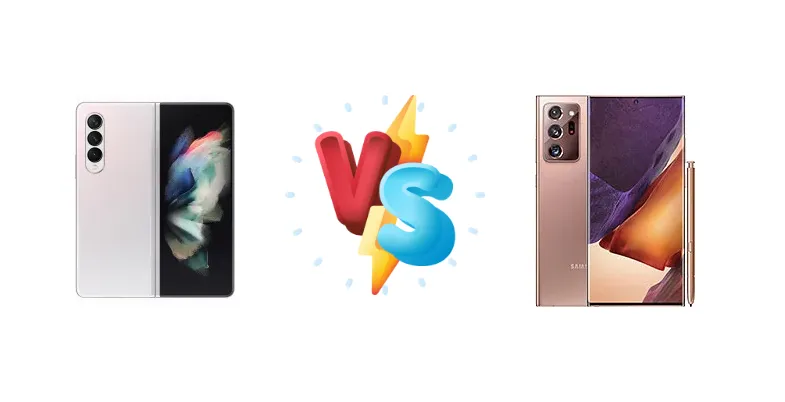
|
🏆 Quick Verdict
For the average user prioritizing battery life and a more mature software experience, the Note20 Ultra 5G remains a compelling choice. However, power users and early adopters seeking a truly unique and productive experience will find the Z Fold3 5G's foldable display and multitasking capabilities worth the compromises.
| PHONES | ||
|---|---|---|
| Phone Names | Samsung Galaxy Z Fold3 5G | Samsung Galaxy Note20 Ultra 5G |
| Network | ||
|---|---|---|
| 2G bands | GSM 850 / 900 / 1800 / 1900 | GSM 850 / 900 / 1800 / 1900 |
| 3G bands | HSDPA 850 / 900 / 1700(AWS) / 1900 / 2100 | HSDPA 850 / 900 / 1700(AWS) / 1900 / 2100 |
| 4G bands | 1, 2, 3, 4, 5, 7, 8, 12, 13, 17, 18, 19, 20, 25, 26, 28, 32, 38, 39, 40, 41, 46, 48, 66 - Europe | 1, 2, 3, 4, 5, 7, 8, 12, 13, 14, 18, 19, 20, 25, 26, 28, 29, 30, 38, 39, 40, 41, 46, 48, 66, 71 - SM-N986U |
| 5G bands | 1, 3, 5, 7, 8, 20, 28, 38, 40, 41, 66, 77, 78 SA/NSA/Sub6 - International | 2, 5, 41, 66, 71, 260, 261 SA/NSA/Sub6/mmWave - SM-N986U |
| Speed | HSPA 42.2/5.76 Mbps, LTE (7CA) Cat20 2000/200 Mbps, 5G | HSPA 42.2/5.76 Mbps, LTE (7CA) Cat20 2000/200 Mbps, 5G |
| Technology | GSM / CDMA / HSPA / EVDO / LTE / 5G | GSM / CDMA / HSPA / EVDO / LTE / 5G |
| 2, 5, 25, 41, 66, 71, 78, 260, 261 SA/NSA/Sub6/mmWave - USA | 41, 66, 71 Sub6 - SM-N986W | |
| Launch | ||
|---|---|---|
| Announced | 2021, August 11 | 2020, August 05 |
| Status | Available. Released 2021, August 27 | Available. Released 2020, August 21 |
| Body | ||
|---|---|---|
| Build | Glass front (Gorilla Glass Victus) (folded), plastic front (unfolded), glass back (Gorilla Glass Victus), aluminum frame | Glass front (Gorilla Glass Victus), glass back (Gorilla Glass Victus), stainless steel frame |
| Dimensions | Unfolded: 158.2 x 128.1 x 6.4 mmFolded: 158.2 x 67.1 x 14.4-16 mm | 164.8 x 77.2 x 8.1 mm (6.49 x 3.04 x 0.32 in) |
| SIM | Nano-SIM + eSIM | · Nano-SIM + eSIM· Nano-SIM + Nano-SIM |
| Weight | 271 g (9.56 oz) | 208 g (7.34 oz) |
| IPX8 water resistant (up to 1.5m for 30 min) Armor aluminum frame with tougher drop and scratch resistance (advertised) Stylus support | IP68 dust/water resistant (up to 1.5m for 30 min) Stylus, 9ms latency (Bluetooth integration, accelerometer, gyro) | |
| Display | ||
|---|---|---|
| Protection | - | Corning Gorilla Glass Victus |
| Resolution | 1768 x 2208 pixels (~374 ppi density) | 1440 x 3088 pixels, 19.3:9 ratio (~496 ppi density) |
| Size | 7.6 inches, 179.9 cm2 (~88.8% screen-to-body ratio) | 6.9 inches, 116.7 cm2 (~91.7% screen-to-body ratio) |
| Type | Foldable Dynamic AMOLED 2X, 120Hz, HDR10+, 1200 nits (peak) | Dynamic AMOLED 2X, 120Hz, HDR10+ |
| Cover display: Dynamic AMOLED 2X, 120Hz, Corning Gorilla Glass Victus 6.2 inches, 832 x 2268 pixels, 25:9 ratio | Always-on display 120Hz@FHD/60Hz@QHD refresh rate | |
| Platform | ||
|---|---|---|
| CPU | Octa-core (1x2.84 GHz Cortex-X1 & 3x2.42 GHz Cortex-A78 & 4x1.80 GHz Cortex-A55) | Octa-core (2x2.73 GHz Mongoose M5 & 2x2.50 GHz Cortex-A76 & 4x2.0 GHz Cortex-A55) - GlobalOcta-core (1x3.0 GHz Kryo 585 & 3x2.42 GHz Cortex-A77 & 4x1.80 GHz Cortex-A55) - USA |
| Chipset | Qualcomm SM8350 Snapdragon 888 5G (5 nm) | Exynos 990 (7 nm+) - GlobalQualcomm SM8250 Snapdragon 865 5G+ (7 nm+) - USA |
| GPU | Adreno 660 | Mali-G77 MP11 - GlobalAdreno 650 - USA |
| OS | Android 11, up to 4 major Android upgrades, One UI 6.1 | Android 10, upgradable to Android 13, One UI 5 |
| Memory | ||
|---|---|---|
| Card slot | No | microSDXC (uses shared SIM slot) |
| Internal | 256GB 12GB RAM, 512GB 12GB RAM | 128GB 6GB RAM, 128GB 8GB RAM, 128GB 12GB RAM, 256GB 8GB RAM, 256GB 12GB RAM, 512GB 12GB RAM |
| UFS 3.1 | UFS 3.0 | |
| Main Camera | ||
|---|---|---|
| Features | LED flash, HDR, panorama | Laser AF, LED flash, auto-HDR, panorama |
| Single | - | 3.15 MP |
| Triple | 12 MP, f/1.8, 26mm (wide), 1/1.76", 1.8µm, dual pixel PDAF, OIS 12 MP, f/2.4, 52mm (telephoto), 1/3.6", 1.0µm, PDAF, OIS, 2x optical zoom 12 MP, f/2.2, 123˚, 12mm (ultrawide), 1.12µm | 108 MP, f/1.8, 26mm (wide), 1/1.33", 0.8µm, PDAF, OIS 12 MP, f/3.0, 120mm (periscope telephoto), 1.0µm, PDAF, OIS, 5x optical zoom, 50x hybrid zoom 12 MP, f/2.2, 120˚, 13mm (ultrawide), 1/2.55", 1.4µm |
| Video | 4K@60fps, 1080p@60/240fps (gyro-EIS), HDR10+ | 8K@24fps, 4K@30/60fps, 1080p@30/60/240fps, 720p@960fps, HDR10+, stereo sound rec., gyro-EIS & OIS |
| Selfie camera | ||
|---|---|---|
| Features | HDR | HDR |
| Single | 4 MP, f/1.8, 2.0µm, under display Cover camera: 10 MP, f/2.2, 26mm (wide), 1/3", 1.22µm | 10 MP, f/2.2, 26mm (wide), 1/3.2", 1.22µm, dual pixel PDAF |
| Video | 4K@30fps, 1080p@30fps, gyro-EIS | 4K@30/60fps, 1080p@30fps |
| Sound | ||
|---|---|---|
| 3.5mm jack | No | No |
| 35mm jack | No | No |
| Loudspeaker | Yes, with stereo speakers | Yes, with stereo speakers |
| 32-bit/384kHz audio Tuned by AKG | 32-bit/384kHz audio Tuned by AKG | |
| Comms | ||
|---|---|---|
| Bluetooth | 5.2, A2DP, LE, aptX HD | 5.0, A2DP, LE, aptX |
| NFC | Yes | Yes |
| Positioning | GPS, GLONASS, GALILEO, BDS | GPS, GLONASS, BDS, GALILEO |
| Radio | No | FM radio (Snapdragon model only; market/operator dependent) |
| USB | USB Type-C 3.2 | USB Type-C 3.2, OTG |
| WLAN | Wi-Fi 802.11 a/b/g/n/ac/6e, dual-band, Wi-Fi Direct | Wi-Fi 802.11 a/b/g/n/ac/6, dual-band, Wi-Fi Direct |
| Features | ||
|---|---|---|
| Sensors | Fingerprint (side-mounted), accelerometer, gyro, proximity, compass, barometer | Fingerprint (under display, ultrasonic), accelerometer, gyro, proximity, compass, barometer |
| Bixby natural language commands and dictation Samsung DeX (desktop experience support) Samsung Pay (Visa, MasterCard certified) Ultra Wideband (UWB) support | Samsung Wireless DeX (desktop experience support) ANT+ Bixby natural language commands and dictation Samsung Pay (Visa, MasterCard certified) Ultra Wideband (UWB) support | |
| Battery | ||
|---|---|---|
| Charging | 25W wired 11W wireless 4.5W reverse wireless | 25W wired, PD3.0 15W wireless (Qi) 4.5W reverse wireless |
| Type | Li-Po 4400 mAh | Li-Ion 4500 mAh |
| Misc | ||
|---|---|---|
| Colors | Phantom Black, Phantom Silver, Phantom Green, Thom Browne Edition, Wooyoungmi Edition | Mystic Bronze, Mystic Black, Mystic White |
| Models | SM-F926B, SM-F926B/DS, SM-F926U, SM-F926U1, SM-F926W, SM-F9260, SM-F926N | SM-N986B, SM-N986B/DS, SM-N986U, SM-N986U1, SM-N986W, SM-N9860, SM-N986N, SC-53A |
| Price | € 453.57 / $ 367.74 / £ 449.99 | € 381.00 / $ 248.44 |
| SAR | 0.73 W/kg (head) 1.22 W/kg (body) | 0.71 W/kg (head) 1.18 W/kg (body) |
| SAR EU | 1.04 W/kg (head) 1.44 W/kg (body) | 0.34 W/kg (head) 1.47 W/kg (body) |
| Tests | ||
|---|---|---|
| Battery life | Endurance rating 75h | Endurance rating 88h |
| Camera | Photo / Video | Photo / Video |
| Display | - | Contrast ratio: Infinite (nominal) |
| Loudspeaker | -25.6 LUFS (Very good) | -27.8 LUFS (Good) |
| Performance | AnTuTu: 635918 (v8), 752218 (v9) GeekBench: 12719 (v4.4), 3239 (v5.1) GFXBench: 38fps (ES 3.1 onscreen) | AnTuTu: 508760 (v8) GeekBench: 2603 (v5.1) GFXBench: 42fps (ES 3.1 onscreen) |
Samsung Galaxy Z Fold3 5G
- Innovative foldable display for multitasking
- More powerful Snapdragon 888 processor
- S Pen support (sold separately)
- Under-display camera for immersive viewing
- Significantly shorter battery life
- Higher price point
- Durability concerns with foldable screen
- Software optimization still maturing
Samsung Galaxy Note20 Ultra 5G
- Exceptional battery life
- Brighter display for outdoor visibility
- Integrated S Pen for productivity
- More mature and refined software experience
- Less powerful processor compared to Z Fold3
- Regional chipset variations (Exynos vs Snapdragon)
- Conventional smartphone form factor
- No foldable display for tablet-like experience
Display Comparison
The Note20 Ultra boasts a brighter display, peaking at 1024 nits, compared to the Z Fold3’s 922 nits, making it more visible outdoors. However, the Z Fold3’s foldable 7.6-inch internal display fundamentally alters the experience, offering a tablet-like canvas. While the Note20 Ultra’s 6.9-inch display is excellent, it can’t match the Z Fold3’s versatility. The Z Fold3 utilizes a more advanced under-display camera (UDC) for a less intrusive viewing experience, though image quality from that camera is lower. Both displays offer a 120Hz refresh rate, but the Z Fold3’s is dynamically adjusted, potentially impacting smoothness in certain scenarios.
Camera Comparison
Both phones offer versatile camera systems, but the Z Fold3’s camera benefits from the newer chipset’s image signal processor (ISP). While detailed sensor specs are not provided, the Z Fold3’s processing likely results in improved dynamic range and low-light performance. The Note20 Ultra’s camera system is known for its excellent zoom capabilities and color science. Both phones are capable of recording high-quality video, but the Z Fold3’s newer processor may offer more advanced video features. The inclusion of a 2MP macro camera on the Note20 Ultra is largely inconsequential, offering limited practical benefit.
Performance
The Z Fold3’s Snapdragon 888 5G (5nm) chipset represents a generational leap over the Note20 Ultra’s Exynos 990 (7nm+) or Snapdragon 865 5G+ (7nm+), depending on the region. The 5nm process node of the Snapdragon 888 delivers improved power efficiency and thermal performance, translating to sustained performance during demanding tasks. The Z Fold3’s CPU, with its Cortex-X1 prime core, offers a noticeable performance advantage in single-core tasks. While the Note20 Ultra remains capable, the Z Fold3’s chipset provides a smoother experience for gaming and resource-intensive applications. The Note20 Ultra's regional chipset variation (Exynos vs Snapdragon) introduces performance inconsistencies, a factor the Z Fold3 avoids.
Battery Life
The Note20 Ultra’s 88-hour endurance rating significantly surpasses the Z Fold3’s 75-hour rating. This difference is primarily due to the Z Fold3’s larger, more power-hungry foldable display and the demands of powering two screens. While both phones support 25W wired charging, the Note20 Ultra’s larger battery means it will take longer to fully charge. The Z Fold3 offers 11W wireless charging, while the Note20 Ultra supports 15W wireless charging (Qi), providing a slightly faster wireless charging experience. The 4.5W reverse wireless charging is identical on both devices.
Buying Guide
Buy the Samsung Galaxy Z Fold3 5G if you need a tablet-sized screen in your pocket for multitasking, content creation, and immersive media consumption, and are willing to accept shorter battery life and a higher price. Buy the Samsung Galaxy Note20 Ultra 5G if you prefer a more conventional, refined smartphone experience with exceptional battery life, a superb camera, and the integrated S Pen for productivity and creativity.