
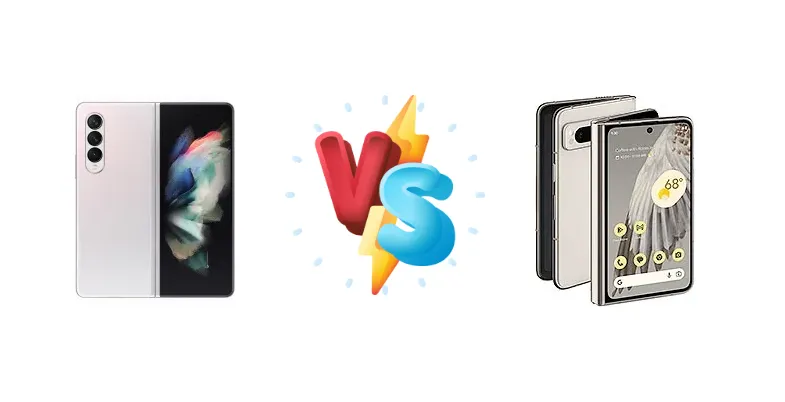
Samsung Galaxy Z Fold3 5G vs. Google Pixel Fold: A Deep Dive Comparison
| Phones Images | |||||
|---|---|---|---|---|---|
|
🏆 Quick Verdict
For most users, the Google Pixel Fold offers a more compelling experience due to its potentially superior software integration and modern chipset. While the Z Fold3 boasts a proven track record and slightly brighter display, the Tensor G2 in the Pixel Fold promises better long-term performance and software support.
| PHONES | ||
|---|---|---|
| Phone Names | Samsung Galaxy Z Fold3 5G | Google Pixel Fold |
| Network | ||
|---|---|---|
| 2G bands | GSM 850 / 900 / 1800 / 1900 | GSM 850 / 900 / 1800 / 1900 |
| 3G bands | HSDPA 850 / 900 / 1700(AWS) / 1900 / 2100 | HSDPA 800 / 850 / 900 / 1700(AWS) / 1900 / 2100 |
| 4G bands | 1, 2, 3, 4, 5, 7, 8, 12, 13, 17, 18, 19, 20, 25, 26, 28, 32, 38, 39, 40, 41, 46, 48, 66 - Europe | 1, 2, 3, 4, 5, 7, 8, 12, 13, 14, 17, 18, 19, 20, 21, 25, 26, 28, 29, 30, 32, 38, 39, 40, 41, 42, 46, 48, 66, 71 |
| 5G bands | 1, 3, 5, 7, 8, 20, 28, 38, 40, 41, 66, 77, 78 SA/NSA/Sub6 - International | 1, 2, 3, 5, 7, 8, 12, 14, 20, 25, 28, 30, 38, 40, 41, 48, 66, 71, 75, 76, 77, 78, 79, 257, 258, 260, 261 SA/NSA/Sub6/mmWave |
| Speed | HSPA 42.2/5.76 Mbps, LTE (7CA) Cat20 2000/200 Mbps, 5G | HSPA, LTE, 5G |
| Technology | GSM / CDMA / HSPA / EVDO / LTE / 5G | GSM / CDMA / HSPA / EVDO / LTE / 5G |
| 2, 5, 25, 41, 66, 71, 78, 260, 261 SA/NSA/Sub6/mmWave - USA | CDMA2000 1xEV-DO | |
| Launch | ||
|---|---|---|
| Announced | 2021, August 11 | 2023, May 10 |
| Status | Available. Released 2021, August 27 | Available. Released 2023, June 27 |
| Body | ||
|---|---|---|
| Build | Glass front (Gorilla Glass Victus) (folded), plastic front (unfolded), glass back (Gorilla Glass Victus), aluminum frame | Glass front (Gorilla Glass Victus) (folded), plastic front (unfolded), glass back (Gorilla Glass Victus), aluminum frame |
| Dimensions | Unfolded: 158.2 x 128.1 x 6.4 mmFolded: 158.2 x 67.1 x 14.4-16 mm | Unfolded: 139.7 x 158.7 x 5.8 mmFolded: 139.7 x 79.5 x 12.1 mm |
| SIM | Nano-SIM + eSIM | Nano-SIM + eSIM |
| Weight | 271 g (9.56 oz) | 283 g (9.98 oz) |
| IPX8 water resistant (up to 1.5m for 30 min) Armor aluminum frame with tougher drop and scratch resistance (advertised) Stylus support | IPX8 water resistant | |
| Display | ||
|---|---|---|
| Resolution | 1768 x 2208 pixels (~374 ppi density) | 1840 x 2208 pixels (~378 ppi density) |
| Size | 7.6 inches, 179.9 cm2 (~88.8% screen-to-body ratio) | 7.6 inches, 183.3 cm2 (~82.7% screen-to-body ratio) |
| Type | Foldable Dynamic AMOLED 2X, 120Hz, HDR10+, 1200 nits (peak) | Foldable OLED, 120Hz, HDR10+, 1000 nits (HBM), 1450 nits (peak) |
| Cover display: Dynamic AMOLED 2X, 120Hz, Corning Gorilla Glass Victus 6.2 inches, 832 x 2268 pixels, 25:9 ratio | Cover display: OLED, 120Hz, HDR, Corning Gorilla Glass Victus 5.8 inches, 1080 x 2092 pixels, 17.4:9 ratio, 408 ppi 1200 nits (HBM), 1550 nits (peak) | |
| Platform | ||
|---|---|---|
| CPU | Octa-core (1x2.84 GHz Cortex-X1 & 3x2.42 GHz Cortex-A78 & 4x1.80 GHz Cortex-A55) | Octa-core (2x2.85 GHz Cortex-X1 & 2x2.35 GHz Cortex-A78 & 4x1.80 GHz Cortex-A55) |
| Chipset | Qualcomm SM8350 Snapdragon 888 5G (5 nm) | Google Tensor G2 (5 nm) |
| GPU | Adreno 660 | Mali-G710 MP7 |
| OS | Android 11, up to 4 major Android upgrades, One UI 6.1 | Android 13, upgradable to Android 15, up to 5 major Android upgrades |
| Memory | ||
|---|---|---|
| Card slot | No | No |
| Internal | 256GB 12GB RAM, 512GB 12GB RAM | 256GB 12GB RAM, 512GB 12GB RAM |
| UFS 3.1 | UFS 3.1 | |
| Main Camera | ||
|---|---|---|
| Features | LED flash, HDR, panorama | Laser AF, Dual-LED flash, HDR, panorama |
| Triple | 12 MP, f/1.8, 26mm (wide), 1/1.76", 1.8µm, dual pixel PDAF, OIS 12 MP, f/2.4, 52mm (telephoto), 1/3.6", 1.0µm, PDAF, OIS, 2x optical zoom 12 MP, f/2.2, 123˚, 12mm (ultrawide), 1.12µm | 48 MP, f/1.7, 25mm (wide), 1/2.0", 0.8µm, dual pixel PDAF, OIS 10.8 MP, f/3.1, 112mm (telephoto), 1/3.1", 1.22µm, dual pixel PDAF, OIS, 5x optical zoom 10.8 MP, f/2.2, 121˚, (ultrawide), 1/3.0", 1.25µm |
| Video | 4K@60fps, 1080p@60/240fps (gyro-EIS), HDR10+ | 4K@30/60fps, 1080p@30/60/120/240fps, 10-bit HDR |
| Selfie camera | ||
|---|---|---|
| Features | HDR | HDR, panorama |
| Single | 4 MP, f/1.8, 2.0µm, under display Cover camera: 10 MP, f/2.2, 26mm (wide), 1/3", 1.22µm | 8 MP, f/2.0, 24mm (wide), 1/4.0", 1.12µm Cover camera: 9.5 MP, f/2.2, 24mm (wide), 1.22µm, dual pixel PDAF |
| Video | 4K@30fps, 1080p@30fps, gyro-EIS | 4K@30/60fps, 1080p@30/60fps |
| Sound | ||
|---|---|---|
| 3.5mm jack | No | No |
| 35mm jack | No | No |
| Loudspeaker | Yes, with stereo speakers | Yes, with stereo speakers |
| 32-bit/384kHz audio Tuned by AKG | - | |
| Comms | ||
|---|---|---|
| Bluetooth | 5.2, A2DP, LE, aptX HD | 5.2, A2DP, LE, aptX HD |
| NFC | Yes | Yes |
| Positioning | GPS, GLONASS, GALILEO, BDS | GPS, GLONASS, GALILEO, BDS |
| Radio | No | No |
| USB | USB Type-C 3.2 | USB Type-C 3.2, OTG |
| WLAN | Wi-Fi 802.11 a/b/g/n/ac/6e, dual-band, Wi-Fi Direct | Wi-Fi 802.11 a/b/g/n/ac/6e, tri-band, Wi-Fi Direct |
| Features | ||
|---|---|---|
| Sensors | Fingerprint (side-mounted), accelerometer, gyro, proximity, compass, barometer | Fingerprint (side-mounted), accelerometer, gyro, proximity, compass, barometer |
| Bixby natural language commands and dictation Samsung DeX (desktop experience support) Samsung Pay (Visa, MasterCard certified) Ultra Wideband (UWB) support | Ultra Wideband (UWB) support | |
| Battery | ||
|---|---|---|
| Charging | 25W wired 11W wireless 4.5W reverse wireless | Wired, PD3.0 Wireless |
| Type | Li-Po 4400 mAh | Li-Po 4821 mAh |
| Misc | ||
|---|---|---|
| Colors | Phantom Black, Phantom Silver, Phantom Green, Thom Browne Edition, Wooyoungmi Edition | Porcelain, Obsidian |
| Models | SM-F926B, SM-F926B/DS, SM-F926U, SM-F926U1, SM-F926W, SM-F9260, SM-F926N | G9FPL |
| Price | € 453.57 / $ 367.74 / £ 449.99 | € 670.87 / $ 389.26 / £ 899.99 |
| SAR | 0.73 W/kg (head) 1.22 W/kg (body) | - |
| SAR EU | 1.04 W/kg (head) 1.44 W/kg (body) | - |
| Tests | ||
|---|---|---|
| Battery life | Endurance rating 75h | - |
| Camera | Photo / Video | - |
| Loudspeaker | -25.6 LUFS (Very good) | - |
| Performance | AnTuTu: 635918 (v8), 752218 (v9) GeekBench: 12719 (v4.4), 3239 (v5.1) GFXBench: 38fps (ES 3.1 onscreen) | - |
Samsung Galaxy Z Fold3 5G
- Brighter display (922 nits)
- Proven foldable design
- More affordable price point
- Older Snapdragon 888 chipset
- Less advanced charging technology
- Limited software update commitment
Google Pixel Fold
- Modern Google Tensor G2 chipset
- Superior software experience
- Potentially faster charging
- Unknown display brightness
- Higher price
- First-generation foldable design risks
Display Comparison
The Samsung Galaxy Z Fold3 5G features a display capable of reaching 922 nits of peak brightness, a significant advantage for outdoor use compared to the Pixel Fold (brightness data unavailable, but typically lower in first-generation foldables). Both utilize foldable OLED technology, but Samsung’s experience in this space is evident in its refined hinge mechanism. The Pixel Fold’s aspect ratio is wider, potentially offering a more comfortable experience for multitasking, but the Z Fold3’s higher peak brightness remains a key differentiator for visibility in direct sunlight. The absence of PWM dimming rate data for the Pixel Fold raises potential concerns for users sensitive to flicker, while the Z Fold3’s PWM rate is not specified, requiring further investigation.
Camera Comparison
Both devices feature capable camera systems, but detailed sensor information is limited. The Pixel Fold leverages Google’s computational photography prowess, promising excellent image quality in various conditions. The Z Fold3’s camera is described as 'Photo / Video', lacking specifics. Given Google’s history, the Pixel Fold likely excels in dynamic range and low-light performance. The absence of detailed camera specs for the Z Fold3 makes a direct comparison difficult, but the Pixel Fold’s Tensor G2 chip is specifically designed to accelerate image processing, giving it a potential advantage. We can assume both phones offer a versatile camera experience, but the Pixel Fold’s software is likely the deciding factor.
Performance
The Google Pixel Fold’s Tensor G2 chipset, built on a 5nm process, represents a generational leap over the Samsung Galaxy Z Fold3’s Snapdragon 888 5G (also 5nm). While both CPUs feature an octa-core configuration with Cortex-X1 prime cores, the Tensor G2’s architecture is optimized for machine learning tasks, potentially leading to faster image processing and smarter features. The Pixel Fold’s CPU clocks slightly higher (2x2.85 GHz vs 1x2.84 GHz), suggesting a marginal performance edge. However, the Snapdragon 888 is a proven performer, and the Z Fold3’s thermal management will be crucial in sustained workloads. The Pixel Fold benefits from Google’s software optimizations, which could further enhance real-world performance.
Battery Life
The Samsung Galaxy Z Fold3 5G has an endurance rating of 75 hours, indicating respectable battery life. The Pixel Fold’s battery capacity is unknown, but its charging capabilities are more modern, supporting wired PD3.0 and wireless charging. The Z Fold3 offers 25W wired charging, 11W wireless, and 4.5W reverse wireless. The Pixel Fold’s charging speeds are not specified, but PD3.0 support suggests faster wired charging potential. The Z Fold3’s 75-hour endurance rating provides a baseline, but the Pixel Fold’s more efficient Tensor G2 chip could potentially deliver comparable or better battery life despite an unknown capacity.
Buying Guide
Buy the Samsung Galaxy Z Fold3 5G if you prioritize a more affordable entry point into the foldable world and value a display that reaches 922 nits of peak brightness for excellent outdoor visibility. Buy the Google Pixel Fold if you prefer a cleaner Android experience, anticipate benefiting from Google’s AI features, and want a device with a more modern processor for sustained performance and future software updates.