
Samsung Galaxy Z Fold3 5G vs. Apple iPhone 14 Pro Max: A Clash of Form and Function
| Phones Images | |||||
|---|---|---|---|---|---|
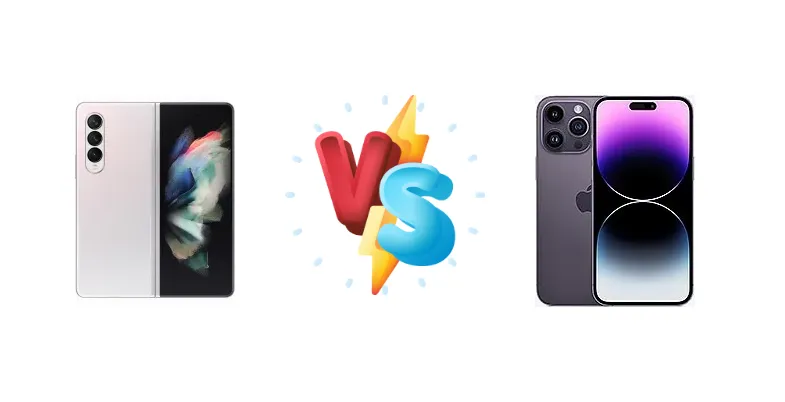
|
🏆 Quick Verdict
For the average user prioritizing battery life, raw processing power, and a mature software ecosystem, the Apple iPhone 14 Pro Max is the clear winner. However, the Samsung Galaxy Z Fold3 5G remains a compelling choice for those seeking a genuinely innovative and versatile form factor, despite its compromises in battery and performance.
| PHONES | ||
|---|---|---|
| Phone Names | Samsung Galaxy Z Fold3 5G | Apple iPhone 14 Pro Max |
| Network | ||
|---|---|---|
| 2G bands | GSM 850 / 900 / 1800 / 1900 | GSM 850 / 900 / 1800 / 1900 |
| 3G bands | HSDPA 850 / 900 / 1700(AWS) / 1900 / 2100 | HSDPA 850 / 900 / 1700(AWS) / 1900 / 2100 |
| 4G bands | 1, 2, 3, 4, 5, 7, 8, 12, 13, 17, 18, 19, 20, 25, 26, 28, 32, 38, 39, 40, 41, 46, 48, 66 - Europe | 1, 2, 3, 4, 5, 7, 8, 12, 13, 17, 18, 19, 20, 25, 26, 28, 30, 32, 34, 38, 39, 40, 41, 42, 46, 48, 66 - A2894, A2896 |
| 5G bands | 1, 3, 5, 7, 8, 20, 28, 38, 40, 41, 66, 77, 78 SA/NSA/Sub6 - International | 1, 2, 3, 5, 7, 8, 12, 20, 25, 26, 28, 30, 38, 40, 41, 48, 66, 70, 77, 78, 79 SA/NSA/Sub6 - A2894, A2896 |
| Speed | HSPA 42.2/5.76 Mbps, LTE (7CA) Cat20 2000/200 Mbps, 5G | HSPA, LTE, 5G, EV-DO Rev.A 3.1 Mbps |
| Technology | GSM / CDMA / HSPA / EVDO / LTE / 5G | GSM / CDMA / HSPA / EVDO / LTE / 5G |
| 2, 5, 25, 41, 66, 71, 78, 260, 261 SA/NSA/Sub6/mmWave - USA | 1, 2, 3, 5, 7, 8, 12, 20, 25, 26, 28, 30, 38, 40, 41, 48, 66, 70, 77, 78, 79 SA/NSA/Sub6 - A2895 | |
| Launch | ||
|---|---|---|
| Announced | 2021, August 11 | 2022, September 07 |
| Status | Available. Released 2021, August 27 | Available. Released 2022, September 16 |
| Body | ||
|---|---|---|
| Build | Glass front (Gorilla Glass Victus) (folded), plastic front (unfolded), glass back (Gorilla Glass Victus), aluminum frame | Glass front, glass back, stainless steel frame |
| Dimensions | Unfolded: 158.2 x 128.1 x 6.4 mmFolded: 158.2 x 67.1 x 14.4-16 mm | 160.7 x 77.6 x 7.9 mm (6.33 x 3.06 x 0.31 in) |
| SIM | Nano-SIM + eSIM | · Nano-SIM + eSIM + eSIM (max 2 at a time; International)· eSIM + eSIM (8 or more, max 2 at a time; USA)· Nano-SIM + Nano-SIM (China) |
| Weight | 271 g (9.56 oz) | 240 g (8.47 oz) |
| IPX8 water resistant (up to 1.5m for 30 min) Armor aluminum frame with tougher drop and scratch resistance (advertised) Stylus support | IP68 dust/water resistant (up to 6m for 30 min) Apple Pay (Visa, MasterCard, AMEX certified) | |
| Display | ||
|---|---|---|
| Protection | - | Ceramic Shield glass |
| Resolution | 1768 x 2208 pixels (~374 ppi density) | 1290 x 2796 pixels, 19.5:9 ratio (~460 ppi density) |
| Size | 7.6 inches, 179.9 cm2 (~88.8% screen-to-body ratio) | 6.7 inches, 110.2 cm2 (~88.3% screen-to-body ratio) |
| Type | Foldable Dynamic AMOLED 2X, 120Hz, HDR10+, 1200 nits (peak) | LTPO Super Retina XDR OLED, 120Hz, HDR10, Dolby Vision, 1000 nits (typ), 2000 nits (HBM) |
| Cover display: Dynamic AMOLED 2X, 120Hz, Corning Gorilla Glass Victus 6.2 inches, 832 x 2268 pixels, 25:9 ratio | Always-On display | |
| Platform | ||
|---|---|---|
| CPU | Octa-core (1x2.84 GHz Cortex-X1 & 3x2.42 GHz Cortex-A78 & 4x1.80 GHz Cortex-A55) | Hexa-core (2x3.46 GHz Everest + 4x2.02 GHz Sawtooth) |
| Chipset | Qualcomm SM8350 Snapdragon 888 5G (5 nm) | Apple A16 Bionic (4 nm) |
| GPU | Adreno 660 | Apple GPU (5-core graphics) |
| OS | Android 11, up to 4 major Android upgrades, One UI 6.1 | iOS 16, upgradable to iOS 26.1 |
| Memory | ||
|---|---|---|
| Card slot | No | No |
| Internal | 256GB 12GB RAM, 512GB 12GB RAM | 128GB 6GB RAM, 256GB 6GB RAM, 512GB 6GB RAM, 1TB 6GB RAM |
| UFS 3.1 | NVMe | |
| Main Camera | ||
|---|---|---|
| Features | LED flash, HDR, panorama | Dual-LED dual-tone flash, HDR (photo/panorama) |
| Single | - | 12 MP, f/1.9, 23mm (wide), 1/3.6", PDAF, OIS (unconfirmed) SL 3D, (depth/biometrics sensor) |
| Triple | 12 MP, f/1.8, 26mm (wide), 1/1.76", 1.8µm, dual pixel PDAF, OIS 12 MP, f/2.4, 52mm (telephoto), 1/3.6", 1.0µm, PDAF, OIS, 2x optical zoom 12 MP, f/2.2, 123˚, 12mm (ultrawide), 1.12µm | 48 MP, f/1.8, 24mm (wide), 1/1.28", 1.22µm, dual pixel PDAF, sensor-shift OIS 12 MP, f/2.8, 77mm (telephoto), 1/3.5", 1.0µm, PDAF, OIS, 3x optical zoom 12 MP, f/2.2, 13mm, 120˚ (ultrawide), 1/2.55", 1.4µm, dual pixel PDAF TOF 3D LiDAR scanner (depth) |
| Video | 4K@60fps, 1080p@60/240fps (gyro-EIS), HDR10+ | 4K@24/25/30/60fps, 1080p@25/30/60/120/240fps, 10-bit HDR, Dolby Vision HDR (up to 60fps), ProRes, stereo sound rec. |
| Selfie camera | ||
|---|---|---|
| Features | HDR | HDR |
| Single | 4 MP, f/1.8, 2.0µm, under display Cover camera: 10 MP, f/2.2, 26mm (wide), 1/3", 1.22µm | 12 MP, f/1.9, 23mm (wide), 1/3.6", 1.0µm, PDAF, OIS SL 3D, (depth/biometrics sensor) |
| Video | 4K@30fps, 1080p@30fps, gyro-EIS | 4K@24/25/30/60fps, 1080p@25/30/60/120fps, gyro-EIS |
| Sound | ||
|---|---|---|
| 3.5mm jack | No | No |
| 35mm jack | No | No |
| Loudspeaker | Yes, with stereo speakers | Yes, with stereo speakers |
| 32-bit/384kHz audio Tuned by AKG | - | |
| Comms | ||
|---|---|---|
| Bluetooth | 5.2, A2DP, LE, aptX HD | 5.3, A2DP, LE |
| NFC | Yes | Yes |
| Positioning | GPS, GLONASS, GALILEO, BDS | GPS (L1+L5), GLONASS, GALILEO, BDS, QZSS |
| Radio | No | No |
| USB | USB Type-C 3.2 | Lightning, USB 2.0 |
| WLAN | Wi-Fi 802.11 a/b/g/n/ac/6e, dual-band, Wi-Fi Direct | Wi-Fi 802.11 a/b/g/n/ac/6, dual-band, hotspot |
| Features | ||
|---|---|---|
| Sensors | Fingerprint (side-mounted), accelerometer, gyro, proximity, compass, barometer | Face ID, accelerometer, gyro, proximity, compass, barometer |
| Bixby natural language commands and dictation Samsung DeX (desktop experience support) Samsung Pay (Visa, MasterCard certified) Ultra Wideband (UWB) support | Ultra Wideband (UWB) support Emergency SOS via satellite (SMS sending/receiving) | |
| Battery | ||
|---|---|---|
| Charging | 25W wired 11W wireless 4.5W reverse wireless | Wired, PD2.0, 50% in 30 min 15W wireless (MagSafe) 15W wireless (Qi2) - requires iOS 17.2 update |
| Type | Li-Po 4400 mAh | Li-Ion 4323 mAh (16.68 Wh) |
| Misc | ||
|---|---|---|
| Colors | Phantom Black, Phantom Silver, Phantom Green, Thom Browne Edition, Wooyoungmi Edition | Space Black, Silver, Gold, Deep Purple |
| Models | SM-F926B, SM-F926B/DS, SM-F926U, SM-F926U1, SM-F926W, SM-F9260, SM-F926N | A2894, A2651, A2893, A2895, A2896, iphone15,3 |
| Price | € 453.57 / $ 367.74 / £ 449.99 | € 530.79 / $ 489.81 / £ 446.75 |
| SAR | 0.73 W/kg (head) 1.22 W/kg (body) | 1.15 W/kg (head) 1.07 W/kg (body) |
| SAR EU | 1.04 W/kg (head) 1.44 W/kg (body) | 0.99 W/kg (head) 0.98 W/kg (body) |
| Tests | ||
|---|---|---|
| Battery life | Endurance rating 75h | Endurance rating 121h |
| Camera | Photo / Video | Photo / Video |
| Display | - | Contrast ratio: Infinite (nominal) |
| Loudspeaker | -25.6 LUFS (Very good) | -24.3 LUFS (Very good) |
| Performance | AnTuTu: 635918 (v8), 752218 (v9) GeekBench: 12719 (v4.4), 3239 (v5.1) GFXBench: 38fps (ES 3.1 onscreen) | AnTuTu: 955884 (v9) GeekBench: 5423 (v5.1) GFXBench: 54fps (ES 3.1 onscreen) |
Samsung Galaxy Z Fold3 5G
- Unique foldable form factor for enhanced multitasking
- Larger screen real estate when unfolded
- S Pen support for increased productivity
- Significantly shorter battery life
- Less powerful processor compared to the A16 Bionic
- Durability concerns with the folding screen
Apple iPhone 14 Pro Max
- Exceptional battery life (121h endurance)
- Industry-leading performance with the A16 Bionic
- Superior camera system with advanced features
- Conventional smartphone form factor
- Higher price point
- Less versatile for multitasking compared to a foldable
Display Comparison
The most striking difference lies in the displays. The Z Fold3 boasts a foldable Dynamic AMOLED 2X panel, offering a unique experience, but peaks at 922 nits of brightness. In contrast, the iPhone 14 Pro Max’s Super Retina XDR display achieves a significantly higher 1760 nits, making it far more visible outdoors. While the Z Fold3’s folding screen is innovative, the iPhone’s infinite contrast ratio and superior brightness provide a more consistently vibrant and readable experience. The iPhone also benefits from ProMotion, Apple’s adaptive refresh rate technology, which isn’t present on the Z Fold3.
Camera Comparison
Both phones offer excellent camera systems, but approach image processing differently. While both capture photo and video, the iPhone 14 Pro Max’s larger main sensor and advanced computational photography algorithms generally produce more detailed and dynamic images, particularly in low light. The Z Fold3’s camera is capable, but the iPhone’s consistently delivers superior results. The iPhone’s Cinematic mode for video recording also provides a creative edge. The Z Fold3’s under-display camera, while innovative, suffers from image quality compromises compared to the iPhone’s front-facing camera.
Performance
Apple’s A16 Bionic chip, fabricated on a 4nm process, demonstrably outperforms the Qualcomm Snapdragon 888 5G (5nm) in the Z Fold3. The A16’s hexa-core architecture (2x3.46 GHz Everest + 4x2.02 GHz Sawtooth) delivers superior single-core and multi-core performance. While the Snapdragon 888 is capable, the A16’s efficiency translates to less throttling during sustained workloads. The iPhone 14 Pro Max also benefits from faster LPDDR5 RAM, contributing to smoother multitasking and app loading times. The Z Fold3’s performance is adequate, but the iPhone offers a more fluid and responsive experience.
Battery Life
Battery life is where the iPhone 14 Pro Max truly shines. Its endurance rating of 121 hours significantly surpasses the Z Fold3’s 75 hours. This difference is due to a combination of the A16 Bionic’s efficiency and a larger battery capacity. The iPhone 14 Pro Max supports fast wired charging (50% in 30 minutes with PD2.0) and 15W wireless charging (MagSafe/Qi2). The Z Fold3’s 25W wired charging is slower, and its 11W wireless charging is even more limited. The Z Fold3 also offers 4.5W reverse wireless charging, a feature absent on the iPhone.
Buying Guide
Buy the Samsung Galaxy Z Fold3 5G if you need a larger screen for multitasking, content creation, or immersive media consumption and are willing to accept shorter battery life and a higher price. Buy the Apple iPhone 14 Pro Max if you prioritize all-day battery life, exceptional camera performance, seamless software integration, and a more durable, conventional smartphone experience.