
Samsung Galaxy Z Fold2 5G vs. Motorola Razr 5G: A Foldable Face-Off
| Phones Images | |||||
|---|---|---|---|---|---|
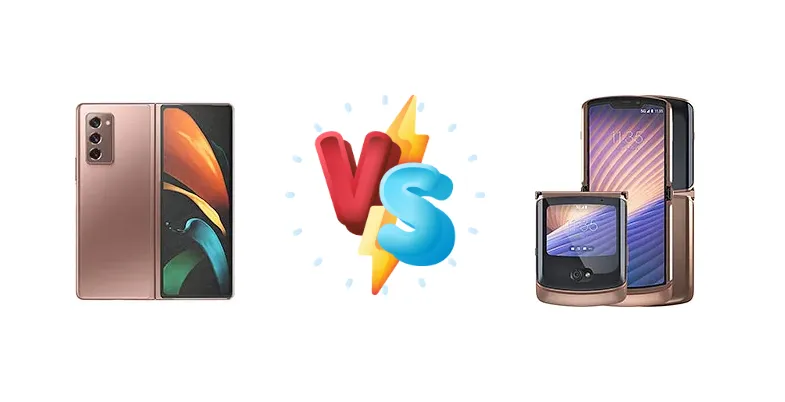
|
🏆 Quick Verdict
For the average user prioritizing performance and longevity, the Samsung Galaxy Z Fold2 5G is the clear winner. Its Snapdragon 865 5G+ chipset and superior battery endurance outweigh the Razr 5G’s nostalgic appeal and more affordable price point. However, the Razr 5G offers a unique form factor for those valuing portability and style.
| PHONES | ||
|---|---|---|
| Phone Names | Samsung Galaxy Z Fold2 5G | Motorola Razr 5G |
| Network | ||
|---|---|---|
| 2G bands | GSM 850 / 900 / 1800 / 1900 | GSM 900 / 1800 / 1900 |
| 3G bands | HSDPA 850 / 900 / 1700(AWS) / 1900 / 2100 - SM-F916B | HSDPA 850 / 900 / 1700(AWS) / 1900 / 2100 |
| 4G bands | 1, 2, 3, 4, 5, 7, 8, 12, 13, 17, 18, 19, 20, 25, 26, 28, 38, 39, 40, 41, 66 - SM-F916B | 1, 2, 3, 4, 5, 7, 8, 12, 13, 14, 17, 18, 19, 20, 25, 26, 28, 29, 30, 38, 39, 40, 41, 46, 48, 66, 71 |
| 5G bands | 1, 3, 5, 7, 8, 28, 40, 41, 77, 78 Sub6 - SM-F916B | 2, 5, 25, 41, 66, 71, 78 SA/NSA/Sub6 |
| Speed | HSPA 42.2/5.76 Mbps, LTE (7CA) Cat20 2000/200 Mbps, 5G | HSPA 42.2/5.76 Mbps, LTE Cat18 1200/150 Mbps, 5G |
| Technology | GSM / CDMA / HSPA / EVDO / LTE / 5G | GSM / CDMA / HSPA / EVDO / LTE / 5G |
| 2, 3, 4, 5, 7, 8, 12, 13, 18, 19, 20, 26, 28, 38, 39, 40, 41, 46, 48, 66 - SM-F916U1 | CDMA2000 1xEV-DO | |
| Launch | ||
|---|---|---|
| Announced | 2020, August 05 | 2020, September 09. Released 2020, September 15 |
| Status | Available. Released 2020, September 18 | Discontinued |
| Body | ||
|---|---|---|
| Build | Glass front (folded), plastic front (unfolded), glass back, aluminum frame | Plastic front (unfolded), glass front (folded, Gorilla Glass 5), glass back (Gorilla Glass 5), aluminum frame (7000 series), hinge (stainless steel) |
| Dimensions | Unfolded: 159.2 x 128.2 x 6.9 mmFolded: 159.2 x 68 x 13.8-16.8 mm | Unfolded: 169.2 x 72.6 x 7.9 mmFolded: 91.7 x 72.6 x 16 mm |
| SIM | Nano-SIM + eSIM | Nano-SIM + eSIM |
| Weight | 282 g (9.95 oz) | 192 g (6.77 oz) |
| - | Water-repellent coating | |
| Display | ||
|---|---|---|
| Resolution | 1768 x 2208 pixels (~373 ppi density) | 876 x 2142 pixels (~373 ppi density) |
| Size | 7.6 inches, 180.8 cm2 (~88.6% screen-to-body ratio) | 6.2 inches, 86.9 cm2 (~70.7% screen-to-body ratio) |
| Type | Foldable Dynamic AMOLED 2X, 120Hz, HDR10+ | Foldable P-OLED |
| Cover display: Super AMOLED, Corning Gorilla Glass Victus 6.23 inches, 816 x 2260 pixels, 25:9 ratio | Second external G-OLED display, 2.7 inches, 600 x 800 pixels | |
| Platform | ||
|---|---|---|
| CPU | Octa-core (1x3.09 GHz Cortex-A77 & 3x2.42 GHz Cortex-A77 & 4x1.80 GHz Cortex-A55) | Octa-core (1x2.4 GHz Kryo 475 Prime & 1x2.2 GHz Kryo 475 Gold & 6x1.8 GHz Kryo 475 Silver) |
| Chipset | Qualcomm SM8250 Snapdragon 865 5G+ (7 nm+) | Qualcomm SM7250 Snapdragon 765G 5G (7 nm) |
| GPU | Adreno 650 | Adreno 620 |
| OS | Android 10, upgradable to Android 13, One UI 5.1.1 | Android 10, upgradable to Android 11 |
| Memory | ||
|---|---|---|
| Card slot | No | No |
| Internal | 256GB 12GB RAM, 512GB 12GB RAM | 256GB 8GB RAM |
| UFS 3.1 | - | |
| Main Camera | ||
|---|---|---|
| Features | LED flash, HDR, panorama | Dual-LED dual-tone flash, auto HDR, panorama |
| Single | - | 48 MP, f/1.7, 26mm (wide), 1/2.0", 0.8µm, PDAF, OIS |
| Triple | 12 MP, f/1.8, 26mm (wide), 1/1.76", 1.8µm, dual pixel PDAF, OIS 12 MP, f/2.4, 52mm (telephoto), 1/3.6", 1.0µm, PDAF, OIS, 2x optical zoom 12 MP, f/2.2, 123˚, 12mm (ultrawide), 1.12µm | - |
| Video | 4K@60fps, 1080p@60/240fps (gyro-EIS), 720p@960fps (gyro-EIS), HDR10+ | 4K@30fps, 1080p@30/60/120fps, gyro-EIS |
| Selfie camera | ||
|---|---|---|
| Features | HDR | Auto HDR |
| Single | 10 MP, f/2.2, 26mm (wide), 1/3", 1.22µm Cover camera: 10 MP, f/2.2, 26mm (wide), 1/3", 1.22µm | 20 MP, f/2.2, (wide), 0.8µm |
| Video | 4K@30fps, 1080p@30fps, gyro-EIS | 1080p@30/60fps |
| Sound | ||
|---|---|---|
| 3.5mm jack | No | No |
| 35mm jack | No | No |
| Loudspeaker | Yes, with stereo speakers | Yes |
| 32-bit/384kHz audio Tuned by AKG | - | |
| Comms | ||
|---|---|---|
| Bluetooth | 5.0, A2DP, LE, aptX HD | 5.1, A2DP, LE |
| NFC | Yes | Yes |
| Positioning | GPS, GLONASS, GALILEO, BDS | GPS, GLONASS, GALILEO |
| Radio | No | No |
| USB | USB Type-C 3.2 | USB Type-C 3.1 |
| WLAN | Wi-Fi 802.11 a/b/g/n/ac/6, dual-band, Wi-Fi Direct | Wi-Fi 802.11 a/b/g/n/ac, dual-band, Wi-Fi Direct |
| Features | ||
|---|---|---|
| Sensors | Fingerprint (side-mounted), accelerometer, gyro, proximity, compass, barometer | Fingerprint (rear-mounted), accelerometer, gyro, proximity, compass, barometer |
| Bixby natural language commands and dictation Samsung DeX (desktop experience support) Samsung Pay (Visa, MasterCard certified) Ultra Wideband (UWB) support | - | |
| Battery | ||
|---|---|---|
| Charging | 25W wired 11W wireless 4.5W reverse wireless | 15W wired |
| Type | Li-Po 4500 mAh | Li-Po 2800 mAh |
| Misc | ||
|---|---|---|
| Colors | Mystic Bronze, Mystic Black, Thom Browne Edition, Aston Martin Racing Edition | Polished Graphite, Blush Gold, Liquid Mercury |
| Models | SM-F916B, SM-F916U, SM-F916U1, SM-F916N, SM-F9160, SM-F916W, SCG05 | XT2071-4, XT2071-3 |
| Price | About 960 EUR | About 490 EUR |
| SAR EU | 0.86 W/kg (head) 1.45 W/kg (body) | - |
| Tests | ||
|---|---|---|
| Battery life | Endurance rating 81h | - |
| Camera | Photo / Video | - |
| Loudspeaker | -25.2 LUFS (Very good) | - |
| Performance | AnTuTu: 564907 (v8) GeekBench: 12607 (v4.4), 2715 (v5.1) GFXBench: 33fps (ES 3.1 onscreen) | - |
Samsung Galaxy Z Fold2 5G
- Flagship-level performance with Snapdragon 865 5G+
- Larger, more versatile display for multitasking
- Faster charging speeds (25W wired)
- Superior battery endurance (81h rating)
- Higher price point
- Bulkier and heavier design
Motorola Razr 5G
- Unique and nostalgic flip phone design
- More compact and pocketable form factor
- More affordable price
- 5G connectivity
- Mid-range Snapdragon 765G chipset
- Slower charging speeds (15W wired)
- Likely inferior camera performance
Display Comparison
The Galaxy Z Fold2 5G boasts a significantly more complex display setup, aiming for a tablet-like experience when unfolded. While specific panel technology details aren't provided, the measured 714 nits of max brightness indicates a vibrant and usable outdoor experience, exceeding what's typically found in the Razr 5G. The Razr 5G, with its clamshell design, focuses on a smaller external display for quick glances and a larger internal display for typical smartphone use. The Z Fold2’s larger canvas is better suited for multitasking and content consumption, while the Razr 5G’s display is constrained by its form factor.
Camera Comparison
Both devices feature photo and video capabilities, but detailed sensor information is lacking. Given the Z Fold2’s flagship positioning, it likely incorporates a more sophisticated camera system with larger sensors and advanced image processing. The Razr 5G, positioned as a more style-focused device, likely prioritizes camera functionality for social media sharing rather than professional-grade photography. Without specific sensor details, it’s reasonable to assume the Z Fold2 offers superior image quality, particularly in low-light conditions, and more versatile shooting options.
Performance
The performance gap between these two devices is substantial. The Samsung Galaxy Z Fold2 5G is powered by the Qualcomm SM8250 Snapdragon 865 5G+ (7 nm+), featuring an octa-core CPU with a prime Cortex-A77 core clocked at 3.09 GHz. This is a flagship-level chipset designed for demanding tasks. In contrast, the Motorola Razr 5G utilizes the Qualcomm SM7250 Snapdragon 765G 5G (7 nm), a mid-range processor. The 765G’s CPU, with a peak clock speed of 2.4 GHz, will handle everyday tasks adequately, but will struggle with intensive gaming or prolonged multitasking compared to the Z Fold2. The Z Fold2’s superior chipset translates to faster app loading times, smoother animations, and a more responsive overall experience.
Battery Life
The Samsung Galaxy Z Fold2 5G achieves an endurance rating of 81 hours, indicating respectable battery life despite powering a larger, more demanding display and chipset. The Razr 5G’s battery capacity is not specified, but its less powerful chipset and smaller display likely contribute to reasonable, though not exceptional, battery performance. The Z Fold2’s 25W wired charging is significantly faster than the Razr 5G’s 15W wired charging, allowing for quicker top-ups. The Z Fold2 also offers 11W wireless and 4.5W reverse wireless charging, features absent in the Razr 5G.
Buying Guide
Buy the Samsung Galaxy Z Fold2 5G if you need a powerful, multitasking device with a large, immersive display for work or entertainment. It’s ideal for power users, content creators, and those who want a tablet-like experience in a phone form factor. Buy the Motorola Razr 5G if you prioritize a compact, pocketable design and appreciate the retro flip phone aesthetic. It’s best for users who value style and portability over raw performance and extended battery life.