
Samsung Galaxy Z Fold2 5G vs. Huawei Mate X2 4G: Which Foldable is Right for You?
| Phones Images | |||||
|---|---|---|---|---|---|
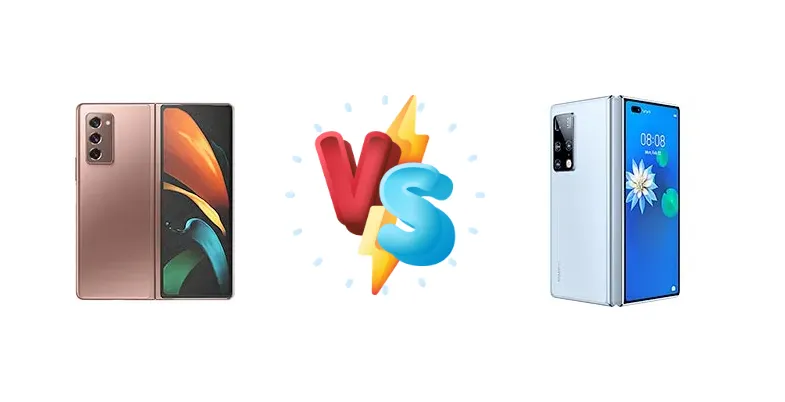
|
🏆 Quick Verdict
For most users, the Samsung Galaxy Z Fold2 5G remains the more practical choice. Its 5G connectivity, coupled with a proven track record of software updates and a slightly better endurance rating of 81h, outweighs the Mate X2’s faster charging. However, the Mate X2’s Kirin 9000 offers competitive performance.
| PHONES | ||
|---|---|---|
| Phone Names | Samsung Galaxy Z Fold2 5G | Huawei Mate X2 4G |
| Network | ||
|---|---|---|
| 2G bands | GSM 850 / 900 / 1800 / 1900 | GSM 850 / 900 / 1800 / 1900 |
| 3G bands | HSDPA 850 / 900 / 1700(AWS) / 1900 / 2100 - SM-F916B | HSDPA 800 / 850 / 900 / 1700(AWS) / 1900 / 2100 |
| 4G bands | 1, 2, 3, 4, 5, 7, 8, 12, 13, 17, 18, 19, 20, 25, 26, 28, 38, 39, 40, 41, 66 - SM-F916B | 1, 2, 3, 4, 5, 6, 7, 8, 9, 12, 17, 18, 19, 20, 26, 34, 38, 39, 40, 41 |
| 5G bands | 1, 3, 5, 7, 8, 28, 40, 41, 77, 78 Sub6 - SM-F916B | - |
| Speed | HSPA 42.2/5.76 Mbps, LTE (7CA) Cat20 2000/200 Mbps, 5G | HSPA, LTE, 5G |
| Technology | GSM / CDMA / HSPA / EVDO / LTE / 5G | GSM / CDMA / HSPA / EVDO / LTE |
| 2, 3, 4, 5, 7, 8, 12, 13, 18, 19, 20, 26, 28, 38, 39, 40, 41, 46, 48, 66 - SM-F916U1 | - | |
| Launch | ||
|---|---|---|
| Announced | 2020, August 05 | 2021, June 28 |
| Status | Available. Released 2020, September 18 | Available. Released 2021, July 15 |
| Body | ||
|---|---|---|
| Build | Glass front (folded), plastic front (unfolded), glass back, aluminum frame | Glass front, glass back, aluminum frame |
| Dimensions | Unfolded: 159.2 x 128.2 x 6.9 mmFolded: 159.2 x 68 x 13.8-16.8 mm | Unfolded: 161.8 x 145.8 x 8.2 mmFolded: 161.8 x 74.6 x 14.7 mm |
| SIM | Nano-SIM + eSIM | Nano-SIM + Nano-SIM |
| Weight | 282 g (9.95 oz) | 295 g (10.41 oz) |
| Display | ||
|---|---|---|
| Resolution | 1768 x 2208 pixels (~373 ppi density) | 2200 x 2480 pixels (~414 ppi density) |
| Size | 7.6 inches, 180.8 cm2 (~88.6% screen-to-body ratio) | 8.0 inches, 205.0 cm2 (~86.9% screen-to-body ratio) |
| Type | Foldable Dynamic AMOLED 2X, 120Hz, HDR10+ | Foldable OLED, 90Hz |
| Cover display: Super AMOLED, Corning Gorilla Glass Victus 6.23 inches, 816 x 2260 pixels, 25:9 ratio | - | |
| Platform | ||
|---|---|---|
| CPU | Octa-core (1x3.09 GHz Cortex-A77 & 3x2.42 GHz Cortex-A77 & 4x1.80 GHz Cortex-A55) | Octa-core (1x3.13 GHz Cortex-A77 & 3x2.54 GHz Cortex-A77 & 4x2.05 GHz Cortex-A55) |
| Chipset | Qualcomm SM8250 Snapdragon 865 5G+ (7 nm+) | Kirin 9000 (5 nm) |
| GPU | Adreno 650 | Mali-G78 MP24 |
| OS | Android 10, upgradable to Android 13, One UI 5.1.1 | HarmonyOS 2.0 |
| Memory | ||
|---|---|---|
| Card slot | No | Nano Memory (uses shared SIM slot) |
| Internal | 256GB 12GB RAM, 512GB 12GB RAM | 256GB 8GB RAM, 512GB 8GB RAM |
| UFS 3.1 | - | |
| Main Camera | ||
|---|---|---|
| Features | LED flash, HDR, panorama | Laser AF, color spectrum sensor, Leica optics, LED flash, panorama, HDR |
| Quad | - | 50 MP, f/1.9, 23mm (wide), 1/1.28", 1.22µm, multi-directional PDAF, OIS 12 MP, f/2.4, 70mm (telephoto), PDAF, OIS, 3x optical zoom 8 MP, f/4.4, 240mm (periscope telephoto), PDAF, OIS, 10x optical zoom 16 MP, f/2.2, 17mm (ultrawide), AF |
| Triple | 12 MP, f/1.8, 26mm (wide), 1/1.76", 1.8µm, dual pixel PDAF, OIS 12 MP, f/2.4, 52mm (telephoto), 1/3.6", 1.0µm, PDAF, OIS, 2x optical zoom 12 MP, f/2.2, 123˚, 12mm (ultrawide), 1.12µm | - |
| Video | 4K@60fps, 1080p@60/240fps (gyro-EIS), 720p@960fps (gyro-EIS), HDR10+ | 4K@30/60fps, 1080p@30/60fps, gyro-EIS |
| Selfie camera | ||
|---|---|---|
| Features | HDR | HDR, panorama |
| Single | 10 MP, f/2.2, 26mm (wide), 1/3", 1.22µm Cover camera: 10 MP, f/2.2, 26mm (wide), 1/3", 1.22µm | 16 MP, f/2.2, (wide) |
| Video | 4K@30fps, 1080p@30fps, gyro-EIS | 1080p@30fps |
| Sound | ||
|---|---|---|
| 3.5mm jack | No | No |
| 35mm jack | No | No |
| Loudspeaker | Yes, with stereo speakers | Yes, with stereo speakers |
| 32-bit/384kHz audio Tuned by AKG | - | |
| Comms | ||
|---|---|---|
| Bluetooth | 5.0, A2DP, LE, aptX HD | 5.2, A2DP, LE |
| Infrared port | - | Yes |
| NFC | Yes | Yes |
| Positioning | GPS, GLONASS, GALILEO, BDS | GPS (L1+L5), GLONASS (L1), BDS (B1I+B1c+B2a+B2b), GALILEO (E1+E5a+E5b), QZSS (L1+L5), NavIC |
| Radio | No | No |
| USB | USB Type-C 3.2 | USB Type-C 3.1, OTG |
| WLAN | Wi-Fi 802.11 a/b/g/n/ac/6, dual-band, Wi-Fi Direct | Wi-Fi 802.11 a/b/g/n/ac/6, dual-band, Wi-Fi Direct |
| Features | ||
|---|---|---|
| Sensors | Fingerprint (side-mounted), accelerometer, gyro, proximity, compass, barometer | Fingerprint (side-mounted), accelerometer, gyro, proximity, compass, barometer |
| Bixby natural language commands and dictation Samsung DeX (desktop experience support) Samsung Pay (Visa, MasterCard certified) Ultra Wideband (UWB) support | - | |
| Battery | ||
|---|---|---|
| Charging | 25W wired 11W wireless 4.5W reverse wireless | 55W wired |
| Type | Li-Po 4500 mAh | Li-Po 4500 mAh |
| Misc | ||
|---|---|---|
| Colors | Mystic Bronze, Mystic Black, Thom Browne Edition, Aston Martin Racing Edition | Black, White, Light Blue |
| Models | SM-F916B, SM-F916U, SM-F916U1, SM-F916N, SM-F9160, SM-F916W, SCG05 | TET-AL00 |
| Price | About 960 EUR | About 2290 EUR |
| SAR EU | 0.86 W/kg (head) 1.45 W/kg (body) | - |
| Tests | ||
|---|---|---|
| Battery life | Endurance rating 81h | - |
| Camera | Photo / Video | - |
| Loudspeaker | -25.2 LUFS (Very good) | - |
| Performance | AnTuTu: 564907 (v8) GeekBench: 12607 (v4.4), 2715 (v5.1) GFXBench: 33fps (ES 3.1 onscreen) | - |
Samsung Galaxy Z Fold2 5G
- 5G Connectivity for faster data speeds
- Established Software Ecosystem and Updates
- Solid 81h Endurance Rating
- Slower 25W Wired Charging
- Older Chipset (Snapdragon 865)
- Potential for Creasing on Foldable Display
Huawei Mate X2 4G
- Extremely Fast 55W Wired Charging
- Potentially More Efficient Kirin 9000 Chipset
- Huawei’s Computational Photography Expertise
- Limited to 4G Connectivity
- Huawei Ecosystem and Software Concerns
- Unknown Long-Term Software Support
Display Comparison
The Z Fold2 5G boasts a 7.6-inch foldable Dynamic AMOLED 2X display, achieving a measured peak brightness of 714 nits. While the Mate X2’s display specifications aren’t provided, Huawei’s history suggests a comparable OLED panel. The Z Fold2’s hinge mechanism, refined from the original Fold, is a key advantage, offering a more durable and reliable folding experience. The lack of detailed display specs for the Mate X2 makes a direct comparison difficult, but the Z Fold2’s brightness is a quantifiable advantage for outdoor visibility.
Camera Comparison
Both devices feature capable camera systems, but detailed specifications are limited. Both are described as having Photo/Video capabilities. Without sensor size or aperture information, a direct comparison is challenging. Huawei historically excels in computational photography, potentially giving the Mate X2 an edge in image processing. However, the Z Fold2 benefits from Samsung’s well-regarded camera software and a more established ecosystem of camera apps. The absence of specific camera details necessitates a cautious approach to assessing their relative strengths.
Performance
The core difference lies in the chipsets: the Z Fold2 5G utilizes the Qualcomm Snapdragon 865 5G+ (7nm+), while the Mate X2 4G features the Kirin 9000 (5nm). The Kirin 9000’s 5nm process theoretically offers better power efficiency and transistor density compared to the 7nm+ Snapdragon 865. However, the Snapdragon 865’s 5G modem is a significant advantage, providing access to faster network speeds where available. Both CPUs feature an octa-core configuration with a Cortex-A77 prime core, but the Mate X2’s slightly higher clock speed (3.13 GHz vs 3.09 GHz) may translate to marginal performance gains in CPU-intensive tasks. The Z Fold2’s LPDDR5 RAM is standard for its class, while the Mate X2’s RAM configuration is unknown, but likely comparable.
Battery Life
The Z Fold2 5G achieves an endurance rating of 81 hours, indicating solid battery life. It supports 25W wired charging, 11W wireless charging, and 4.5W reverse wireless charging. The Mate X2 4G, however, boasts significantly faster 55W wired charging, allowing for a much quicker 0-100% charge. While the Mate X2’s battery capacity is unknown, the faster charging speed is a compelling advantage for users who prioritize convenience. The Z Fold2’s wireless charging options offer added flexibility, but the slower speeds are less impactful.
Buying Guide
Buy the Samsung Galaxy Z Fold2 5G if you prioritize 5G connectivity, a wider ecosystem of apps and services, and long-term software support. It’s ideal for power users who need multitasking capabilities and reliable performance. Buy the Huawei Mate X2 4G if you value extremely fast charging (55W) and are comfortable operating within the Huawei ecosystem, accepting the limitations of 4G connectivity and potential software constraints.