
Samsung Galaxy Z Fold Special vs. Motorola Razr+ 2025: A Deep Dive into Foldable Futures
| Phones Images | |||||
|---|---|---|---|---|---|
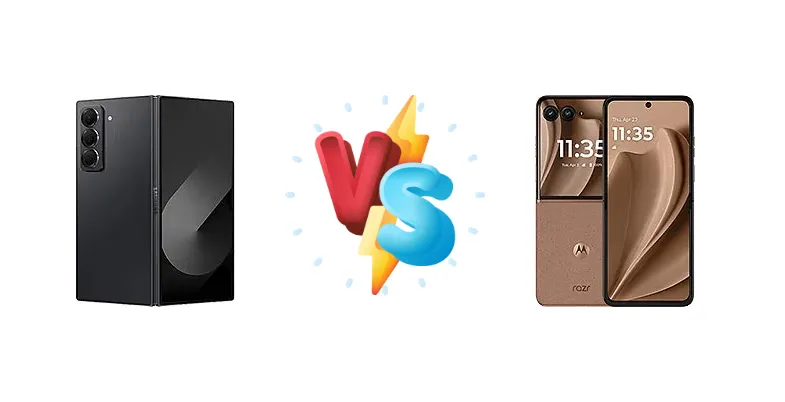
|
🏆 Quick Verdict
For users prioritizing raw power and multitasking, the Samsung Galaxy Z Fold Special takes the lead thanks to its Snapdragon 8 Gen 3. However, the Motorola Razr+ 2025 delivers a compelling experience with its impressive 10:12 hour active use battery life and faster 45W charging, making it ideal for those valuing longevity and convenience.
| PHONES | ||
|---|---|---|
| Phone Names | Samsung Galaxy Z Fold Special | Motorola Razr+ 2025 |
| Network | ||
|---|---|---|
| 2G bands | GSM 850 / 900 / 1800 / 1900 | GSM 900 / 1800 / 1900 |
| 3G bands | HSDPA 850 / 900 / 1700(AWS) / 1900 / 2100 | HSDPA 850 / 900 / 1700(AWS) / 1900 / 2100 |
| 4G bands | 1, 2, 3, 4, 5, 7, 8, 12, 13, 17, 18, 19, 20, 25, 26, 28, 38, 39, 40, 41, 66 | 1, 2, 3, 4, 5, 7, 8, 12, 13, 14, 17, 18, 19, 20, 25, 26, 28, 29, 30, 38, 39, 40, 41, 46, 48, 66, 71 |
| 5G bands | 1, 2, 3, 5, 7, 8, 12, 20, 25, 26, 28, 38, 40, 41, 66, 77, 78 SA/NSA/Sub6 | 1, 2, 3, 5, 7, 12, 14, 20, 25, 26, 28, 29, 30, 38, 40, 41, 48, 66, 70, 71, 77, 78 SA/NSA/Sub6 |
| Speed | HSPA, LTE, 5G | HSPA, LTE, 5G |
| Technology | GSM / HSPA / LTE / 5G | GSM / HSPA / LTE / 5G |
| Launch | ||
|---|---|---|
| Announced | 2024, October 21 | 2025, April 24 |
| Status | Available. Released 2024, October 24 | Available. Released 2025, June 03 |
| Body | ||
|---|---|---|
| Build | Glass front (Gorilla Glass Victus 2) (folded), plastic front (unfolded), glass back (Gorilla Glass Victus 2), aluminum frame | Plastic front (unfolded), glass front (folded, Gorilla Glass Victus), silicone polymer back (eco leather), aluminum frame (6000 series), hinge (titanium) |
| Dimensions | Unfolded: 157.9 x 142.6 x 4.9 mmFolded: 157.9 x 72.8 x 10.6 mm | Unfolded: 171.4 x 74 x 7.1 mmFolded: 88.1 x 74 x 15.3 mm |
| SIM | Nano-SIM + eSIM + eSIM (max 2 at a time) | Nano-SIM + eSIM |
| Weight | 236 g (8.32 oz) | 189 g (6.67 oz) |
| Display | ||
|---|---|---|
| Resolution | 1968 x 2184 pixels (~367 ppi density) | 1080 x 2640 pixels (~413 ppi density) |
| Size | 8.0 inches, 205.3 cm2 (~91.2% screen-to-body ratio) | 6.9 inches, 107.6 cm2 (~84.9% screen-to-body ratio) |
| Type | Foldable Dynamic LTPO AMOLED 2X, 120Hz, HDR10+, 2600 nits (peak) | Foldable LTPO AMOLED, 1B colors, Dolby Vision, 165Hz, HDR10+, 3000 nits (peak) |
| Platform | ||
|---|---|---|
| CPU | 8-core (1x3.39GHz Cortex-X4 & 3x3.1GHz Cortex-A720 & 2x2.9GHz Cortex-A720 & 2x2.2GHz Cortex-A520) | Octa-core (1x3.0 GHz Cortex-X4 & 4x2.8 GHz Cortex-A720 & 3x2.0 GHz Cortex-A520) |
| Chipset | Qualcomm SM8650-AC Snapdragon 8 Gen 3 (4 nm) | Qualcomm SM8635 Snapdragon 8s Gen 3 (4 nm) |
| GPU | Adreno 750 (1 GHz) | Adreno 735 |
| OS | Android 14, up to 7 major Android upgrades, One UI 6.1.1 | Android 15 |
| Memory | ||
|---|---|---|
| Card slot | No | No |
| Internal | 512GB 16GB RAM | 256GB 12GB RAM |
| Main Camera | ||
|---|---|---|
| Dual | - | 50 MP, f/1.7, 24mm (wide), 1/1.95", 0.8µm, dual pixel PDAF, OIS 50 MP, f/2.0, 47mm (telephoto), 1/2.76", 0.64µm, PDAF, 2x optical zoom |
| Features | LED flash, HDR, panorama | LED flash, panorama, HDR |
| Triple | 200 MP, f/1.8, (wide), PDAF, OIS 10 MP, f/2.4, 66mm (telephoto), 1.0µm, PDAF, OIS, 3x optical zoom 12 MP, f/2.2, 123˚, 12mm (ultrawide), 1.12µm, AF | - |
| Video | 8K@30fps, 4K@60fps, 1080p@60/120/240fps (gyro-EIS), 720p@960fps (gyro-EIS), HDR10+ | 4K@30/60fps, 1080p@30/60/120/240/960fps, HDR10+, gyro-EIS |
| Selfie camera | ||
|---|---|---|
| Features | HDR | HDR |
| Single | 4 MP, f/1.8, 26mm (wide), 2.0µm Cover camera: 10 MP, f/2.2, 24mm (wide), 1/3", 1.22µm | 32 MP, f/2.4, 25mm (wide), 1/3.14", 0.7µm |
| Video | 4K@30/60fps, 1080p@30/60fps, gyro-EIS | 4K@30/60fps, 1080p@30/60fps |
| Sound | ||
|---|---|---|
| 35mm jack | No | No |
| Loudspeaker | Yes, with stereo speakers | Yes, with stereo speakers (with Dolby Atmos) |
| Comms | ||
|---|---|---|
| Bluetooth | 5.3, A2DP, LE | 5.4, A2DP, LE, aptX HD, aptX Adaptive, aptX Lossless |
| NFC | Yes | Yes |
| Positioning | GPS, GALILEO, GLONASS, BDS, QZSS | GPS (L1+L5), GLONASS (L1), BDS (B1I+B1c+B2a), GALILEO (E1+E5a), QZSS (L1+L5) |
| Radio | No | No |
| USB | USB Type-C 3.2, OTG | USB Type-C 2.0, OTG |
| WLAN | Wi-Fi 802.11 a/b/g/n/ac/6e/7, tri-band, Wi-Fi Direct | Wi-Fi 802.11 a/b/g/n/ac/6e/7, tri-band |
| Features | ||
|---|---|---|
| Sensors | Fingerprint (side-mounted), accelerometer, gyro, proximity, compass, barometer | Fingerprint (side-mounted), accelerometer, gyro, proximity, compass, barometer |
| Battery | ||
|---|---|---|
| Charging | 25W wired, QC2.0, 50% in 30 min 15W wireless 4.5W reverse wireless | 45W wired 15W wireless 5W reverse wired |
| Type | Li-Po 4400 mAh | 4000 mAh |
| Misc | ||
|---|---|---|
| Colors | Black | Pantone: Mocha Mousse, Midnight Blue, Hot Pink |
| Models | SM-F958N | XT2451-1 |
| Price | About 1870 EUR | $ 500.00 |
| SAR | 0.66 W/kg (head) 1.13 W/kg (body) | - |
Samsung Galaxy Z Fold Special
- Unmatched processing power with Snapdragon 8 Gen 3
- Likely superior camera performance due to advanced ISP
- Potential for smoother multitasking and gaming
- Potentially shorter battery life due to power-hungry chipset
- Slower 25W wired charging
Motorola Razr+ 2025
- Excellent 10:12 hour active use battery life
- Faster 45W wired charging for quick top-ups
- More compact and pocketable foldable design
- Less powerful Snapdragon 8s Gen 3 chipset
- Potentially lower camera performance compared to Z Fold Special
Display Comparison
While display specs are absent, the Z Fold Special, being a larger foldable, likely prioritizes screen real estate for multitasking. The Razr+ 2025, as a flip phone, will focus on a more compact external and internal display. The Snapdragon 8 Gen 3’s ISP will likely drive superior image processing for both displays, but the Z Fold Special’s larger canvas will be more beneficial for content creation. Expect both to utilize LTPO technology for variable refresh rates, optimizing battery consumption.
Camera Comparison
Without detailed camera specs, it’s difficult to make a definitive judgment. However, Samsung typically equips its Z Fold series with flagship-level camera systems. The Snapdragon 8 Gen 3’s advanced ISP in the Z Fold Special will likely deliver superior image processing, dynamic range, and low-light performance. Motorola’s focus with the Razr+ 2025 is often on software optimization and user experience, but the Z Fold Special’s chipset advantage gives it a potential edge in computational photography.
Performance
The Samsung Galaxy Z Fold Special’s Qualcomm SM8650-AC Snapdragon 8 Gen 3 (4nm) represents the pinnacle of Android processing power, boasting a 1x3.39GHz Cortex-X4 prime core. This is a significant advantage over the Motorola Razr+ 2025’s Snapdragon 8s Gen 3 (4nm), which features a slightly lower clocked 1x3.0 GHz Cortex-X4. The Z Fold Special’s CPU configuration (3x3.1GHz Cortex-A720, 2x2.9GHz Cortex-A720, 2x2.2GHz Cortex-A520) provides a broader performance bandwidth. While both chips are 4nm, the Gen 3’s architectural improvements and higher clock speeds translate to faster app loading, smoother multitasking, and superior gaming performance. The Z Fold Special will likely benefit from faster LPDDR5x RAM, further enhancing responsiveness.
Battery Life
The Motorola Razr+ 2025 shines with its reported 10:12 hour active use battery score, indicating excellent power efficiency. While the Z Fold Special’s battery capacity is unknown, its more powerful Snapdragon 8 Gen 3 is likely to consume more energy. The Razr+ 2025’s 45W wired charging is significantly faster than the Z Fold Special’s 25W, allowing for quicker top-ups. The inclusion of 15W wireless charging on both devices is a welcome convenience, but the Razr+ 2025’s 5W reverse wired charging offers a slight advantage over the Z Fold Special’s 4.5W reverse wireless.
Buying Guide
Buy the Samsung Galaxy Z Fold Special if you demand the absolute best performance for demanding tasks like video editing, gaming, or running multiple apps simultaneously, and are willing to trade some battery life for it. Buy the Motorola Razr+ 2025 if you prioritize all-day battery life, faster charging, and a more compact, pocketable foldable experience, even if it means sacrificing some peak processing power.