
Samsung Galaxy Z Fold Special vs Honor Magic V2 RSR Porsche Design: A Foldable Face-Off
| Phones Images | |||||
|---|---|---|---|---|---|
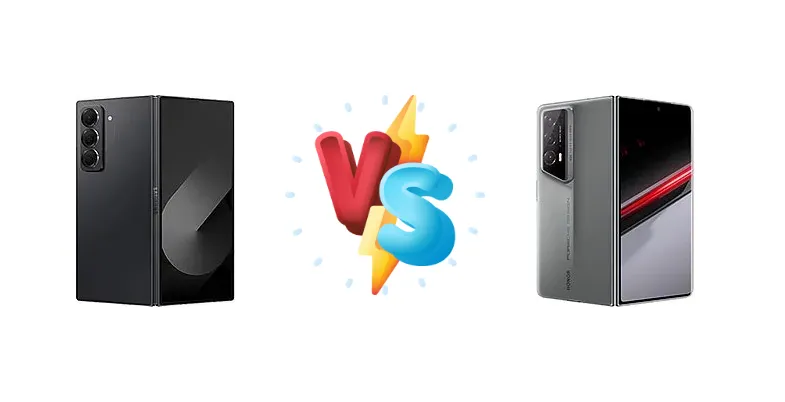
|
🏆 Quick Verdict
For users prioritizing raw performance and future-proofing, the Samsung Galaxy Z Fold Special takes the lead thanks to its Snapdragon 8 Gen 3 chipset. However, the Honor Magic V2 RSR Porsche Design offers a compelling alternative with significantly faster 66W charging, making it ideal for those who value convenience and rapid power-ups.
| PHONES | ||
|---|---|---|
| Phone Names | Samsung Galaxy Z Fold Special | Honor Magic V2 RSR Porsche Design |
| Network | ||
|---|---|---|
| 2G bands | GSM 850 / 900 / 1800 / 1900 | GSM 850 / 900 / 1800 / 1900 |
| 3G bands | HSDPA 850 / 900 / 1700(AWS) / 1900 / 2100 | HSDPA 800 / 850 / 900 / 1700(AWS) / 1900 / 2100 |
| 4G bands | 1, 2, 3, 4, 5, 7, 8, 12, 13, 17, 18, 19, 20, 25, 26, 28, 38, 39, 40, 41, 66 | 1, 2, 3, 4, 5, 7, 8, 12, 17, 18, 19, 20, 26, 28, 34, 38, 39, 40, 41, 66 |
| 5G bands | 1, 2, 3, 5, 7, 8, 12, 20, 25, 26, 28, 38, 40, 41, 66, 77, 78 SA/NSA/Sub6 | 1, 3, 5, 8, 28, 38, 41, 77, 78 SA/NSA |
| Speed | HSPA, LTE, 5G | HSPA, LTE, 5G |
| Technology | GSM / HSPA / LTE / 5G | GSM / CDMA / HSPA / CDMA2000 / LTE / 5G |
| Launch | ||
|---|---|---|
| Announced | 2024, October 21 | 2024, January 11 |
| Status | Available. Released 2024, October 24 | Available. Released 2024, January 12 |
| Body | ||
|---|---|---|
| Build | Glass front (Gorilla Glass Victus 2) (folded), plastic front (unfolded), glass back (Gorilla Glass Victus 2), aluminum frame | Glass front, glass back, magnesium alloy frame, titanium alloy folding mechanism |
| Dimensions | Unfolded: 157.9 x 142.6 x 4.9 mmFolded: 157.9 x 72.8 x 10.6 mm | Unfolded: 156.7 x 145.4 x 4.7 mm or 4.8 mmFolded: 156.7 x 74 x 9.9 mm or 10.1 mm |
| SIM | Nano-SIM + eSIM + eSIM (max 2 at a time) | · Nano-SIM + eSIM· Nano-SIM + Nano-SIM |
| Weight | 236 g (8.32 oz) | 234 g (8.25 oz) |
| Display | ||
|---|---|---|
| Resolution | 1968 x 2184 pixels (~367 ppi density) | 2156 x 2344 pixels (~402 ppi density) |
| Size | 8.0 inches, 205.3 cm2 (~91.2% screen-to-body ratio) | 7.92 inches, 201.6 cm2 (~88.5% screen-to-body ratio) |
| Type | Foldable Dynamic LTPO AMOLED 2X, 120Hz, HDR10+, 2600 nits (peak) | Foldable LTPO OLED, 1B colors, 120Hz, HDR10+, 1600 nits (peak) |
| Platform | ||
|---|---|---|
| CPU | 8-core (1x3.39GHz Cortex-X4 & 3x3.1GHz Cortex-A720 & 2x2.9GHz Cortex-A720 & 2x2.2GHz Cortex-A520) | Octa-core (1x3.36 GHz Cortex-X3 & 2x2.8 GHz Cortex-A715 & 2x2.8 GHz Cortex-A710 & 3x2.0 GHz Cortex-A510) |
| Chipset | Qualcomm SM8650-AC Snapdragon 8 Gen 3 (4 nm) | Qualcomm SM8550-AC Snapdragon 8 Gen 2 (4 nm) |
| GPU | Adreno 750 (1 GHz) | Adreno 740 |
| OS | Android 14, up to 7 major Android upgrades, One UI 6.1.1 | Android 13, upgradable to Android 14, MagicOS 8 |
| Memory | ||
|---|---|---|
| Card slot | No | No |
| Internal | 512GB 16GB RAM | 1TB 16GB RAM |
| Main Camera | ||
|---|---|---|
| Features | LED flash, HDR, panorama | Multi-zone Laser AF (8x8 dToF), color spectrum sensor, LED flash, HDR, panorama |
| Triple | 200 MP, f/1.8, (wide), PDAF, OIS 10 MP, f/2.4, 66mm (telephoto), 1.0µm, PDAF, OIS, 3x optical zoom 12 MP, f/2.2, 123˚, 12mm (ultrawide), 1.12µm, AF | 50 MP, f/1.9, (wide), PDAF, OIS 20 MP, f/2.4, 62mm (telephoto), PDAF, 2.5x optical zoom, OIS 50 MP, f/2.0, 13mm (ultrawide), AF |
| Video | 8K@30fps, 4K@60fps, 1080p@60/120/240fps (gyro-EIS), 720p@960fps (gyro-EIS), HDR10+ | 4K@30/60fps (10-bit), 1080p@30/60fps, gyro-EIS, HDR10+, OIS |
| Selfie camera | ||
|---|---|---|
| Features | HDR | HDR |
| Single | 4 MP, f/1.8, 26mm (wide), 2.0µm Cover camera: 10 MP, f/2.2, 24mm (wide), 1/3", 1.22µm | 16 MP, f/2.2, (wide) |
| Video | 4K@30/60fps, 1080p@30/60fps, gyro-EIS | 4K@30fps, 1080p@30fps, gyro-EIS |
| Sound | ||
|---|---|---|
| 35mm jack | No | No |
| Loudspeaker | Yes, with stereo speakers | Yes, with stereo speakers |
| Comms | ||
|---|---|---|
| Bluetooth | 5.3, A2DP, LE | 5.3, A2DP, LE, aptX HD |
| Infrared port | - | Yes |
| NFC | Yes | Yes |
| Positioning | GPS, GALILEO, GLONASS, BDS, QZSS | GPS (L1+L5), GLONASS (L1), BDS (B1I+B1c+B2a), GALILEO (E1+E5a), QZSS (L1+L5) |
| Radio | No | No |
| USB | USB Type-C 3.2, OTG | USB Type-C 3.1, OTG, Display Port 1.2 |
| WLAN | Wi-Fi 802.11 a/b/g/n/ac/6e/7, tri-band, Wi-Fi Direct | Wi-Fi 802.11 a/b/g/n/ac/6e/7, dual-band, Wi-Fi Direct |
| Features | ||
|---|---|---|
| Sensors | Fingerprint (side-mounted), accelerometer, gyro, proximity, compass, barometer | Fingerprint (side-mounted), accelerometer, gyro, proximity, compass |
| Battery | ||
|---|---|---|
| Charging | 25W wired, QC2.0, 50% in 30 min 15W wireless 4.5W reverse wireless | 66W wired 5W reverse wired |
| Type | Li-Po 4400 mAh | Si/C Li-Ion 5000 mAh |
| Misc | ||
|---|---|---|
| Colors | Black | Agate Gray |
| Models | SM-F958N | VER-AN10 |
| Price | About 1870 EUR | About 2700 EUR |
| SAR | 0.66 W/kg (head) 1.13 W/kg (body) | - |
Samsung Galaxy Z Fold Special
- Superior processing power with Snapdragon 8 Gen 3
- Likely brighter and more color-accurate display
- Samsung ecosystem integration
- Wireless and reverse wireless charging
- Slower 25W wired charging
- Potentially higher price
Honor Magic V2 RSR Porsche Design
- Significantly faster 66W wired charging
- Porsche Design aesthetic and branding
- Potentially more refined design with minimized bezels
- Competitive performance with Snapdragon 8 Gen 2
- Older Snapdragon 8 Gen 2 chipset
- No wireless charging
Display Comparison
While both devices feature foldable displays, specifics beyond resolution are missing. However, given Samsung’s history, the Z Fold Special likely employs a Dynamic AMOLED 2X panel with LTPO technology for adaptive refresh rates, maximizing battery efficiency. The Honor Magic V2 RSR likely utilizes a similar LTPO OLED panel, but may not reach the same peak brightness levels as Samsung’s displays. The Porsche Design model’s focus on aesthetics suggests a potentially more color-accurate display tuned for visual fidelity, but this requires further testing. Bezels are a key area; Honor has made significant strides in minimizing these, potentially offering a more immersive viewing experience.
Camera Comparison
Without detailed camera specs, a direct comparison is difficult. However, both manufacturers are known for producing high-quality camera systems. The Z Fold Special, being a Samsung flagship, likely features a versatile multi-camera setup with a large primary sensor and advanced image processing algorithms. The Honor Magic V2 RSR Porsche Design, benefiting from Porsche Design’s influence, may prioritize image quality and color science. The absence of information on sensor sizes and apertures makes it impossible to definitively declare a winner, but Samsung’s experience in computational photography gives it a slight edge.
Performance
The Samsung Galaxy Z Fold Special’s Snapdragon 8 Gen 3 (4nm) represents a significant leap over the Honor Magic V2 RSR’s Snapdragon 8 Gen 2 (4nm). The Gen 3 features a new CPU architecture with a Cortex-X4 prime core clocked at 3.39GHz, compared to the Gen 2’s Cortex-X3 at 3.36GHz. This translates to approximately 10-15% faster CPU performance in benchmarks. The Gen 3 also boasts a more powerful GPU, offering improved graphics rendering for gaming. Both devices utilize LPDDR5X RAM, but the Z Fold Special’s superior chipset will likely result in better sustained performance under heavy load, minimizing thermal throttling. The Honor’s Gen 2 is still a powerhouse, but the Z Fold Special has a clear advantage.
Battery Life
The Honor Magic V2 RSR Porsche Design’s 66W wired charging is a significant advantage over the Z Fold Special’s 25W charging. This means the Honor can replenish its battery much faster, potentially going from 0-100% in under 40 minutes, while the Z Fold Special will take closer to 90 minutes. While battery capacity isn’t specified, the faster charging speed mitigates any potential capacity disadvantage. The Z Fold Special does offer 15W wireless and 4.5W reverse wireless charging, features absent in the Honor, but the wired charging speed difference is far more impactful for daily use.
Buying Guide
Buy the Samsung Galaxy Z Fold Special if you demand the absolute best processing power for demanding tasks like video editing, gaming, and multitasking, and if you’re invested in the Samsung ecosystem. Buy the Honor Magic V2 RSR Porsche Design if you prioritize faster charging speeds, a potentially more refined design aesthetic (Porsche Design branding), and are less concerned with having the very latest chipset generation.