
Samsung Galaxy Z Fold Special vs Google Pixel Fold: Which Foldable Reigns Supreme?
| Phones Images | |||||
|---|---|---|---|---|---|
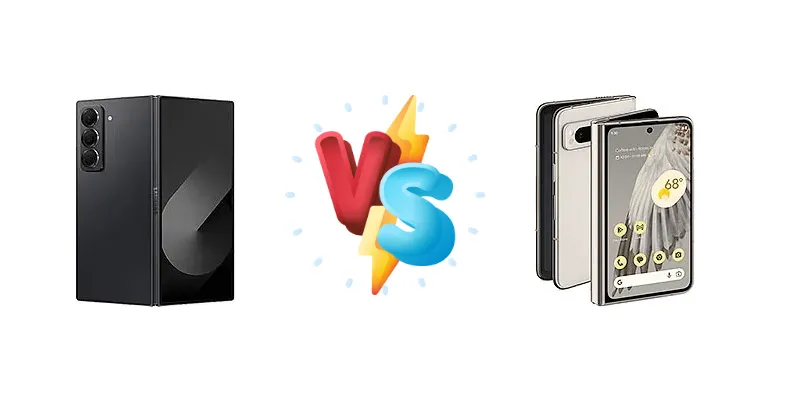
|
🏆 Quick Verdict
For users prioritizing peak performance and demanding tasks like gaming or video editing, the Samsung Galaxy Z Fold Special is the clear winner thanks to its Snapdragon 8 Gen 3 chipset. However, the Google Pixel Fold offers a compelling alternative for those valuing Google’s AI features and software experience.
| PHONES | ||
|---|---|---|
| Phone Names | Samsung Galaxy Z Fold Special | Google Pixel Fold |
| Network | ||
|---|---|---|
| 2G bands | GSM 850 / 900 / 1800 / 1900 | GSM 850 / 900 / 1800 / 1900 |
| 3G bands | HSDPA 850 / 900 / 1700(AWS) / 1900 / 2100 | HSDPA 800 / 850 / 900 / 1700(AWS) / 1900 / 2100 |
| 4G bands | 1, 2, 3, 4, 5, 7, 8, 12, 13, 17, 18, 19, 20, 25, 26, 28, 38, 39, 40, 41, 66 | 1, 2, 3, 4, 5, 7, 8, 12, 13, 14, 17, 18, 19, 20, 21, 25, 26, 28, 29, 30, 32, 38, 39, 40, 41, 42, 46, 48, 66, 71 |
| 5G bands | 1, 2, 3, 5, 7, 8, 12, 20, 25, 26, 28, 38, 40, 41, 66, 77, 78 SA/NSA/Sub6 | 1, 2, 3, 5, 7, 8, 12, 14, 20, 25, 28, 30, 38, 40, 41, 48, 66, 71, 75, 76, 77, 78, 79, 257, 258, 260, 261 SA/NSA/Sub6/mmWave |
| Speed | HSPA, LTE, 5G | HSPA, LTE, 5G |
| Technology | GSM / HSPA / LTE / 5G | GSM / CDMA / HSPA / EVDO / LTE / 5G |
| - | CDMA2000 1xEV-DO | |
| Launch | ||
|---|---|---|
| Announced | 2024, October 21 | 2023, May 10 |
| Status | Available. Released 2024, October 24 | Available. Released 2023, June 27 |
| Body | ||
|---|---|---|
| Build | Glass front (Gorilla Glass Victus 2) (folded), plastic front (unfolded), glass back (Gorilla Glass Victus 2), aluminum frame | Glass front (Gorilla Glass Victus) (folded), plastic front (unfolded), glass back (Gorilla Glass Victus), aluminum frame |
| Dimensions | Unfolded: 157.9 x 142.6 x 4.9 mmFolded: 157.9 x 72.8 x 10.6 mm | Unfolded: 139.7 x 158.7 x 5.8 mmFolded: 139.7 x 79.5 x 12.1 mm |
| SIM | Nano-SIM + eSIM + eSIM (max 2 at a time) | Nano-SIM + eSIM |
| Weight | 236 g (8.32 oz) | 283 g (9.98 oz) |
| - | IPX8 water resistant | |
| Display | ||
|---|---|---|
| Resolution | 1968 x 2184 pixels (~367 ppi density) | 1840 x 2208 pixels (~378 ppi density) |
| Size | 8.0 inches, 205.3 cm2 (~91.2% screen-to-body ratio) | 7.6 inches, 183.3 cm2 (~82.7% screen-to-body ratio) |
| Type | Foldable Dynamic LTPO AMOLED 2X, 120Hz, HDR10+, 2600 nits (peak) | Foldable OLED, 120Hz, HDR10+, 1000 nits (HBM), 1450 nits (peak) |
| - | Cover display: OLED, 120Hz, HDR, Corning Gorilla Glass Victus 5.8 inches, 1080 x 2092 pixels, 17.4:9 ratio, 408 ppi 1200 nits (HBM), 1550 nits (peak) | |
| Platform | ||
|---|---|---|
| CPU | 8-core (1x3.39GHz Cortex-X4 & 3x3.1GHz Cortex-A720 & 2x2.9GHz Cortex-A720 & 2x2.2GHz Cortex-A520) | Octa-core (2x2.85 GHz Cortex-X1 & 2x2.35 GHz Cortex-A78 & 4x1.80 GHz Cortex-A55) |
| Chipset | Qualcomm SM8650-AC Snapdragon 8 Gen 3 (4 nm) | Google Tensor G2 (5 nm) |
| GPU | Adreno 750 (1 GHz) | Mali-G710 MP7 |
| OS | Android 14, up to 7 major Android upgrades, One UI 6.1.1 | Android 13, upgradable to Android 15, up to 5 major Android upgrades |
| Memory | ||
|---|---|---|
| Card slot | No | No |
| Internal | 512GB 16GB RAM | 256GB 12GB RAM, 512GB 12GB RAM |
| - | UFS 3.1 | |
| Main Camera | ||
|---|---|---|
| Features | LED flash, HDR, panorama | Laser AF, Dual-LED flash, HDR, panorama |
| Triple | 200 MP, f/1.8, (wide), PDAF, OIS 10 MP, f/2.4, 66mm (telephoto), 1.0µm, PDAF, OIS, 3x optical zoom 12 MP, f/2.2, 123˚, 12mm (ultrawide), 1.12µm, AF | 48 MP, f/1.7, 25mm (wide), 1/2.0", 0.8µm, dual pixel PDAF, OIS 10.8 MP, f/3.1, 112mm (telephoto), 1/3.1", 1.22µm, dual pixel PDAF, OIS, 5x optical zoom 10.8 MP, f/2.2, 121˚, (ultrawide), 1/3.0", 1.25µm |
| Video | 8K@30fps, 4K@60fps, 1080p@60/120/240fps (gyro-EIS), 720p@960fps (gyro-EIS), HDR10+ | 4K@30/60fps, 1080p@30/60/120/240fps, 10-bit HDR |
| Selfie camera | ||
|---|---|---|
| Features | HDR | HDR, panorama |
| Single | 4 MP, f/1.8, 26mm (wide), 2.0µm Cover camera: 10 MP, f/2.2, 24mm (wide), 1/3", 1.22µm | 8 MP, f/2.0, 24mm (wide), 1/4.0", 1.12µm Cover camera: 9.5 MP, f/2.2, 24mm (wide), 1.22µm, dual pixel PDAF |
| Video | 4K@30/60fps, 1080p@30/60fps, gyro-EIS | 4K@30/60fps, 1080p@30/60fps |
| Sound | ||
|---|---|---|
| 3.5mm jack | - | No |
| 35mm jack | No | No |
| Loudspeaker | Yes, with stereo speakers | Yes, with stereo speakers |
| Comms | ||
|---|---|---|
| Bluetooth | 5.3, A2DP, LE | 5.2, A2DP, LE, aptX HD |
| NFC | Yes | Yes |
| Positioning | GPS, GALILEO, GLONASS, BDS, QZSS | GPS, GLONASS, GALILEO, BDS |
| Radio | No | No |
| USB | USB Type-C 3.2, OTG | USB Type-C 3.2, OTG |
| WLAN | Wi-Fi 802.11 a/b/g/n/ac/6e/7, tri-band, Wi-Fi Direct | Wi-Fi 802.11 a/b/g/n/ac/6e, tri-band, Wi-Fi Direct |
| Features | ||
|---|---|---|
| Sensors | Fingerprint (side-mounted), accelerometer, gyro, proximity, compass, barometer | Fingerprint (side-mounted), accelerometer, gyro, proximity, compass, barometer |
| - | Ultra Wideband (UWB) support | |
| Battery | ||
|---|---|---|
| Charging | 25W wired, QC2.0, 50% in 30 min 15W wireless 4.5W reverse wireless | Wired, PD3.0 Wireless |
| Type | Li-Po 4400 mAh | Li-Po 4821 mAh |
| Misc | ||
|---|---|---|
| Colors | Black | Porcelain, Obsidian |
| Models | SM-F958N | G9FPL |
| Price | About 1870 EUR | € 670.87 / $ 389.26 / £ 899.99 |
| SAR | 0.66 W/kg (head) 1.13 W/kg (body) | - |
Samsung Galaxy Z Fold Special
- Superior processing power with Snapdragon 8 Gen 3
- Faster wired charging at 25W
- Potentially brighter and more color-accurate display
- May be more expensive
- Samsung’s One UI can be feature-heavy for some users
Google Pixel Fold
- Google’s AI-powered features and software integration
- Potentially more compact and ergonomic design
- Wireless and reverse wireless charging
- Slower processing power with Tensor G2
- Slower wired charging speeds
- Image processing may prioritize computational photography over raw sensor quality
Display Comparison
While both devices feature foldable displays, specifics are missing. However, Samsung historically leads in display technology. The Z Fold Special likely boasts a higher peak brightness and potentially a more refined hinge mechanism. The Snapdragon’s ISP will also likely contribute to more accurate color reproduction. The Pixel Fold’s display quality will depend heavily on Google’s calibration, but it will likely prioritize color accuracy over sheer brightness. The absence of refresh rate data makes a direct comparison difficult, but both are expected to offer adaptive refresh rates for smoother scrolling.
Camera Comparison
Without detailed sensor information, a direct camera comparison is limited. However, Samsung typically employs larger sensors and more versatile lens configurations. The Z Fold Special likely features a more capable main sensor and telephoto lens. The Tensor G2’s strength lies in computational photography, potentially offering superior image processing in challenging lighting conditions. Google’s software algorithms excel at noise reduction and dynamic range optimization. The absence of details regarding OIS and aperture sizes prevents a definitive assessment, but Samsung’s history suggests a more feature-rich camera system.
Performance
The Samsung Galaxy Z Fold Special’s Qualcomm Snapdragon 8 Gen 3 (4nm) is a significant advantage over the Google Pixel Fold’s Google Tensor G2 (5nm). The Snapdragon 8 Gen 3’s Cortex-X4 prime core, clocked at 3.39GHz, offers substantially higher single-core performance than the Tensor G2’s Cortex-X1 cores at 2.85GHz. The Snapdragon’s more modern architecture and 4nm process node also translate to better thermal efficiency, reducing the likelihood of throttling during sustained workloads. The Tensor G2 focuses on AI and machine learning tasks, but falls behind in raw processing power, impacting gaming and demanding applications. The Z Fold Special’s LPDDR5x RAM will also contribute to faster data access and overall system responsiveness.
Battery Life
Battery capacity is not specified, but the Z Fold Special’s 25W wired charging with QC2.0 support offers a faster charging experience than the Pixel Fold’s unspecified wired charging. The Pixel Fold’s inclusion of wireless charging and reverse wireless charging provides added convenience, but the slower charging speeds may be a drawback for users who frequently need to top up their battery. The Snapdragon 8 Gen 3’s improved power efficiency could partially offset the Pixel Fold’s potential battery capacity advantage.
Buying Guide
Buy the Samsung Galaxy Z Fold Special if you need uncompromising performance for demanding applications, extended gaming sessions, and benefit from faster charging speeds. Buy the Google Pixel Fold if you prefer a more streamlined software experience, prioritize Google’s AI-powered features, and value a potentially more compact and ergonomic design (assuming real-world dimensions favor the Pixel Fold).