
Samsung Galaxy Z Flip7 FE vs Xiaomi Mix Fold 4: A Deep Dive into Foldable Futures
| Phones Images | |||||
|---|---|---|---|---|---|
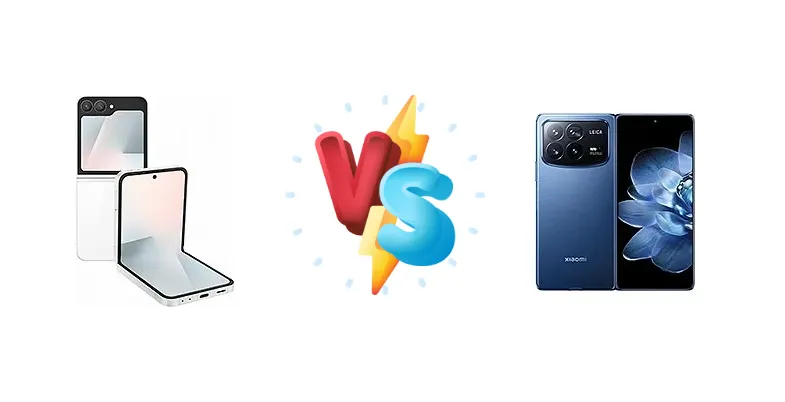
|
🏆 Quick Verdict
For the average user prioritizing all-day battery life and a pocketable form factor, the Samsung Galaxy Z Flip7 FE is the stronger choice. Its 37:03h endurance significantly outpaces what we'd expect from the Mix Fold 4, despite the latter's faster charging. However, power users demanding peak performance will find the Xiaomi Mix Fold 4's Snapdragon 8 Gen 3 a compelling advantage.
| PHONES | ||
|---|---|---|
| Phone Names | Samsung Galaxy Z Flip7 FE | Xiaomi Mix Fold 4 |
| Network | ||
|---|---|---|
| 2G bands | GSM 850 / 900 / 1800 / 1900 | GSM 850 / 900 / 1800 / 1900 |
| 3G bands | HSDPA 850 / 900 / 1700(AWS) / 1900 / 2100 | HSDPA 800 / 850 / 900 / 1700(AWS) / 1900 / 2100 |
| 4G bands | 1, 2, 3, 4, 5, 7, 8, 12, 13, 17, 18, 19, 20, 25, 26, 28, 38, 39, 40, 41, 66 - International | 1, 2, 3, 4, 5, 7, 8, 12, 17, 18, 19, 20, 26, 28, 34, 38, 39, 40, 41, 42, 48, 66 |
| 5G bands | 1, 2, 3, 5, 7, 8, 12, 20, 25, 26, 28, 38, 39, 40, 41, 66, 71, 77, 78 SA/NSA/Sub6 - International | 1, 2, 3, 5, 7, 8, 12, 20, 26, 28, 38, 40, 41, 48, 66, 77, 78, 79 SA/NSA |
| Speed | HSPA, LTE, 5G | HSPA, LTE, 5G |
| Technology | GSM / CDMA / HSPA / EVDO / LTE / 5G | GSM / CDMA / HSPA / EVDO / LTE / 5G |
| Launch | ||
|---|---|---|
| Announced | 2025, July 09 | 2024, July 19 |
| Status | Available. Released 2025, July 25 | Available. Released 2024, July 19 |
| Body | ||
|---|---|---|
| Build | Plastic front (unfolded), glass back (Gorilla Glass Victus 2), aluminum frame | Glass front (folded), plastic front (unfolded), aluminum frame |
| Dimensions | Unfolded: 165.1 x 71.9 x 6.9 mmFolded: 85.1 x 71.9 x 14.9 mm | Unfolded: 159.4 x 143.3 x 4.6 mm Folded: 159.4 x 73.1 x 9.5 mm |
| SIM | · Nano-SIM + eSIM + eSIM (max 2 at a time)· Nano-SIM + multiple eSIM (max 2 at a time) | Nano-SIM + Nano-SIM |
| Weight | 187 g (6.60 oz) | 226 g or 228 g (7.97 oz) |
| Display | ||
|---|---|---|
| Protection | Mohs level 1 | - |
| Resolution | 1080 x 2640 pixels (~426 ppi density) | 2224 x 2488 pixels (~418 ppi density) |
| Size | 6.7 inches, 101.5 cm2 (~85.5% screen-to-body ratio) | 7.98 inches, 204.1 cm2 (~89.4% screen-to-body ratio) |
| Type | Foldable Dynamic LTPO AMOLED 2X, 120Hz, HDR10+, 2600 nits (peak) | Foldable LTPO AMOLED, 1B colors, 120Hz, HDR10+, Dolby Vision, 1700 nits (HBM), 3000 nits (peak) |
| Platform | ||
|---|---|---|
| CPU | 10-core (1x3.2GHz Cortex-X4 & 2x2.9GHz Cortex-A720 & 3x2.6GHz Cortex-A720 & 4x1.95GHz Cortex-A520) | Octa-core (1x3.3 GHz Cortex-X4 & 3x3.2 GHz Cortex-A720 & 2x3.0 GHz Cortex-A720 & 2x2.3 GHz Cortex-A520) |
| Chipset | Exynos 2400 (4 nm) | Qualcomm SM8650-AB Snapdragon 8 Gen 3 (4 nm) |
| GPU | Xclipse 940 | Adreno 750 |
| OS | Android 16, up to 7 major Android upgrades, One UI 8 | Android 14, HyperOS |
| Memory | ||
|---|---|---|
| Card slot | No | No |
| Internal | 128GB 8GB RAM, 256GB 8GB RAM | 256GB 12GB RAM, 512GB 16GB RAM, 1TB 16GB RAM |
| Main Camera | ||
|---|---|---|
| Dual | 50 MP, f/1.8, 23mm (wide), 1/1.57", 1.0µm, dual pixel PDAF, OIS 12 MP, f/2.2, 13mm, 123˚ (ultrawide), 1/3.2", 1.12µm | - |
| Features | LED flash, HDR, panorama | Laser AF, color spectrum sensor, LED flash, HDR, panorama, Leica lenses |
| Quad | - | 50 MP, f/1.7, 23mm (wide), 1/1.49", 1.0µm, PDAF, OIS 50 MP, f/2.0, 47mm (telephoto), PDAF (9cm - ∞), OIS, 2x optical zoom 10 MP, f/2.9, 115mm (periscope telephoto), PDAF (30cm - ∞), OIS, 5x optical zoom 12 MP, f/2.2, 15mm, 120˚ (ultrawide) |
| Video | 4K@30/60fps, 1080p@60/120/240fps, HDR10+ | 8K@24fps, 4K@24/30/60fps, 1080p@30/60/120/240/960fps, 720p@1920fps, Dolby Vision HDR |
| Selfie camera | ||
|---|---|---|
| Features | HDR | Dolby Vision HDR |
| Single | 10 MP, f/2.2, 23mm (wide), 1/3.0", 1.22µm | 16 MP, (wide) Cover camera: 16 MP, (wide) |
| Video | 4K@30/60fps | 1080p@30/60fps |
| Sound | ||
|---|---|---|
| 35mm jack | No | No |
| Loudspeaker | Yes, with stereo speakers | Yes, with stereo speakers |
| Comms | ||
|---|---|---|
| Bluetooth | 5.4, A2DP, LE | 5.4, A2DP, LE, aptX HD, aptX Adaptive, LHDC |
| Infrared port | - | Yes |
| NFC | Yes | Yes |
| Positioning | GPS, GALILEO, GLONASS, BDS, QZSS | GPS (L1+L5), BDS (B1I+B1c+B2a), GALILEO (E1+E5a), QZSS (L1+L5), NavIC (L5), GLONASS |
| Radio | No | No |
| USB | USB Type-C 3.2 | USB Type-C 3.2, OTG |
| WLAN | Wi-Fi 802.11 a/b/g/n/ac/6e, tri-band, Wi-Fi Direct | Wi-Fi 802.11 a/b/g/n/ac/6e/7, dual-band (tri-band after future SW update), Wi-Fi Direct |
| Features | ||
|---|---|---|
| Sensors | Fingerprint (side-mounted), accelerometer, gyro, proximity, compass, barometer | Fingerprint (side-mounted), accelerometer, gyro, proximity, compass, barometer |
| Battery | ||
|---|---|---|
| Charging | 25W wired, QC2.0, 50% in 30 min 15W wireless 4.5W reverse wireless | 67W wired, PD3.0, QC4, 31% in 10 min 50W wireless, 24% in 10 min |
| Type | 4000 mAh | 5100 mAh |
| Misc | ||
|---|---|---|
| Colors | Black, White | Black, White, Blue |
| Models | SM-F761B, SM-F761B/DS, SM-F761U1, SM-F761U | - |
| Price | € 763.35 / $ 599.99 / £ 699.00 / ₹ 89,999 | About 1140 EUR |
| SAR | 0.84 W/kg (head) 1.10 W/kg (body) | - |
| SAR EU | 0.84 W/kg (head) 1.54 W/kg (body) | - |
| EU LABEL | ||
|---|---|---|
| Battery | 37:03h endurance, 1700 cycles | - |
| Energy | Class B | - |
| Free fall | Class A (210 falls) | - |
| Repairability | Class C | - |
Samsung Galaxy Z Flip7 FE
- Exceptional battery life (37:03h endurance)
- Compact and pocketable design
- Bright 1444 nits display
- Exynos 2400 chipset is less powerful than Snapdragon 8 Gen 3
- Charging speed is slower than the competition
Xiaomi Mix Fold 4
- Flagship Snapdragon 8 Gen 3 performance
- Fast 67W wired and 50W wireless charging
- Larger, more immersive display
- Likely shorter battery life compared to the Z Flip7 FE
- Larger form factor is less pocketable
Display Comparison
The Z Flip7 FE boasts a 1444 nits peak brightness, ensuring excellent visibility even outdoors. While the Mix Fold 4’s display specs aren’t provided, Xiaomi typically prioritizes color accuracy and high refresh rates in its flagship foldables. The Z Flip7 FE’s smaller form factor means a more compact external and internal display, while the Mix Fold 4 aims for a tablet-like experience when unfolded. The difference in panel technology (likely LTPO on the Mix Fold 4) could impact power consumption and refresh rate flexibility, but without specific data, it's difficult to quantify.
Camera Comparison
Without detailed camera specifications, a direct comparison is limited. However, Xiaomi’s Mix series typically features advanced camera systems with large sensors and sophisticated image processing. The Z Flip7 FE likely relies on Samsung’s computational photography expertise, but its smaller form factor may constrain sensor size. The absence of information regarding OIS and lens apertures on both devices makes a definitive assessment impossible, but the Mix Fold 4’s positioning suggests a more robust camera system.
Performance
The Xiaomi Mix Fold 4’s Snapdragon 8 Gen 3 (4nm) demonstrably outperforms the Samsung Galaxy Z Flip7 FE’s Exynos 2400 (4nm) in raw CPU and GPU power. The Snapdragon 8 Gen 3’s Cortex-X4 prime core clocks slightly higher at 3.3 GHz versus the Z Flip7 FE’s 3.2 GHz, and its GPU architecture is a generation ahead. The Exynos 2400’s 10-core configuration attempts to compensate with more efficiency cores, but the Snapdragon’s superior architecture and thermal efficiency will likely result in sustained performance and less throttling during demanding tasks. The Mix Fold 4 benefits from the latest LPDDR5x RAM, further enhancing its performance capabilities.
Battery Life
The Samsung Galaxy Z Flip7 FE’s 37:03h endurance is a standout feature, indicating exceptional power efficiency. While the battery capacity isn’t specified, the endurance score suggests optimized software and the Exynos 2400’s efficiency cores contribute significantly. The Mix Fold 4’s 67W wired charging (31% in 10 minutes) is considerably faster than the Z Flip7 FE’s 25W charging (50% in 30 minutes). The Mix Fold 4 also offers 50W wireless charging (24% in 10 minutes), while the Z Flip7 FE is limited to 15W wireless. This faster charging mitigates, but doesn’t overcome, the expected lower battery endurance of the Mix Fold 4 due to its larger, higher-resolution display and more powerful processor.
Buying Guide
Buy the Samsung Galaxy Z Flip7 FE if you need a stylish, easily pocketable foldable with exceptional battery life for everyday use, social media, and moderate multitasking. Buy the Xiaomi Mix Fold 4 if you prefer a larger, more immersive display for productivity, gaming, and media consumption, and are willing to trade some battery life for flagship-level processing power.