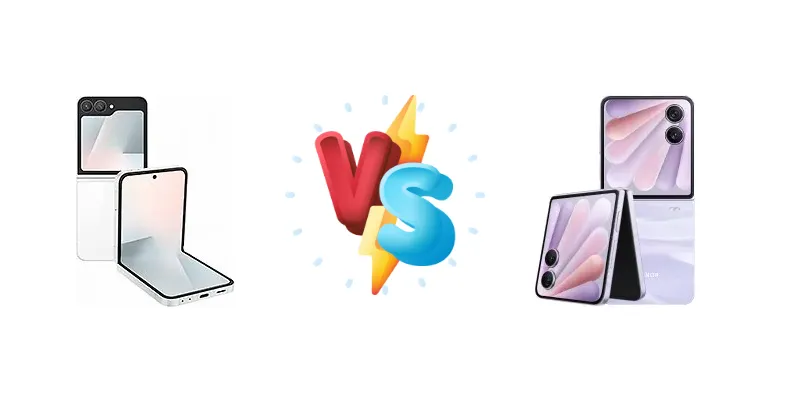
The foldable phone market is heating up, with Samsung’s established Flip series facing new competition. The Samsung Galaxy Z Flip7 FE aims to deliver a refined foldable experience at a competitive price, while the Honor Magic V Flip 2 enters the arena with a focus on premium features like blazing-fast charging and a brighter display. This comparison dissects the core differences between these two devices to determine which one best suits your needs.
🏆 Quick Verdict
For the average user prioritizing all-around performance and a well-established ecosystem, the Honor Magic V Flip 2 emerges as the winner. Its Snapdragon 8 Gen 3 chipset, significantly faster charging, and brighter display outweigh the Z Flip7 FE’s slightly longer battery endurance. However, the Z Flip7 FE remains a compelling option for Samsung loyalists.
| Network |
|---|
| 2G bands | GSM 850 / 900 / 1800 / 1900 | GSM 850 / 900 / 1800 / 1900 |
| 3G bands | HSDPA 850 / 900 / 1700(AWS) / 1900 / 2100 | HSDPA 800 / 850 / 900 / 1700(AWS) / 1900 / 2100 |
| 4G bands | 1, 2, 3, 4, 5, 7, 8, 12, 13, 17, 18, 19, 20, 25, 26, 28, 38, 39, 40, 41, 66 - International | LTE |
| 5G bands | 1, 2, 3, 5, 7, 8, 12, 20, 25, 26, 28, 38, 39, 40, 41, 66, 71, 77, 78 SA/NSA/Sub6 - International | SA/NSA |
| Speed | HSPA, LTE, 5G | HSPA, LTE, 5G |
| Technology | GSM / CDMA / HSPA / EVDO / LTE / 5G | GSM / CDMA / HSPA / CDMA2000 / LTE / 5G |
| Launch |
|---|
| Announced | 2025, July 09 | 2025, August 21 |
| Status | Available. Released 2025, July 25 | Available. Released 2025, August 21 |
| Body |
|---|
| Build | Plastic front (unfolded), glass back (Gorilla Glass Victus 2), aluminum frame | Aluminum frame |
| Dimensions | Unfolded: 165.1 x 71.9 x 6.9 mmFolded: 85.1 x 71.9 x 14.9 mm | Unfolded: 167.1 x 75.6 x 6.9 mm Folded: 86.2 x 75.6 x 15.5 mm |
| SIM | · Nano-SIM + eSIM + eSIM (max 2 at a time)· Nano-SIM + multiple eSIM (max 2 at a time) | Nano-SIM + Nano-SIM |
| Weight | 187 g (6.60 oz) | 204 g (7.20 oz) |
| Display |
|---|
| Protection | Mohs level 1 | - |
| Resolution | 1080 x 2640 pixels (~426 ppi density) | 1232 x 2868 pixels, 21:9 ratio (~458 ppi density) |
| Size | 6.7 inches, 101.5 cm2 (~85.5% screen-to-body ratio) | 6.82 inches, 108.8 cm2 (~86.1% screen-to-body ratio) |
| Type | Foldable Dynamic LTPO AMOLED 2X, 120Hz, HDR10+, 2600 nits (peak) | Foldable LTPO OLED, 1B colors, 120Hz, 4320Hz PWM, HDR, Dolby Vision, BT.2020, 5000 nits (peak) |
| Platform |
|---|
| CPU | 10-core (1x3.2GHz Cortex-X4 & 2x2.9GHz Cortex-A720 & 3x2.6GHz Cortex-A720 & 4x1.95GHz Cortex-A520) | Octa-core (1x3.3 GHz Cortex-X4 & 3x3.2 GHz Cortex-A720 & 2x3.0 GHz Cortex-A720 & 2x2.3 GHz Cortex-A520) |
| Chipset | Exynos 2400 (4 nm) | Qualcomm SM8650-AB Snapdragon 8 Gen 3 (4 nm) |
| GPU | Xclipse 940 | Adreno 750 |
| OS | Android 16, up to 7 major Android upgrades, One UI 8 | Android 15, MagicOS 9 |
| Memory |
|---|
| Card slot | No | No |
| Internal | 128GB 8GB RAM, 256GB 8GB RAM | 256GB 12GB RAM, 512GB 12GB RAM, 1TB 12GB RAM, 1TB 16GB RAM |
| Main Camera |
|---|
| Dual | 50 MP, f/1.8, 23mm (wide), 1/1.57", 1.0µm, dual pixel PDAF, OIS
12 MP, f/2.2, 13mm, 123˚ (ultrawide), 1/3.2", 1.12µm | 200 MP, f/1.9, (wide), 1/1.3", 0.6µm, multi-directional PDAF, OIS
50 MP, f/2.0, 120˚ (ultrawide), AF |
| Features | LED flash, HDR, panorama | LED flash, HDR, panorama |
| Video | 4K@30/60fps, 1080p@60/120/240fps, HDR10+ | 4K, 1080p, gyro-EIS |
| Selfie camera |
|---|
| Features | HDR | - |
| Single | 10 MP, f/2.2, 23mm (wide), 1/3.0", 1.22µm | 50 MP, f/2.0, (wide), AF |
| Video | 4K@30/60fps | 4K, 1080p |
| Sound |
|---|
| 35mm jack | No | No |
| Loudspeaker | Yes, with stereo speakers | Yes, with stereo speakers |
| Comms |
|---|
| Bluetooth | 5.4, A2DP, LE | 5.4, A2DP, LE, aptX HD, aptX Adaptive, ASHA |
| Infrared port | - | Yes |
| NFC | Yes | Yes |
| Positioning | GPS, GALILEO, GLONASS, BDS, QZSS | GPS (L1+L5), BDS (B1I+B1C+B2a+B2b), GALILEO (E1+E5a+E5b), QZSS (L1+L5), NavIC (L5), GLONASS |
| Radio | No | No |
| USB | USB Type-C 3.2 | USB Type-C 2.0, OTG |
| WLAN | Wi-Fi 802.11 a/b/g/n/ac/6e, tri-band, Wi-Fi Direct | Wi-Fi 802.11 a/b/g/n/ac/6, dual-band, Wi-Fi Direct |
| Features |
|---|
| Sensors | Fingerprint (side-mounted), accelerometer, gyro, proximity, compass, barometer | Fingerprint (side-mounted), gyro, accelerometer, proximity (ultrasonic), compass |
| Battery |
|---|
| Charging | 25W wired, QC2.0, 50% in 30 min
15W wireless
4.5W reverse wireless | 80W wired, 100% in 42 min
50W wireless
5W reverse wired
Reverse wireless |
| Type | 4000 mAh | Si/C Li-Po 5500 mAh |
| Misc |
|---|
| Colors | Black, White | Purple, Silver, Gray, Blue |
| Models | SM-F761B, SM-F761B/DS, SM-F761U1, SM-F761U | CLE-AN00 |
| Price | € 763.35 / $ 599.99 / £ 699.00 / ₹ 89,999 | - |
| SAR | 0.84 W/kg (head) 1.10 W/kg (body) | - |
| SAR EU | 0.84 W/kg (head) 1.54 W/kg (body) | - |
| EU LABEL |
|---|
| Battery | 37:03h endurance, 1700 cycles | - |
| Energy | Class B | - |
| Free fall | Class A (210 falls) | - |
| Repairability | Class C | - |
Samsung Galaxy Z Flip7 FE
- Familiar Samsung One UI experience
- Longer measured battery endurance (37:03h)
- Extensive software support and updates
- Slower charging speeds (25W wired)
- Less powerful Exynos 2400 chipset
- Dimmer display compared to the Magic V Flip 2
Honor Magic V Flip 2
- Blazing-fast 80W wired charging (100% in 42 min)
- More powerful Snapdragon 8 Gen 3 chipset
- Brighter display (1786 nits)
- Faster wireless charging (50W)
- Less established software ecosystem (MagicOS)
- Potentially shorter overall battery life (though efficient)
Display Comparison
The Honor Magic V Flip 2 boasts a clear advantage in display technology, achieving a measured peak brightness of 1786 nits compared to the Z Flip7 FE’s 1444 nits. This translates to superior visibility in direct sunlight. While both utilize foldable OLED panels, the higher brightness of the Magic V Flip 2 is immediately noticeable. We lack PWM frequency data for both, but the difference in brightness may be more impactful for outdoor use than subtle flicker differences. Both are likely to offer vibrant colors and deep blacks characteristic of OLED technology, but the Honor’s panel is demonstrably brighter.
Camera Comparison
Unfortunately, detailed camera specifications are missing. However, given the market positioning, we can infer that both phones will feature dual-camera systems on the exterior. The Honor Magic V Flip 2, being positioned as a more premium device, likely benefits from a larger main sensor and more advanced image processing algorithms. The Z Flip7 FE will likely focus on computational photography to enhance image quality. Without specific sensor size and aperture data, it’s difficult to make a definitive judgment, but the Magic V Flip 2’s higher price point suggests a more capable camera system. The inclusion of a 2MP macro camera on either device is likely a marketing feature with limited real-world utility.
Performance
The chipset is where the most significant difference lies. The Honor Magic V Flip 2 is powered by the Qualcomm Snapdragon 8 Gen 3 (4nm), an octa-core processor with a peak clock speed of 3.3 GHz. This is a substantial upgrade over the Samsung Galaxy Z Flip7 FE’s Exynos 2400 (4nm). The Snapdragon 8 Gen 3’s CPU architecture, featuring a single Cortex-X4 prime core, is optimized for peak performance, while the Exynos 2400 utilizes a more complex 10-core configuration. While the Exynos 2400 attempts to balance power and efficiency, the Snapdragon 8 Gen 3 delivers superior sustained performance and is less prone to thermal throttling during demanding tasks like gaming. The Snapdragon’s Adreno GPU also provides a noticeable edge in graphics processing.
Battery Life
The Honor Magic V Flip 2’s 80W wired charging is a game-changer, achieving a full charge in just 42 minutes. This is significantly faster than the Z Flip7 FE’s 25W charging, which takes 30 minutes to reach 50% and considerably longer for a full charge. While the Z Flip7 FE boasts a measured battery endurance of 37:03 hours, the Magic V Flip 2’s active use score of 12:43h suggests more efficient power management despite a potentially smaller battery capacity. The 50W wireless charging on the Magic V Flip 2 is also a substantial advantage over the Z Flip7 FE’s 15W wireless charging. The faster charging speeds of the Magic V Flip 2 mitigate any potential concerns about slightly lower battery endurance.
Buying Guide
Buy the Samsung Galaxy Z Flip7 FE if you prioritize a familiar Samsung One UI experience, extensive software support, and a slightly longer overall battery endurance measured in total hours. Buy the Honor Magic V Flip 2 if you value raw performance, incredibly fast 80W charging, a significantly brighter display for outdoor visibility, and are comfortable with Honor’s MagicOS interface.
Frequently Asked Questions
❓ Does the Exynos 2400 in the Z Flip7 FE overheat during prolonged gaming sessions?
The Exynos 2400, while a capable chip, is known to generate more heat than the Snapdragon 8 Gen 3. While Samsung has implemented cooling solutions, extended gaming sessions may lead to thermal throttling, resulting in reduced performance. The Snapdragon 8 Gen 3 in the Magic V Flip 2 is more thermally efficient and will likely maintain higher sustained performance.
❓ How does the 50W wireless charging on the Magic V Flip 2 compare to the 15W on the Z Flip7 FE in real-world use?
The 50W wireless charging on the Magic V Flip 2 is significantly faster. Expect a substantial difference in charging times, with the Magic V Flip 2 gaining a considerable percentage of battery life in the same amount of time it takes the Z Flip7 FE to add a small amount. This makes the Magic V Flip 2 much more convenient for users who frequently rely on wireless charging.
❓ Is the reverse wireless charging feature useful on either device?
Reverse wireless charging, at 4.5W on the Z Flip7 FE and 5W on the Magic V Flip 2, is primarily useful for topping up accessories like earbuds or smartwatches. It's not a practical solution for significantly charging other smartphones due to its slow speed. The Honor's inclusion of reverse *wired* charging is a unique benefit.