
Samsung Galaxy Z Flip vs. Z Fold7: A Detailed Comparison of Foldable Power
| Phones Images | |||||
|---|---|---|---|---|---|
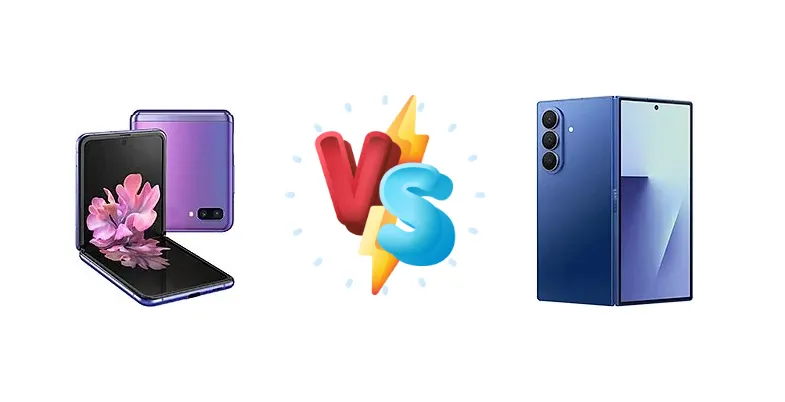
|
🏆 Quick Verdict
For the average user prioritizing battery life and raw performance, the Samsung Galaxy Z Fold7 is the clear winner. Its Snapdragon 8 Elite chipset and impressive 40:28h endurance significantly outperform the Z Flip's older Snapdragon 855+ and limited battery. However, the Z Flip remains a viable option for those seeking a more compact and affordable foldable.
| PHONES | ||
|---|---|---|
| Phone Names | Samsung Galaxy Z Flip | Samsung Galaxy Z Fold7 |
| Network | ||
|---|---|---|
| 2G bands | GSM 850 / 900 / 1800 / 1900 | GSM 850 / 900 / 1800 / 1900 |
| 3G bands | HSDPA 850 / 900 / 1700(AWS) / 1900 / 2100 | HSDPA 850 / 900 / 1700(AWS) / 1900 / 2100 |
| 4G bands | 1, 2, 3, 4, 5, 7, 8, 12, 13, 14, 17, 18, 19, 20, 25, 26, 28, 29, 30, 34, 38, 39, 40, 41, 46, 66, 71 | 1, 2, 3, 4, 5, 7, 8, 12, 13, 17, 18, 19, 20, 25, 26, 28, 38, 39, 40, 41, 66 - International |
| 5G bands | - | 1, 2, 3, 5, 7, 8, 12, 20, 25, 26, 28, 38, 40, 41, 66, 71, 77, 78 SA/NSA/Sub6 - International |
| Speed | HSPA 42.2/5.76 Mbps, LTE (5CA) Cat16 1000/150 Mbps | HSPA, LTE, 5G |
| Technology | GSM / CDMA / HSPA / EVDO / LTE | GSM / CDMA / HSPA / EVDO / LTE / 5G |
| Launch | ||
|---|---|---|
| Announced | 2020, February 11 | 2025, July 09 |
| Status | Available. Released 2020, February 14 | Available. Released 2025, July 25 |
| Body | ||
|---|---|---|
| Build | Plastic front, glass back (Gorilla Glass 6), aluminum frame | Glass front (Gorilla Glass Victus Ceramic 2) (folded), plastic front (unfolded), glass back (Gorilla Glass Victus 2), aluminum frame |
| Dimensions | Unfolded: 167.3 x 73.6 x 7.2 mm Folded: 87.4 x 73.6 x 17.3 mm | Unfolded: 158.4 x 143.2 x 4.2 mmFolded: 158.4 x 72.8 x 8.9 mm |
| SIM | Nano-SIM + eSIM | · Nano-SIM + Nano-SIM + eSIM + eSIM (max 2 at a time)· Nano-SIM + Nano-SIM + multiple eSIM (max 2 at a time) |
| Weight | 183 g (6.46 oz) | 215 g (7.58 oz) |
| Display | ||
|---|---|---|
| Protection | - | Mohs level 1 |
| Resolution | 1080 x 2636 pixels (~425 ppi density) | 1968 x 2184 pixels (~368 ppi density) |
| Size | 6.7 inches, 101.6 cm2 (~82.5% screen-to-body ratio) | 8.0 inches, 204.2 cm2 (~90.0% screen-to-body ratio) |
| Type | Foldable Dynamic AMOLED, HDR10+ | Foldable Dynamic LTPO AMOLED 2X, 120Hz, HDR10+, 2600 nits (peak) |
| Platform | ||
|---|---|---|
| CPU | Octa-core (1x2.95 GHz Kryo 485 & 3x2.41 GHz Kryo 485 & 4x1.78 GHz Kryo 485) | Octa-core (2x4.47 GHz Oryon V2 Phoenix L + 6x3.53 GHz Oryon V2 Phoenix M) |
| Chipset | Qualcomm SM8150 Snapdragon 855+ (7 nm) | Qualcomm SM8750-AC Snapdragon 8 Elite (3 nm) |
| GPU | Adreno 640 (700 MHz) | Adreno 830 (1200 MHz) |
| OS | Android 10, upgradable to Android 12, One UI 4.1.1 | Android 16, up to 7 major Android upgrades, One UI 8 |
| Memory | ||
|---|---|---|
| Card slot | No | No |
| Internal | 256GB 8GB RAM | 256GB 12GB RAM, 512GB 12GB RAM, 1TB 12GB RAM, 1TB 16GB RAM |
| Main Camera | ||
|---|---|---|
| Dual | 12 MP, f/1.8, 27mm (wide), 1/2.55", 1.4µm, dual pixel PDAF, OIS 12 MP, f/2.2, 123˚ (ultrawide), 1.12µm | - |
| Features | LED flash, HDR, panorama | LED flash, HDR, panorama |
| Triple | - | 200 MP, f/1.7, 24mm (wide), 1/1.3", 0.6µm, multi-directional PDAF, OIS 10 MP, f/2.4, 67mm (telephoto), 1/3.94", 1.0µm, PDAF, OIS, 3x optical zoom 12 MP, f/2.2, 13mm, 120˚ (ultrawide), 1/2.55", 1.4µm, dual pixel PDAF |
| Video | 4K@30/60fps, 1080p@60/240fps, 720p@960fps, HDR10+ | 8K@30fps, 4K@60fps, 1080p@60/120/240fps (gyro-EIS), 10-bit HDR, HDR10+ |
| Selfie camera | ||
|---|---|---|
| Features | HDR | HDR |
| Single | 10 MP, f/2.4, 26mm (wide), 1.22µm | 10 MP, f/2.2, 18mm (ultrawide), 1/3.0", 1.12µm Cover camera: 10 MP, f/2.2, 24mm (wide), 1/3.0", 1.12µm |
| Video | 4K@30fps | 4K@30/60fps, 1080p@30/60fps, gyro-EIS |
| Sound | ||
|---|---|---|
| 3.5mm jack | No | - |
| 35mm jack | No | No |
| Loudspeaker | Yes | Yes, with stereo speakers |
| Comms | ||
|---|---|---|
| Bluetooth | 5.0, A2DP, LE | 5.4, A2DP, LE, aptX HD |
| NFC | Yes | Yes |
| Positioning | GPS, GLONASS, GALILEO, BDS | GPS, GALILEO, GLONASS, BDS, QZSS |
| Radio | No | No |
| USB | USB Type-C 2.0, OTG | USB Type-C 3.2, OTG |
| WLAN | Wi-Fi 802.11 a/b/g/n/ac, dual-band, Wi-Fi Direct | Wi-Fi 802.11 a/b/g/n/ac/6e/7, tri-band, Wi-Fi Direct |
| Features | ||
|---|---|---|
| Sensors | Fingerprint (side-mounted), accelerometer, gyro, proximity, compass, barometer | Fingerprint (side-mounted), accelerometer, gyro, proximity, compass, barometer |
| Battery | ||
|---|---|---|
| Charging | 15W wired Wireless | 25W wired, QC2.0, 50% in 30 min 15W wireless 4.5W reverse wireless |
| Type | Li-Po 3300 mAh | Li-Po 4400 mAh |
| Misc | ||
|---|---|---|
| Colors | Mirror Black, Mirror Purple, Mirror Gold, Thom Browne Edition | Blue Shadow, Silver Shadow, Jet Black, Mint |
| Models | SM-F700, SM-F700F, SM-F700F/DS, SM-F700U/DS, SM-F700U1/DS, SM-F700N, M-F7000, SM-F700W/DS, SM-F700U1 | SM-F966B, SM-F966B/DS, SM-F966U, SM-F966U1 |
| Price | About 770 EUR | € 1,367.99 / $ 1,399.99 / £ 1,449.00 / ₹ 174,999 |
| SAR | 0.54 W/kg (head) 0.96 W/kg (body) | 1.24 W/kg (head) 1.36 W/kg (body) |
| SAR EU | 0.37 W/kg (head) 1.55 W/kg (body) | 1.42 W/kg (head) 1.24 W/kg (body) |
| EU LABEL | ||
|---|---|---|
| Battery | - | 40:28h endurance, 2000 cycles |
| Energy | - | Class B |
| Free fall | - | Class A (210 falls) |
| Repairability | - | Class C |
Samsung Galaxy Z Flip
- More compact and pocketable design
- Lower price point
- Stylish clamshell form factor
- Significantly weaker performance
- Limited battery life
- Older chipset and technology
Samsung Galaxy Z Fold7
- Exceptional performance with Snapdragon 8 Elite
- Outstanding battery life and fast charging
- Larger, brighter, and more immersive display
- Higher price tag
- Larger and heavier form factor
- Less pocketable than the Z Flip
Display Comparison
The Z Fold7 boasts a significantly brighter display, reaching a measured 1408 nits compared to the Z Flip’s 596 nits. This translates to vastly improved visibility in direct sunlight. While both utilize foldable OLED technology, the Z Fold7’s larger surface area and newer panel likely benefit from improved color accuracy and potentially a higher refresh rate (though not specified). The Z Flip’s smaller display is adequate for quick tasks, but the Z Fold7 offers a more expansive viewing experience for media consumption and productivity.
Camera Comparison
Context data lacks detailed camera specifications for both devices. However, given the Z Fold7’s positioning as a premium device, it’s reasonable to assume it features a more advanced camera system with larger sensors and improved image processing. The Z Flip, being an older model, likely utilizes a more basic camera setup. Without specific sensor details, it’s difficult to make a definitive comparison, but the Z Fold7’s higher price point suggests a superior photographic experience.
Performance
The performance gap is substantial. The Z Fold7’s Qualcomm SM8750-AC Snapdragon 8 Elite, built on a 3nm process, features an octa-core CPU configuration (2x4.47 GHz Oryon V2 Phoenix L + 6x3.53 GHz Oryon V2 Phoenix M) that dwarfs the Z Flip’s 7nm Snapdragon 855+ (1x2.95 GHz Kryo 485 & 3x2.41 GHz Kryo 485 & 4x1.78 GHz Kryo 485). The newer chipset’s architecture and process node deliver significantly improved CPU and GPU performance, alongside superior thermal efficiency. This means the Z Fold7 will handle demanding tasks like video editing and graphically intensive games with ease, while the Z Flip may exhibit throttling under sustained load.
Battery Life
Battery life is where the Z Fold7 truly shines. Its endurance rating of 40:28h and active use score of 11:44h are dramatically better than what the Z Flip can achieve. The Z Fold7 also supports 25W wired charging with Quick Charge 2.0, achieving 50% charge in just 30 minutes, while the Z Flip is limited to 15W wired charging. The Z Fold7’s larger battery capacity (implied by the endurance rating) combined with the efficient Snapdragon 8 Elite chipset provides a significant advantage for all-day use.
Buying Guide
Buy the Samsung Galaxy Z Flip if you need a highly portable, stylish foldable that fits easily into pockets and prioritize a lower price point. Buy the Samsung Galaxy Z Fold7 if you prefer a larger, more immersive display for multitasking, demanding gaming, and extended battery life, and are willing to invest in the latest technology.