
Samsung Galaxy Z Flip vs. Huawei Mate Xs 2: A Detailed Folding Phone Comparison
| Phones Images | |||||
|---|---|---|---|---|---|
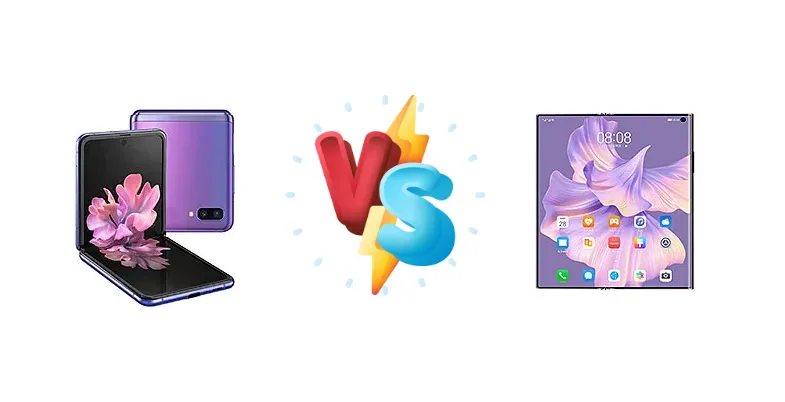
|
🏆 Quick Verdict
For most users, the Huawei Mate Xs 2 offers a more compelling experience. Its significantly brighter display (725 nits vs 596 nits) and substantially faster 66W charging outweigh the Z Flip’s smaller form factor. However, the Z Flip remains a viable option for those prioritizing ultimate pocketability.
| PHONES | ||
|---|---|---|
| Phone Names | Samsung Galaxy Z Flip | Huawei Mate Xs 2 |
| Network | ||
|---|---|---|
| 2G bands | GSM 850 / 900 / 1800 / 1900 | GSM 850 / 900 / 1800 / 1900 |
| 3G bands | HSDPA 850 / 900 / 1700(AWS) / 1900 / 2100 | HSDPA 800 / 850 / 900 / 1700(AWS) / 1900 / 2100 |
| 4G bands | 1, 2, 3, 4, 5, 7, 8, 12, 13, 14, 17, 18, 19, 20, 25, 26, 28, 29, 30, 34, 38, 39, 40, 41, 46, 66, 71 | 1, 2, 3, 4, 5, 7, 8, 12, 17, 18, 19, 20, 26, 28, 34, 38, 39, 40, 41 |
| Speed | HSPA 42.2/5.76 Mbps, LTE (5CA) Cat16 1000/150 Mbps | HSPA, LTE |
| Technology | GSM / CDMA / HSPA / EVDO / LTE | GSM / CDMA / HSPA / EVDO / LTE |
| - | CDMA2000 1xEV-DO | |
| Launch | ||
|---|---|---|
| Announced | 2020, February 11 | 2022, April 28 |
| Status | Available. Released 2020, February 14 | Available. Released 2022, May 07 |
| Body | ||
|---|---|---|
| Build | Plastic front, glass back (Gorilla Glass 6), aluminum frame | - |
| Dimensions | Unfolded: 167.3 x 73.6 x 7.2 mm Folded: 87.4 x 73.6 x 17.3 mm | Unfolded: 156.5 x 139.3 x 5.4 mmFolded: 156.5 x 75.5 x 11.1 mm |
| SIM | Nano-SIM + eSIM | Nano-SIM + Nano-SIM |
| Weight | 183 g (6.46 oz) | 255 g / 257 g (8.99 oz) |
| Display | ||
|---|---|---|
| Resolution | 1080 x 2636 pixels (~425 ppi density) | 2200 x 2480 pixels (~424 ppi density) |
| Size | 6.7 inches, 101.6 cm2 (~82.5% screen-to-body ratio) | 7.8 inches, 195.8 cm2 (~89.8% screen-to-body ratio) |
| Type | Foldable Dynamic AMOLED, HDR10+ | Foldable OLED, 1B colors, 120Hz |
| - | Folded cover display: OLED, 6.5 inches, 1176 x 2480 pixels | |
| Platform | ||
|---|---|---|
| CPU | Octa-core (1x2.95 GHz Kryo 485 & 3x2.41 GHz Kryo 485 & 4x1.78 GHz Kryo 485) | Octa-core (1x2.84 GHz Cortex-X1 & 3x2.42 GHz Cortex-A78 & 4x1.80 GHz Cortex-A55) |
| Chipset | Qualcomm SM8150 Snapdragon 855+ (7 nm) | Qualcomm SM8350 Snapdragon 888 4G (5 nm) |
| GPU | Adreno 640 (700 MHz) | Adreno 660 |
| OS | Android 10, upgradable to Android 12, One UI 4.1.1 | EMUI 12, no Google Play Services (International); HarmonyOS 2.0 (China) |
| Memory | ||
|---|---|---|
| Card slot | No | Nano Memory (uses shared SIM slot) |
| Internal | 256GB 8GB RAM | 256GB 8GB RAM, 512GB 8GB RAM, 512GB 12GB RAM |
| - | UFS | |
| Main Camera | ||
|---|---|---|
| Dual | 12 MP, f/1.8, 27mm (wide), 1/2.55", 1.4µm, dual pixel PDAF, OIS 12 MP, f/2.2, 123˚ (ultrawide), 1.12µm | - |
| Features | LED flash, HDR, panorama | Laser AF, color spectrum sensor, Dual-LED dual-tone flash, panorama, HDR |
| Single | - | 10.7 MP, f/2.2 |
| Triple | - | 50 MP, f/1.8, (wide), PDAF 8 MP, f/2.4, 81mm (telephoto), PDAF, OIS, 3x optical zoom 13 MP, f/2.2, 120˚ (ultrawide) |
| Video | 4K@30/60fps, 1080p@60/240fps, 720p@960fps, HDR10+ | 4K@30/60fps, 1080p@30/240fps |
| Selfie camera | ||
|---|---|---|
| Features | HDR | HDR |
| Single | 10 MP, f/2.4, 26mm (wide), 1.22µm | 10.7 MP, f/2.2 |
| Video | 4K@30fps | 4K@30fps, 1080p@30/240fps |
| Sound | ||
|---|---|---|
| 3.5mm jack | No | No |
| 35mm jack | No | No |
| Loudspeaker | Yes | Yes, with stereo speakers |
| Comms | ||
|---|---|---|
| Bluetooth | 5.0, A2DP, LE | 5.2, A2DP, LE |
| Infrared port | - | Yes |
| NFC | Yes | Yes |
| Positioning | GPS, GLONASS, GALILEO, BDS | GPS (L1+L5), GLONASS (L1), BDS (B1I+B1c+B2a), GALILEO (E1+E5a), QZSS (L1+L5), NavIC (L5) |
| Radio | No | No |
| USB | USB Type-C 2.0, OTG | USB Type-C 3.1, OTG |
| WLAN | Wi-Fi 802.11 a/b/g/n/ac, dual-band, Wi-Fi Direct | Wi-Fi 802.11 a/b/g/n/ac/6, dual-band, Wi-Fi Direct |
| Features | ||
|---|---|---|
| Sensors | Fingerprint (side-mounted), accelerometer, gyro, proximity, compass, barometer | Fingerprint (side-mounted), accelerometer, gyro, proximity, compass, barometer |
| Battery | ||
|---|---|---|
| Charging | 15W wired Wireless | 66W wired 5W reverse wired |
| Type | Li-Po 3300 mAh | Market-dependent versions:· Li-Po 4600 mAh (w/ 8GB RAM)· Li-Po 4880 mAh (w/ 12GB RAM) |
| Misc | ||
|---|---|---|
| Colors | Mirror Black, Mirror Purple, Mirror Gold, Thom Browne Edition | Black, White, Purple |
| Models | SM-F700, SM-F700F, SM-F700F/DS, SM-F700U/DS, SM-F700U1/DS, SM-F700N, M-F7000, SM-F700W/DS, SM-F700U1 | PAL-AL00, PAL-LX9 |
| Price | About 770 EUR | About 2000 EUR |
| SAR | 0.54 W/kg (head) 0.96 W/kg (body) | - |
| SAR EU | 0.37 W/kg (head) 1.55 W/kg (body) | - |
| Tests | ||
|---|---|---|
| Battery life | - | Endurance rating 49h |
| Camera | - | Photo / Video |
| Display | - | Contrast ratio: Infinite (nominal) |
| Loudspeaker | - | -25.8 LUFS (Very good) |
| Performance | - | AnTuTu: 641608 (v9) GeekBench: 3131 (v5.1) GFXBench: 28fps (ES 3.1 onscreen) |
Samsung Galaxy Z Flip
- Ultra-compact and pocketable design
- Familiar clamshell form factor
- More affordable price point (likely)
- Older Snapdragon 855+ chipset
- Lower display brightness
- Slow 15W charging
Huawei Mate Xs 2
- Brighter and larger display
- Faster Snapdragon 888 4G chipset
- 66W fast charging
- Larger and less pocketable design
- Outward-folding design may be more prone to scratches
- Potentially higher price
Display Comparison
The displays represent a core divergence. The Huawei Mate Xs 2 boasts a 725-nit peak brightness, offering superior visibility in direct sunlight compared to the Samsung Galaxy Z Flip’s 596 nits. While both utilize OLED technology, the Mate Xs 2’s outward-folding design provides a larger, uninterrupted viewing area. The Mate Xs 2 also claims an infinite contrast ratio, typical of OLED panels, while the Z Flip’s contrast ratio isn’t specified, suggesting a standard OLED implementation. The Z Flip’s smaller size, however, makes it more comfortable for one-handed use, a trade-off for the larger screen real estate of the Mate Xs 2.
Camera Comparison
Both devices feature photo and video capabilities, but detailed camera specifications are limited in the provided data. Without sensor size or aperture information, a direct comparison is difficult. However, given Huawei’s historical strength in mobile photography, it’s reasonable to assume the Mate Xs 2 benefits from more advanced image processing algorithms and potentially larger sensors. The Z Flip’s camera system likely prioritizes compactness, potentially sacrificing some image quality in low-light conditions. The absence of specific details necessitates caution when evaluating camera performance.
Performance
Under the hood, the Mate Xs 2 utilizes the Qualcomm Snapdragon 888 4G (5nm), a generational leap over the Z Flip’s Snapdragon 855+ (7nm). The 5nm process node of the 888 translates to improved power efficiency and thermal performance, allowing for sustained peak performance. The Mate Xs 2’s CPU, featuring a Cortex-X1 prime core, offers a performance advantage over the Z Flip’s Kryo 485-based CPU. While both phones are capable of handling everyday tasks, the Mate Xs 2 will exhibit smoother performance in demanding applications and games. The Z Flip’s older chipset may show signs of throttling under prolonged heavy load.
Battery Life
The Huawei Mate Xs 2’s 66W wired charging is a significant advantage, allowing for a full charge in a fraction of the time compared to the Z Flip’s 15W charging. Both devices share an endurance rating of 49 hours, suggesting comparable battery life despite potential differences in battery capacity (not specified). The Mate Xs 2’s faster charging mitigates any potential capacity disadvantage, ensuring minimal downtime. The inclusion of 5W reverse wired charging on the Mate Xs 2 adds a convenient feature for topping up accessories.
Buying Guide
Buy the Samsung Galaxy Z Flip if you prioritize extreme portability and a familiar clamshell experience. It’s ideal for users who want a phone that easily fits in any pocket and enjoy the nostalgia of a flip phone. Buy the Huawei Mate Xs 2 if you value a larger, immersive display, faster charging, and don’t mind a larger, less pocketable device. This is the choice for media consumption and productivity on the go.