
Samsung Galaxy Z Flip vs. Google Pixel Fold: A Detailed Comparison
| Phones Images | |||||
|---|---|---|---|---|---|
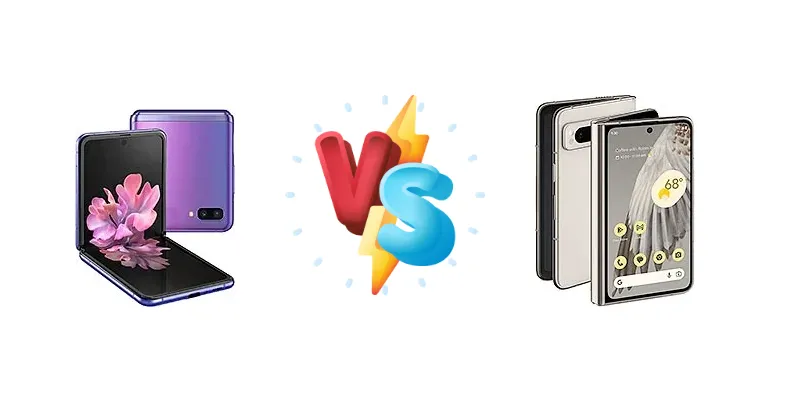
|
🏆 Quick Verdict
For the average user prioritizing portability and a lower price point, the Samsung Galaxy Z Flip remains a compelling choice. However, the Google Pixel Fold’s more modern chipset and larger, more versatile display offer a superior experience for power users and those heavily invested in the Google ecosystem.
| PHONES | ||
|---|---|---|
| Phone Names | Samsung Galaxy Z Flip | Google Pixel Fold |
| Network | ||
|---|---|---|
| 2G bands | GSM 850 / 900 / 1800 / 1900 | GSM 850 / 900 / 1800 / 1900 |
| 3G bands | HSDPA 850 / 900 / 1700(AWS) / 1900 / 2100 | HSDPA 800 / 850 / 900 / 1700(AWS) / 1900 / 2100 |
| 4G bands | 1, 2, 3, 4, 5, 7, 8, 12, 13, 14, 17, 18, 19, 20, 25, 26, 28, 29, 30, 34, 38, 39, 40, 41, 46, 66, 71 | 1, 2, 3, 4, 5, 7, 8, 12, 13, 14, 17, 18, 19, 20, 21, 25, 26, 28, 29, 30, 32, 38, 39, 40, 41, 42, 46, 48, 66, 71 |
| 5G bands | - | 1, 2, 3, 5, 7, 8, 12, 14, 20, 25, 28, 30, 38, 40, 41, 48, 66, 71, 75, 76, 77, 78, 79, 257, 258, 260, 261 SA/NSA/Sub6/mmWave |
| Speed | HSPA 42.2/5.76 Mbps, LTE (5CA) Cat16 1000/150 Mbps | HSPA, LTE, 5G |
| Technology | GSM / CDMA / HSPA / EVDO / LTE | GSM / CDMA / HSPA / EVDO / LTE / 5G |
| - | CDMA2000 1xEV-DO | |
| Launch | ||
|---|---|---|
| Announced | 2020, February 11 | 2023, May 10 |
| Status | Available. Released 2020, February 14 | Available. Released 2023, June 27 |
| Body | ||
|---|---|---|
| Build | Plastic front, glass back (Gorilla Glass 6), aluminum frame | Glass front (Gorilla Glass Victus) (folded), plastic front (unfolded), glass back (Gorilla Glass Victus), aluminum frame |
| Dimensions | Unfolded: 167.3 x 73.6 x 7.2 mm Folded: 87.4 x 73.6 x 17.3 mm | Unfolded: 139.7 x 158.7 x 5.8 mmFolded: 139.7 x 79.5 x 12.1 mm |
| SIM | Nano-SIM + eSIM | Nano-SIM + eSIM |
| Weight | 183 g (6.46 oz) | 283 g (9.98 oz) |
| - | IPX8 water resistant | |
| Display | ||
|---|---|---|
| Resolution | 1080 x 2636 pixels (~425 ppi density) | 1840 x 2208 pixels (~378 ppi density) |
| Size | 6.7 inches, 101.6 cm2 (~82.5% screen-to-body ratio) | 7.6 inches, 183.3 cm2 (~82.7% screen-to-body ratio) |
| Type | Foldable Dynamic AMOLED, HDR10+ | Foldable OLED, 120Hz, HDR10+, 1000 nits (HBM), 1450 nits (peak) |
| - | Cover display: OLED, 120Hz, HDR, Corning Gorilla Glass Victus 5.8 inches, 1080 x 2092 pixels, 17.4:9 ratio, 408 ppi 1200 nits (HBM), 1550 nits (peak) | |
| Platform | ||
|---|---|---|
| CPU | Octa-core (1x2.95 GHz Kryo 485 & 3x2.41 GHz Kryo 485 & 4x1.78 GHz Kryo 485) | Octa-core (2x2.85 GHz Cortex-X1 & 2x2.35 GHz Cortex-A78 & 4x1.80 GHz Cortex-A55) |
| Chipset | Qualcomm SM8150 Snapdragon 855+ (7 nm) | Google Tensor G2 (5 nm) |
| GPU | Adreno 640 (700 MHz) | Mali-G710 MP7 |
| OS | Android 10, upgradable to Android 12, One UI 4.1.1 | Android 13, upgradable to Android 15, up to 5 major Android upgrades |
| Memory | ||
|---|---|---|
| Card slot | No | No |
| Internal | 256GB 8GB RAM | 256GB 12GB RAM, 512GB 12GB RAM |
| - | UFS 3.1 | |
| Main Camera | ||
|---|---|---|
| Dual | 12 MP, f/1.8, 27mm (wide), 1/2.55", 1.4µm, dual pixel PDAF, OIS 12 MP, f/2.2, 123˚ (ultrawide), 1.12µm | - |
| Features | LED flash, HDR, panorama | Laser AF, Dual-LED flash, HDR, panorama |
| Triple | - | 48 MP, f/1.7, 25mm (wide), 1/2.0", 0.8µm, dual pixel PDAF, OIS 10.8 MP, f/3.1, 112mm (telephoto), 1/3.1", 1.22µm, dual pixel PDAF, OIS, 5x optical zoom 10.8 MP, f/2.2, 121˚, (ultrawide), 1/3.0", 1.25µm |
| Video | 4K@30/60fps, 1080p@60/240fps, 720p@960fps, HDR10+ | 4K@30/60fps, 1080p@30/60/120/240fps, 10-bit HDR |
| Selfie camera | ||
|---|---|---|
| Features | HDR | HDR, panorama |
| Single | 10 MP, f/2.4, 26mm (wide), 1.22µm | 8 MP, f/2.0, 24mm (wide), 1/4.0", 1.12µm Cover camera: 9.5 MP, f/2.2, 24mm (wide), 1.22µm, dual pixel PDAF |
| Video | 4K@30fps | 4K@30/60fps, 1080p@30/60fps |
| Sound | ||
|---|---|---|
| 3.5mm jack | No | No |
| 35mm jack | No | No |
| Loudspeaker | Yes | Yes, with stereo speakers |
| Comms | ||
|---|---|---|
| Bluetooth | 5.0, A2DP, LE | 5.2, A2DP, LE, aptX HD |
| NFC | Yes | Yes |
| Positioning | GPS, GLONASS, GALILEO, BDS | GPS, GLONASS, GALILEO, BDS |
| Radio | No | No |
| USB | USB Type-C 2.0, OTG | USB Type-C 3.2, OTG |
| WLAN | Wi-Fi 802.11 a/b/g/n/ac, dual-band, Wi-Fi Direct | Wi-Fi 802.11 a/b/g/n/ac/6e, tri-band, Wi-Fi Direct |
| Features | ||
|---|---|---|
| Sensors | Fingerprint (side-mounted), accelerometer, gyro, proximity, compass, barometer | Fingerprint (side-mounted), accelerometer, gyro, proximity, compass, barometer |
| - | Ultra Wideband (UWB) support | |
| Battery | ||
|---|---|---|
| Charging | 15W wired Wireless | Wired, PD3.0 Wireless |
| Type | Li-Po 3300 mAh | Li-Po 4821 mAh |
| Misc | ||
|---|---|---|
| Colors | Mirror Black, Mirror Purple, Mirror Gold, Thom Browne Edition | Porcelain, Obsidian |
| Models | SM-F700, SM-F700F, SM-F700F/DS, SM-F700U/DS, SM-F700U1/DS, SM-F700N, M-F7000, SM-F700W/DS, SM-F700U1 | G9FPL |
| Price | About 770 EUR | € 670.87 / $ 389.26 / £ 899.99 |
| SAR | 0.54 W/kg (head) 0.96 W/kg (body) | - |
| SAR EU | 0.37 W/kg (head) 1.55 W/kg (body) | - |
Samsung Galaxy Z Flip
- More affordable price point
- Highly portable and pocketable design
- Unique and stylish form factor
- Outdated Snapdragon 855+ chipset
- Slow 15W charging
- Lower peak display brightness
Google Pixel Fold
- Modern Google Tensor G2 chipset
- Larger, more versatile display
- Advanced Google software features
- Likely higher price
- Potentially less pocketable design
- Battery life dependent on optimization
Display Comparison
The Galaxy Z Flip boasts a 596 nit peak brightness, adequate for outdoor visibility but noticeably less vibrant than modern flagships. The Pixel Fold’s display specifications are not provided, but its larger size suggests a focus on immersive content consumption. The Z Flip’s smaller display is optimized for one-handed use, while the Pixel Fold aims for a more tablet-like experience when unfolded. The absence of LTPO information for either device makes it difficult to assess power efficiency gains from variable refresh rates.
Camera Comparison
Without detailed camera specifications for the Pixel Fold, a direct comparison is limited. However, Google’s computational photography prowess is a known strength. The Z Flip’s camera details are also missing, but its market positioning suggests a focus on social media-friendly images. The Tensor G2’s image signal processor (ISP) likely offers advanced features like Magic Eraser and Photo Unblur, enhancing image quality and editing capabilities. The absence of sensor size information for both devices makes it difficult to assess low-light performance.
Performance
The Samsung Galaxy Z Flip is powered by the Qualcomm Snapdragon 855+, a 7nm chipset that, while capable, is several generations behind. Its octa-core configuration (1x2.95 GHz Kryo 485, 3x2.41 GHz Kryo 485, 4x1.78 GHz Kryo 485) delivers adequate performance for everyday tasks. The Google Pixel Fold, equipped with the Google Tensor G2 (5nm), offers a significant performance leap. The Tensor G2’s Cortex-X1 cores (2x2.85 GHz) provide superior single-core performance, crucial for responsive app launches and smooth scrolling. The 5nm process node also translates to improved thermal efficiency, potentially reducing throttling during sustained workloads. This benefits users who engage in mobile gaming or video editing.
Battery Life
The Galaxy Z Flip’s 15W wired charging is comparatively slow, requiring significant time to reach a full charge. Wireless charging is available, but adds further to the charging duration. The Pixel Fold supports faster PD3.0 wired charging, and wireless charging, but specific wattage is not provided. The Tensor G2’s improved power efficiency could offset a potentially smaller battery capacity in the Pixel Fold, resulting in comparable or even better real-world battery life. The Z Flip’s smaller battery capacity, combined with the power demands of the Snapdragon 855+, likely necessitates more frequent charging.
Buying Guide
Buy the Samsung Galaxy Z Flip if you need a genuinely pocketable foldable that prioritizes style and affordability. It’s ideal for users who want a unique form factor without breaking the bank. Buy the Google Pixel Fold if you prefer a larger, more tablet-like unfolded experience, demand the latest Google software features, and value performance for demanding tasks like gaming and multitasking.