
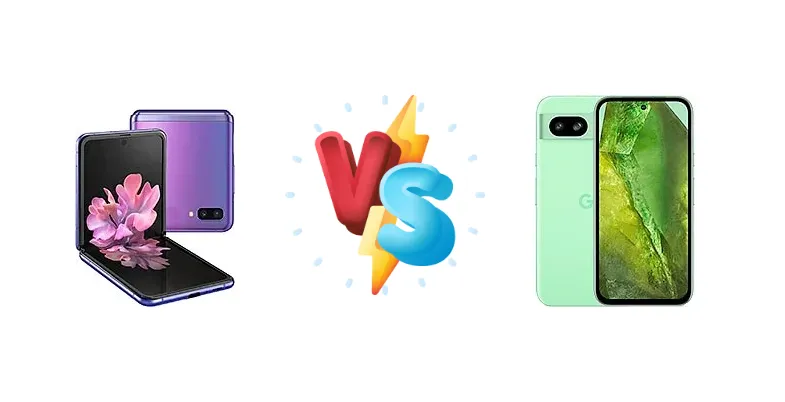
Samsung Galaxy Z Flip vs. Google Pixel 8a: A Detailed Comparison
| Phones Images | |||||
|---|---|---|---|---|---|
|
🏆 Quick Verdict
For the average user prioritizing longevity, battery life, and a consistently smooth experience, the Google Pixel 8a emerges as the stronger choice. Its Tensor G3 chipset and exceptional battery endurance (40:06h) outweigh the Z Flip’s novelty, especially considering the Z Flip’s older Snapdragon 855+ and limited 15W charging.
| PHONES | ||
|---|---|---|
| Phone Names | Samsung Galaxy Z Flip | Google Pixel 8a |
| Network | ||
|---|---|---|
| 2G bands | GSM 850 / 900 / 1800 / 1900 | GSM 850 / 900 / 1800 / 1900 |
| 3G bands | HSDPA 850 / 900 / 1700(AWS) / 1900 / 2100 | HSDPA 800 / 850 / 900 / 1700(AWS) / 1900 / 2100 |
| 4G bands | 1, 2, 3, 4, 5, 7, 8, 12, 13, 14, 17, 18, 19, 20, 25, 26, 28, 29, 30, 34, 38, 39, 40, 41, 46, 66, 71 | 1, 2, 3, 4, 5, 7, 8, 12, 17, 18, 19, 20, 26, 28, 32, 38, 40, 41, 42, 66 - G6GPR (International) |
| 5G bands | - | 1, 2, 3, 5, 7, 8, 12, 20, 26, 28, 38, 40, 41, 66, 75, 76, 77, 78 SA/NSA/Sub6 - G6GPR (International) |
| Speed | HSPA 42.2/5.76 Mbps, LTE (5CA) Cat16 1000/150 Mbps | HSPA, LTE, 5G |
| Technology | GSM / CDMA / HSPA / EVDO / LTE | GSM / HSPA / LTE / 5G |
| Launch | ||
|---|---|---|
| Announced | 2020, February 11 | 2024, May 07 |
| Status | Available. Released 2020, February 14 | Available. Released 2024, May 14 |
| Body | ||
|---|---|---|
| Build | Plastic front, glass back (Gorilla Glass 6), aluminum frame | Glass front (Gorilla Glass 3), aluminum frame, plastic back |
| Dimensions | Unfolded: 167.3 x 73.6 x 7.2 mm Folded: 87.4 x 73.6 x 17.3 mm | 152.1 x 72.7 x 8.9 mm (5.99 x 2.86 x 0.35 in) |
| SIM | Nano-SIM + eSIM | Nano-SIM + eSIM |
| Weight | 183 g (6.46 oz) | 188 g (6.63 oz) |
| Display | ||
|---|---|---|
| Protection | - | Corning Gorilla Glass 3, Mohs level 5 |
| Resolution | 1080 x 2636 pixels (~425 ppi density) | 1080 x 2400 pixels, 20:9 ratio (~430 ppi density) |
| Size | 6.7 inches, 101.6 cm2 (~82.5% screen-to-body ratio) | 6.1 inches, 90.3 cm2 (~81.6% screen-to-body ratio) |
| Type | Foldable Dynamic AMOLED, HDR10+ | OLED, HDR, 120Hz, 2000 nits (peak) |
| Platform | ||
|---|---|---|
| CPU | Octa-core (1x2.95 GHz Kryo 485 & 3x2.41 GHz Kryo 485 & 4x1.78 GHz Kryo 485) | Nona-core (1x3.0 GHz Cortex-X3 & 4x2.45 GHz Cortex-A715 & 4x2.15 GHz Cortex-A510) |
| Chipset | Qualcomm SM8150 Snapdragon 855+ (7 nm) | Google Tensor G3 (4 nm) |
| GPU | Adreno 640 (700 MHz) | Immortalis-G715s MC10 |
| OS | Android 10, upgradable to Android 12, One UI 4.1.1 | Android 14, upgradable to Android 16, up to 7 major Android upgrades |
| Memory | ||
|---|---|---|
| Card slot | No | No |
| Internal | 256GB 8GB RAM | 128GB 8GB RAM, 256GB 8GB RAM |
| Main Camera | ||
|---|---|---|
| Dual | 12 MP, f/1.8, 27mm (wide), 1/2.55", 1.4µm, dual pixel PDAF, OIS 12 MP, f/2.2, 123˚ (ultrawide), 1.12µm | 64 MP (16 MP eff.), f/1.9, 26mm (wide), 1/1.73", 0.8µm, dual pixel PDAF, OIS 13 MP, f/2.2, 120˚ (ultrawide), 1.12µm |
| Features | LED flash, HDR, panorama | Dual-LED flash, Pixel Shift, Ultra HDR, panorama, Best Take |
| Video | 4K@30/60fps, 1080p@60/240fps, 720p@960fps, HDR10+ | 4K@30/60fps, 1080p@30/60/120/240fps, OIS |
| Selfie camera | ||
|---|---|---|
| Features | HDR | HDR, panorama |
| Single | 10 MP, f/2.4, 26mm (wide), 1.22µm | 13 MP, f/2.2, 20mm (ultrawide), 1.12µm |
| Video | 4K@30fps | 4K@30fps, 1080p@30/60fps |
| Sound | ||
|---|---|---|
| 3.5mm jack | No | - |
| 35mm jack | No | No |
| Loudspeaker | Yes | Yes, with stereo speakers |
| Comms | ||
|---|---|---|
| Bluetooth | 5.0, A2DP, LE | 5.3, A2DP, LE |
| NFC | Yes | Yes |
| Positioning | GPS, GLONASS, GALILEO, BDS | GPS, GLONASS, GALILEO, BDS, QZSS, NavIC |
| Radio | No | No |
| USB | USB Type-C 2.0, OTG | USB Type-C 3.2 |
| WLAN | Wi-Fi 802.11 a/b/g/n/ac, dual-band, Wi-Fi Direct | Wi-Fi 802.11 a/b/g/n/ac/6e, dual/tri-band (market/region dependent) |
| Features | ||
|---|---|---|
| Sensors | Fingerprint (side-mounted), accelerometer, gyro, proximity, compass, barometer | Fingerprint (under display, optical), accelerometer, gyro, proximity, compass, barometer |
| Battery | ||
|---|---|---|
| Charging | 15W wired Wireless | 18W wired, PD3.0 7.5W wireless Bypass charging |
| Type | Li-Po 3300 mAh | Li-Po 4492 mAh |
| Misc | ||
|---|---|---|
| Colors | Mirror Black, Mirror Purple, Mirror Gold, Thom Browne Edition | Obsidian, Porcelain, Bay, Aloe |
| Models | SM-F700, SM-F700F, SM-F700F/DS, SM-F700U/DS, SM-F700U1/DS, SM-F700N, M-F7000, SM-F700W/DS, SM-F700U1 | GKV4X, G6GPR, G8HHN, G576D |
| Price | About 770 EUR | $ 229.98 / C$ 417.99 / £ 279.00 / € 299.99 / ₹ 33,300 |
| SAR | 0.54 W/kg (head) 0.96 W/kg (body) | - |
| SAR EU | 0.37 W/kg (head) 1.55 W/kg (body) | - |
| EU LABEL | ||
|---|---|---|
| Battery | - | 40:06h endurance, 1000 cycles |
| Energy | - | Class B |
| Free fall | - | Class A (270 falls) |
| Repairability | - | Class B |
Samsung Galaxy Z Flip
- Unique and eye-catching folding design
- Compact and portable form factor
- Functional cover screen for quick glances
- Older Snapdragon 855+ chipset
- Slow 15W charging
- Limited battery life compared to Pixel 8a
Google Pixel 8a
- Exceptional battery life (40:06h endurance)
- Powerful Google Tensor G3 chipset
- Superior camera performance with AI features
- Less visually striking design
- No folding display novelty
- May not appeal to those seeking a unique form factor
Display Comparison
The Pixel 8a’s display significantly outshines the Z Flip in terms of brightness, reaching a measured 1508 nits compared to the Z Flip’s 596 nits. This translates to vastly superior visibility in direct sunlight. While the Z Flip’s folding display is innovative, it utilizes older technology and lacks the high peak brightness crucial for outdoor usability. The Pixel 8a’s display is likely to offer better color accuracy and viewing angles as well, given its newer panel technology, though specific panel type details are not provided. The Z Flip’s smaller cover screen is a convenience, but doesn’t replace the full-screen experience of the Pixel 8a.
Camera Comparison
Without detailed camera specs for the Z Flip, a direct comparison is challenging. However, the Pixel 8a benefits from Google’s renowned computational photography expertise. The Tensor G3’s dedicated image processing unit (ISP) excels at dynamic range, noise reduction, and detail preservation. While the Z Flip likely offers a capable camera system, it won’t match the Pixel 8a’s consistently high-quality results, especially in low-light conditions. The Pixel 8a’s software features, like Magic Eraser and Photo Unblur, further enhance its photographic capabilities.
Performance
The Google Pixel 8a’s Tensor G3, built on a 4nm process, represents a significant architectural leap over the Samsung Galaxy Z Flip’s 7nm Snapdragon 855+. The Tensor G3’s nona-core configuration (1x3.0 GHz Cortex-X3, 4x2.45 GHz Cortex-A715, 4x2.15 GHz Cortex-A510) is designed for AI-driven tasks and offers improved efficiency. While the Snapdragon 855+ was a flagship chip in its time, it’s now showing its age, particularly in sustained workloads. The Pixel 8a’s CPU architecture will deliver faster processing speeds and better multitasking capabilities. The Z Flip’s older chipset may struggle with demanding applications and future software updates.
Battery Life
The Pixel 8a’s battery endurance of 40:06h is a standout feature, dwarfing the expected battery life of the Z Flip. The Z Flip’s 15W wired charging is slow compared to the Pixel 8a’s 18W wired charging with PD3.0, and the Pixel 8a also offers 7.5W wireless charging. The Pixel 8a’s ‘bypass charging’ feature, which reduces battery degradation during overnight charging, is another advantage. The Z Flip’s smaller battery capacity and slower charging speeds will require more frequent top-ups, impacting usability throughout the day.
Buying Guide
Buy the Samsung Galaxy Z Flip if you prioritize a head-turning design and are willing to accept compromises in battery life and processing power for a truly unique form factor. Buy the Google Pixel 8a if you value a reliable, long-lasting battery, excellent camera performance powered by AI, and a consistently smooth software experience at a more accessible price point.