
Samsung Galaxy Z Flip vs. Apple iPhone 15 Pro Max: A Detailed Comparison
| Phones Images | |||||
|---|---|---|---|---|---|
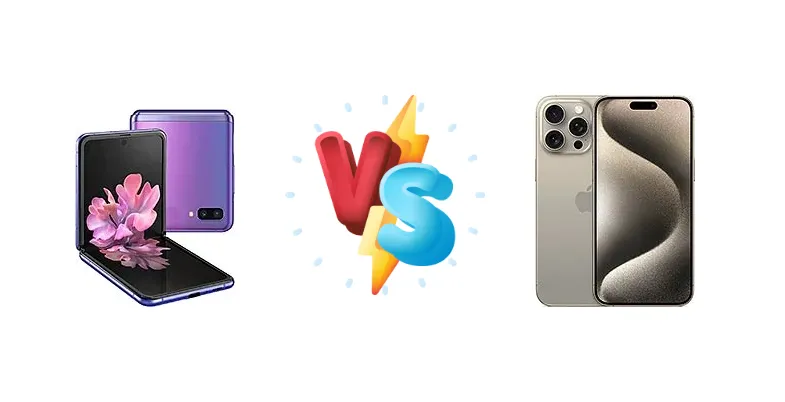
|
🏆 Quick Verdict
For the average user prioritizing longevity, performance, and a robust camera system, the Apple iPhone 15 Pro Max is the clear winner. Its significantly brighter display, vastly superior chipset, and exceptional battery life outweigh the Z Flip’s novelty and compact form factor.
| PHONES | ||
|---|---|---|
| Phone Names | Samsung Galaxy Z Flip | Apple iPhone 15 Pro Max |
| Network | ||
|---|---|---|
| 2G bands | GSM 850 / 900 / 1800 / 1900 | GSM 850 / 900 / 1800 / 1900 |
| 3G bands | HSDPA 850 / 900 / 1700(AWS) / 1900 / 2100 | HSDPA 850 / 900 / 1700(AWS) / 1900 / 2100 |
| 4G bands | 1, 2, 3, 4, 5, 7, 8, 12, 13, 14, 17, 18, 19, 20, 25, 26, 28, 29, 30, 34, 38, 39, 40, 41, 46, 66, 71 | 1, 2, 3, 4, 5, 7, 8, 12, 13, 17, 18, 19, 20, 25, 26, 28, 30, 32, 34, 38, 39, 40, 41, 42, 46, 48, 53, 66 - A3106 |
| 5G bands | - | 1, 2, 3, 5, 7, 8, 12, 20, 25, 26, 28, 30, 38, 40, 41, 48, 53, 66, 70, 77, 78, 79 SA/NSA/Sub6 - A3106 |
| Speed | HSPA 42.2/5.76 Mbps, LTE (5CA) Cat16 1000/150 Mbps | HSPA, LTE, 5G, EV-DO Rev.A 3.1 Mbps |
| Technology | GSM / CDMA / HSPA / EVDO / LTE | GSM / CDMA / HSPA / EVDO / LTE / 5G |
| Launch | ||
|---|---|---|
| Announced | 2020, February 11 | 2023, September 12 |
| Status | Available. Released 2020, February 14 | Available. Released 2023, September 22 |
| Body | ||
|---|---|---|
| Build | Plastic front, glass back (Gorilla Glass 6), aluminum frame | Glass front, glass back, titanium frame (grade 5) |
| Dimensions | Unfolded: 167.3 x 73.6 x 7.2 mm Folded: 87.4 x 73.6 x 17.3 mm | 159.9 x 76.7 x 8.3 mm (6.30 x 3.02 x 0.33 in) |
| SIM | Nano-SIM + eSIM | · Nano-SIM + eSIM + eSIM (max 2 at a time; International)· eSIM + eSIM (8 or more, max 2 at a time; USA)· Nano-SIM + Nano-SIM (China) |
| Weight | 183 g (6.46 oz) | 221 g (7.80 oz) |
| Display | ||
|---|---|---|
| Protection | - | Ceramic Shield glass |
| Resolution | 1080 x 2636 pixels (~425 ppi density) | 1290 x 2796 pixels, 19.5:9 ratio (~460 ppi density) |
| Size | 6.7 inches, 101.6 cm2 (~82.5% screen-to-body ratio) | 6.7 inches, 110.2 cm2 (~89.8% screen-to-body ratio) |
| Type | Foldable Dynamic AMOLED, HDR10+ | LTPO Super Retina XDR OLED, 120Hz, HDR10, Dolby Vision, 1000 nits (typ), 2000 nits (HBM) |
| Platform | ||
|---|---|---|
| CPU | Octa-core (1x2.95 GHz Kryo 485 & 3x2.41 GHz Kryo 485 & 4x1.78 GHz Kryo 485) | Hexa-core (2x3.78 GHz + 4x2.11 GHz) |
| Chipset | Qualcomm SM8150 Snapdragon 855+ (7 nm) | Apple A17 Pro (3 nm) |
| GPU | Adreno 640 (700 MHz) | Apple GPU (6-core graphics) |
| OS | Android 10, upgradable to Android 12, One UI 4.1.1 | iOS 17, upgradable to iOS 26.1 |
| Memory | ||
|---|---|---|
| Card slot | No | No |
| Internal | 256GB 8GB RAM | 256GB 8GB RAM, 512GB 8GB RAM, 1TB 8GB RAM |
| Main Camera | ||
|---|---|---|
| Dual | 12 MP, f/1.8, 27mm (wide), 1/2.55", 1.4µm, dual pixel PDAF, OIS 12 MP, f/2.2, 123˚ (ultrawide), 1.12µm | - |
| Features | LED flash, HDR, panorama | Dual-LED dual-tone flash, HDR (photo/panorama) |
| Triple | - | 48 MP, f/1.8, 24mm (wide), 1/1.28", 1.22µm, dual pixel PDAF, sensor-shift OIS 12 MP, f/2.8, 120mm (periscope telephoto), 1/3.06", 1.12µm, dual pixel PDAF, 3D sensor‑shift OIS, 5x optical zoom 12 MP, f/2.2, 13mm, 120˚ (ultrawide), 1/2.55", 1.4µm, dual pixel PDAF TOF 3D LiDAR scanner (depth) |
| Video | 4K@30/60fps, 1080p@60/240fps, 720p@960fps, HDR10+ | 4K@24/25/30/60fps, 1080p@25/30/60/120/240fps, 10-bit HDR, Dolby Vision HDR (up to 60fps), ProRes, 3D (spatial) video, stereo sound rec. |
| Selfie camera | ||
|---|---|---|
| Features | HDR | HDR, Dolby Vision HDR |
| Single | 10 MP, f/2.4, 26mm (wide), 1.22µm | 12 MP, f/1.9, 23mm (wide), 1/3.6", 1.0µm, PDAF, OIS SL 3D, (depth/biometrics sensor) |
| Video | 4K@30fps | 4K@24/25/30/60fps, 1080p@25/30/60/120fps, gyro-EIS |
| Sound | ||
|---|---|---|
| 3.5mm jack | No | - |
| 35mm jack | No | No |
| Loudspeaker | Yes | Yes, with stereo speakers |
| Comms | ||
|---|---|---|
| Bluetooth | 5.0, A2DP, LE | 5.3, A2DP, LE |
| NFC | Yes | Yes |
| Positioning | GPS, GLONASS, GALILEO, BDS | GPS (L1+L5), GLONASS, GALILEO, BDS, QZSS, NavIC |
| Radio | No | No |
| USB | USB Type-C 2.0, OTG | USB Type-C 3.2 Gen 2, DisplayPort |
| WLAN | Wi-Fi 802.11 a/b/g/n/ac, dual-band, Wi-Fi Direct | Wi-Fi 802.11 a/b/g/n/ac/6e, tri-band, hotspot |
| Features | ||
|---|---|---|
| Sensors | Fingerprint (side-mounted), accelerometer, gyro, proximity, compass, barometer | Face ID, accelerometer, gyro, proximity, compass, barometer |
| Battery | ||
|---|---|---|
| Charging | 15W wired Wireless | Wired, PD2.0, 50% in 30 min 15W wireless (MagSafe) 15W wireless (Qi2) - requires iOS 17.2 update 4.5W reverse wired |
| Type | Li-Po 3300 mAh | Li-Ion 4441 mAh |
| Misc | ||
|---|---|---|
| Colors | Mirror Black, Mirror Purple, Mirror Gold, Thom Browne Edition | Black Titanium, White Titanium, Blue Titanium, Natural Titanium |
| Models | SM-F700, SM-F700F, SM-F700F/DS, SM-F700U/DS, SM-F700U1/DS, SM-F700N, M-F7000, SM-F700W/DS, SM-F700U1 | A2849, A3105, A3106, A3108, iPhone16,2 |
| Price | About 770 EUR | € 758.79 / $ 579.87 / £ 628.29 |
| SAR | 0.54 W/kg (head) 0.96 W/kg (body) | 1.07 W/kg (head) 1.11 W/kg (body) |
| SAR EU | 0.37 W/kg (head) 1.55 W/kg (body) | 0.98 W/kg (head) 0.98 W/kg (body) |
Samsung Galaxy Z Flip
- Unique foldable design for portability
- Conversation-starting aesthetic
- Relatively affordable (compared to the iPhone)
- Significantly weaker performance
- Inferior display brightness and quality
- Limited battery life
Apple iPhone 15 Pro Max
- Exceptional performance with the A17 Pro chip
- Industry-leading battery life
- Superior display brightness and quality
- Higher price point
- Larger and heavier form factor
- Less innovative design
Display Comparison
The iPhone 15 Pro Max boasts a dramatically brighter display, peaking at 1787 nits, compared to the Z Flip’s 596 nits. This difference is immediately noticeable in outdoor visibility, making the iPhone far more usable in direct sunlight. While the Z Flip’s foldable screen is innovative, the iPhone’s superior brightness and likely higher color accuracy (based on Apple’s historical performance) provide a more consistently enjoyable viewing experience. The iPhone likely utilizes LTPO technology for adaptive refresh rates, contributing to battery efficiency, a feature not explicitly stated for the Z Flip.
Camera Comparison
While both phones offer capable cameras, the iPhone 15 Pro Max is expected to deliver a more refined and versatile experience. The context data doesn’t provide specific camera details for either device, but Apple’s history suggests a focus on computational photography and video quality. The iPhone’s larger sensor size (likely) and advanced image processing algorithms will result in superior low-light performance and dynamic range. The Z Flip’s camera system, while adequate, is likely to be limited by its older hardware and processing capabilities. We can assume the iPhone will offer more advanced video recording features.
Performance
The performance gap between these devices is substantial. The iPhone 15 Pro Max’s Apple A17 Pro, built on a 3nm process, features a hexa-core CPU with peak clock speeds of 3.78 GHz. This contrasts sharply with the Z Flip’s older Qualcomm Snapdragon 855+ (7nm), an octa-core processor with a peak of 2.95 GHz. The A17 Pro’s architectural advantages and smaller node size translate to significantly higher processing power and improved thermal efficiency, meaning sustained performance during demanding tasks. The iPhone’s GPU will also offer a far superior gaming experience. The Z Flip, while capable for everyday tasks, will struggle with graphically intensive applications.
Battery Life
The iPhone 15 Pro Max excels in battery life, achieving an active use score of 16:01h and an endurance rating of 118h. This is a significant advantage over the Z Flip, which lacks detailed battery performance data but is hampered by its smaller battery capacity and the power demands of its foldable display. The iPhone also supports faster wired charging (50% in 30 minutes with PD2.0) and modern wireless charging standards like MagSafe and Qi2, while the Z Flip offers only 15W wired and unspecified wireless charging.
Buying Guide
Buy the Samsung Galaxy Z Flip if you prioritize a truly unique, pocketable design and are willing to compromise on raw power and battery life for the sake of portability and a conversation starter. Buy the Apple iPhone 15 Pro Max if you demand top-tier performance for demanding tasks like video editing or gaming, require all-day battery life, and value a consistently excellent camera experience with a mature software ecosystem.