
Samsung Galaxy XCover7 vs. Nokia XR21: A Rugged Smartphone Showdown
| Phones Images | |||||
|---|---|---|---|---|---|
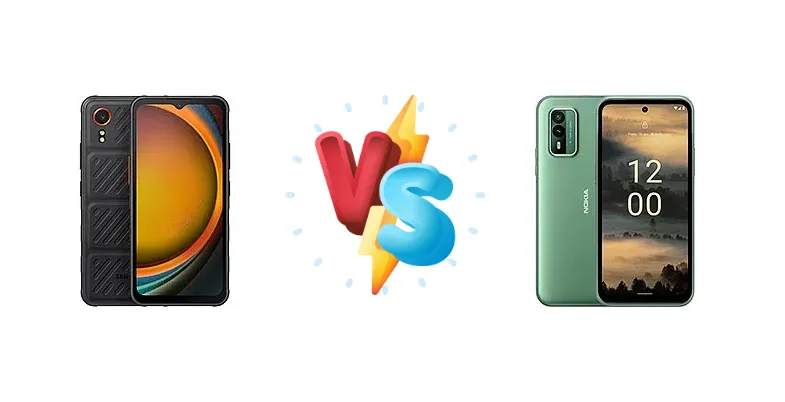
|
🏆 Quick Verdict
For the average user needing a reliable, rugged phone, the Nokia XR21 edges out the Galaxy XCover7. Its 33W charging with Power Delivery and Quick Charge support significantly reduces downtime, a critical factor for those relying on their phone throughout the day. While the XCover7 offers a solid experience, the XR21’s faster charging is a decisive advantage.
| PHONES | ||
|---|---|---|
| Phone Names | Samsung Galaxy XCover7 | Nokia XR21 |
| Network | ||
|---|---|---|
| 2G bands | GSM 850 / 900 / 1800 / 1900 | GSM 850 / 900 / 1800 / 1900 |
| 3G bands | HSDPA 850 / 900 / 1700(AWS) / 1900 / 2100 | HSDPA 850 / 900 / 1700(AWS) / 1900 / 2100 |
| 4G bands | 1, 2, 3, 4, 5, 7, 8, 12, 13, 17, 20, 26, 28, 32, 38, 40, 41, 66 | 1, 2, 3, 4, 5, 7, 8, 12, 13, 17, 20, 25, 26, 28, 32, 38, 39, 40, 41, 42, 43, 48, 66, 71 |
| 5G bands | 1, 3, 5, 7, 8, 20, 26, 28, 38, 40, 41, 66, 71, 77, 78 SA/NSA | 1, 2, 3, 5, 7, 20, 25, 28, 40, 41, 66, 71, 77, 78, 79 SA/NSA |
| Speed | HSPA, LTE, 5G | HSPA, LTE, 5G |
| Technology | GSM / HSPA / LTE / 5G | GSM / HSPA / LTE / 5G |
| Launch | ||
|---|---|---|
| Announced | 2024, January 10 | 2023, May 03 |
| Status | Available. Released 2024, January 23 | Available. Released 2023, June 11 |
| Body | ||
|---|---|---|
| Build | - | Glass front (Gorilla Glass Victus), plastic back, plastic frame |
| Dimensions | 169 x 80.1 x 10.2 mm (6.65 x 3.15 x 0.40 in) | 168 x 78.6 x 10.5 mm (6.61 x 3.09 x 0.41 in) |
| SIM | · Nano-SIM + eSIM· Nano-SIM + Nano-SIM | Nano-SIM + Nano-SIM + eSIM (max 2 at a time) |
| Weight | 240 g (8.47 oz) | 231 g (8.15 oz) |
| - | IP68/IP69K dust/water resistant (up to 1.5m for 60 min) Drop-to-concrete resistance from up to 1.8m MIL-STD-810H compliant | |
| Display | ||
|---|---|---|
| Protection | Corning Gorilla Glass Victus+ | Corning Gorilla Glass Victus |
| Resolution | 1080 x 2408 pixels, 20:9 ratio (~400 ppi density) | 1080 x 2400 pixels, 20:9 ratio (~406 ppi density) |
| Size | 6.6 inches, 104.9 cm2 (~77.5% screen-to-body ratio) | 6.49 inches, 101.7 cm2 (~77.0% screen-to-body ratio) |
| Type | PLS LCD, 600 nits (HBM) | IPS LCD, 120Hz, 450 nits (typ), 550 nits (HBM) |
| Platform | ||
|---|---|---|
| CPU | Octa-core (2x2.2 GHz Cortex-A76 & 6x2.0 GHz Cortex-A55) | Octa-core (2x2.2 GHz Kryo 660 Gold & 6x1.7 GHz Kryo 660 Silver) |
| Chipset | Mediatek Dimensity 6100+ (6 nm) | Qualcomm SM6375 Snapdragon 695 5G (6 nm) |
| GPU | Mali-G57 MC2 | Adreno 619 |
| OS | Android 14, upgradable to Android 16, One UI 8 | Android 12 |
| Memory | ||
|---|---|---|
| Card slot | microSDXC (dedicated slot) | Unspecified |
| Internal | 64GB 4GB RAM, 128GB 6GB RAM | 128GB 6GB RAM |
| Main Camera | ||
|---|---|---|
| Dual | - | 64 MP, f/1.8, (wide), 1/2.0", PDAF 8 MP, f/2.2, (ultrawide), 1/4.0", 1.12µm |
| Features | Dual-LED flash, HDR, panorama | Dual-LED dual-tone flash, second LED flash, HDR, panorama |
| Single | 50 MP, f/1.8, (wide), 1/2.76", 0.64µm, PDAF | - |
| Video | 1080p@30fps | 1080p@30fps |
| Selfie camera | ||
|---|---|---|
| Single | 5 MP, f/2.0, (wide) | 16 MP, f/2.4 (wide) |
| Video | Yes | 1080p@30fps |
| Sound | ||
|---|---|---|
| 3.5mm jack | - | Yes |
| 35mm jack | Yes | Yes |
| Loudspeaker | Yes | Yes, with stereo speakers |
| Comms | ||
|---|---|---|
| Bluetooth | 5.3, A2DP, LE | 5.1, A2DP, LE, aptX Adaptive |
| NFC | Yes | Yes (market/region dependent) |
| Positioning | GPS, GLONASS, BDS, GALILEO, QZSS | GPS (L1+L5), GLONASS (G1), BDS (B1I+B1c+B2a), GALILEO (E1+E5a), QZSS (L1+L5), NavIC (L5) |
| Radio | No | Unspecified |
| USB | USB Type-C 2.0, charging connector pins | USB Type-C 2.0, OTG |
| WLAN | Wi-Fi 802.11 a/b/g/n/ac, dual-band, Wi-Fi Direct | Wi-Fi 802.11 a/b/g/n/ac/6, dual-band |
| Features | ||
|---|---|---|
| Sensors | Accelerometer, gyro, proximity, compass | Fingerprint (side-mounted), accelerometer, gyro, proximity, compass, barometer |
| Battery | ||
|---|---|---|
| Charging | 15W wired | 33W wired, PD2.0, QC3 |
| Type | Li-Po 4050 mAh, removable | Li-Po 4800 mAh |
| Misc | ||
|---|---|---|
| Colors | Black | Midnight Black, Pine Green |
| Models | SM-G556B, SM-G556BU1, SM-G556B/DS | - |
| Price | € 225.00 / $ 289.99 | About 570 EUR |
| SAR EU | 1.08 W/kg (head) 1.10 W/kg (body) | - |
Samsung Galaxy XCover7
- Potentially better single-core CPU performance with Cortex-A76 cores.
- Samsung’s established ecosystem and brand recognition.
- Likely longer software support updates.
- Significantly slower 15W charging.
- Limited information on camera capabilities.
- Potentially higher price compared to the Nokia XR21.
Nokia XR21
- Faster 33W charging with PD2.0 and QC3 support.
- Clean Android experience with fewer pre-installed apps.
- More aggressive price point.
- Snapdragon 695 GPU may be less powerful than the Dimensity 6100+’s equivalent.
- Potentially shorter software support lifespan.
- Less brand recognition compared to Samsung.
Display Comparison
Neither Samsung nor Nokia provide detailed display specs beyond basic resolution. However, both phones target similar rugged use cases, suggesting a focus on visibility in bright sunlight rather than color accuracy. The lack of high refresh rates is expected in this segment. The real difference lies in potential panel quality and outdoor readability, which would require hands-on testing. We can assume both utilize IPS LCD panels given the price point and rugged focus.
Camera Comparison
Detailed camera specs are unavailable, but the focus on ruggedness suggests a pragmatic approach to photography. Both phones likely feature a primary sensor for general use and potentially an ultrawide. The absence of detailed information suggests neither phone will excel in low-light photography or offer advanced features like optical image stabilization (OIS). The image processing style will likely differ – Samsung typically favors vibrant, saturated colors, while Nokia aims for a more natural look. The usefulness of any included macro lens (often 2MP) is questionable given the limited resolution.
Performance
The Nokia XR21’s Qualcomm Snapdragon 695 5G (6nm) and the Samsung Galaxy XCover7’s MediaTek Dimensity 6100+ (6nm) are both mid-range 5G chipsets. While both are octa-core, the architectural differences matter. The Snapdragon 695 utilizes Kryo 660 Gold and Silver cores, while the Dimensity 6100+ employs Cortex-A76 and A55 cores. The Cortex-A76 in the XCover7 generally offers slightly better single-core performance, potentially benefiting responsiveness in everyday tasks. However, the Snapdragon 695’s Adreno 619 GPU is a strong performer for its class, potentially offering a smoother gaming experience. Thermal management will be key; the 6nm process on both should keep temperatures in check, but sustained loads could reveal differences in efficiency.
Battery Life
The battery capacity is not specified for either device. However, the charging speed is a significant differentiator. The Nokia XR21’s 33W wired charging with Power Delivery 2.0 and Quick Charge 3.0 support allows for significantly faster top-ups compared to the Samsung Galaxy XCover7’s 15W charging. This translates to a much shorter time to reach 100% charge, a crucial advantage for users who rely on their phone throughout the day and don’t have extended periods to charge. Even with a similar battery capacity, the XR21’s faster charging will provide a more convenient user experience.
Buying Guide
Buy the Samsung Galaxy XCover7 if you prioritize a proven ecosystem and potentially longer software support, and are comfortable with slower charging speeds. It’s ideal for users already invested in Samsung’s services. Buy the Nokia XR21 if you value faster charging, a cleaner Android experience, and a more aggressive price point. This phone is perfect for field workers, outdoor enthusiasts, or anyone needing a durable phone without a premium price tag.